

Audio By Carbonatix
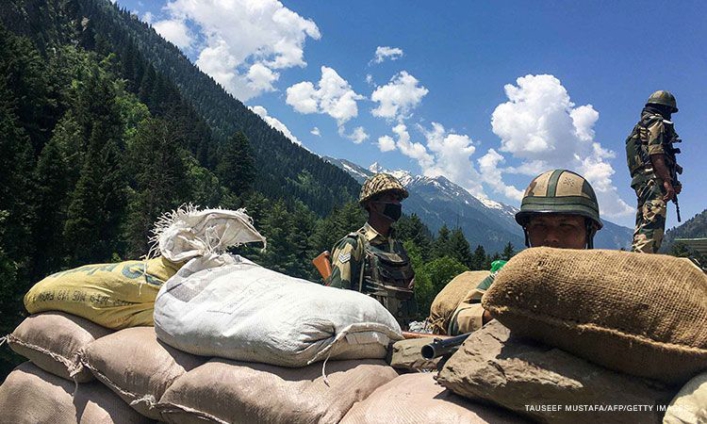
China and India on Monday agreed to stop sending more troops to their disputed border in the Himalayas, following an escalation in tensions between the two nuclear powers.
Indian and Chinese senior military commanders met on Monday to discuss stabilizing tensions along the Line of Actual Control (LAC), the loosely defined demarcation line that separates the two countries.
In a joint statement, both sides agreed to strengthen communication on the ground to avoid misunderstandings or action "that may complicate the situation."
They also agreed to not take any unilateral action that would change the situation on the ground, according to the statement. Another round of high-level military meetings will be held "as soon as possible," the statement said.
Tensions have been rising in the Himalayas since a bloody clash between Indian and Chinese troops in June and efforts to deescalate in the wake of the violence appeared to be faltering.
At least 20 Indian soldiers were killed in that incident, the deadliest border conflict with China in over 40 years. China has never acknowledged any casualties from that clash.
Meetings were immediately set up between top Chinese and Indian military officials, and both sides called for calm, but in early September both New Delhi and Beijing accused each other of illegally crossing into their territories, leading to a renewed bout of saber-rattling on both sides.
A week later, China and India accused each other's troops of firing warning shots across the Sino-Indian border, reportedly the first such case in more than four decades. Both sides blamed the other for violating bilateral agreements and taking "provocative" actions.
India and China share a 2,100 mile-long (3,379-kilometer) border in the Himalayas, but both sides claim territory either side of it.
The most recent dispute was around Pangong Tso, a strategically located lake some 14,000 feet (4,200 meters) above sea level that spans an area stretching from the Indian territory of Ladakh to Chinese-controlled Tibet, in the greater Kashmir region, where India, China and Pakistan all claim territory.
The Line of Actual Control, which marks the de facto border and passes through the lake, was established in the wake of the 1962 Sino-Indian war.
Though it shows up on maps, India and China do not agree on its precise location and both regularly accuse the other of overstepping it, or seeking to expand their territory.
In 1996, the two countries signed an agreement which states that neither side shall open fire within 2 kilometers (1.24 miles) from the LAC to "prevent dangerous military activities."
Latest Stories
-
Video: Immunity should be exercised without creating classism – Inusah Fuseini on cocaine bust
3 minutes -
Ghana Air Force passes out 293 recruits after six months of intensive training
11 minutes -
EOCO vrs Baffour Awuah: EOCO should have secured warrant before arrest attempt at court – Inusah Fuseini
15 minutes -
Triple fibre cuts disrupt telecom services across Northern, Oti regions – Sam George
18 minutes -
Politicisation could undermine parliamentary probe into cocaine seizures – Dr Osae-Kwapong
25 minutes -
EOCO chases MP: Can Section 41 cure lacuna in EOCO Act? – Inusah Fuseini asks
28 minutes -
GNFS, GWL inspect fire hydrants in Ministries enclave; 23 found faulty
33 minutes -
Gov’t directs release of 50,000 bags of grain to ECOWAS
35 minutes -
Ghana, Germany deepen cooperation on railways, labour mobility
40 minutes -
Huge crowds greet Pope in Paris for open-air Mass
51 minutes -
‘I never said I’ll declare a state of emergency’ – President Mahama on galamsey
2 hours -
Bobby Banson condemns EOCO’s attempted arrest of Nana Agyei Baffour Awuah
2 hours -
When Kumasi begins to look like somebody is in charge
2 hours -
Parliamentary probe into cocaine seizure would be a waste of time – Inusah Fuseini
2 hours -
Cocaine seizure: Focus on Ghana’s reputation, not partisan blame – Osae-Kwapong
2 hours