

Audio By Carbonatix
Opposition leaders in Ivory Coast are demanding a "civil transition", following Saturday's presidential poll that their parties boycotted.
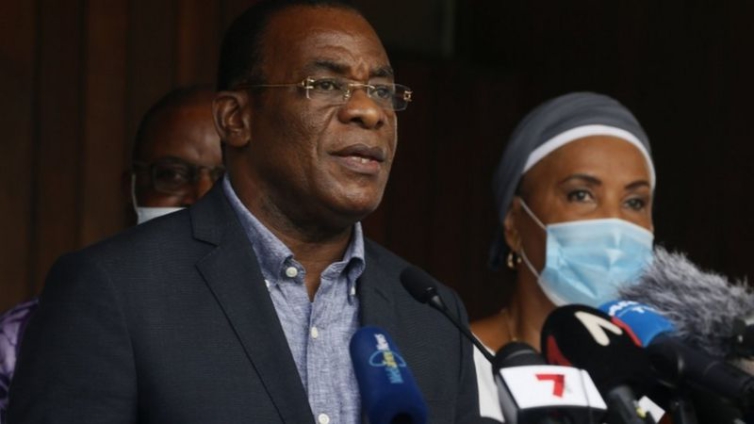
Pascal Affi N'Guessan and Henri Konan Bédié say it was illegal for President Alassane Ouattara to stand for a third term as it broke rules on term limits.
But the president's supporters dispute this, citing a constitutional change in 2016 which they say means his first term effectively did not count.
Vote counting is still under way.
At least 16 people have been killed since riots broke out in August after President Ouattara said he would run again following the sudden death of his preferred successor.
At least two people were killed during Saturday's vote.
Key opposition figures are urging mass protests to block what they describe as a "dictatorship".
Mr N'Guessan said on Sunday: "Opposition parties and political groups call for the start of a civil transition."
"[We] note the end of President Alassane Ouattara's mandate on 31 October and call on the international community to take note," he added, saying a civil transition was needed to "create the conditions for a fair, transparent and inclusive election."
Several polling stations were ransacked in opposition strongholds on Saturday and election materials were burned.
In the eastern town of Daoukro, protesters erected roadblocks. Meanwhile tear gas was used to push away demonstrators who gathered close to where the president cast his ballot in the main city, Abidjan.
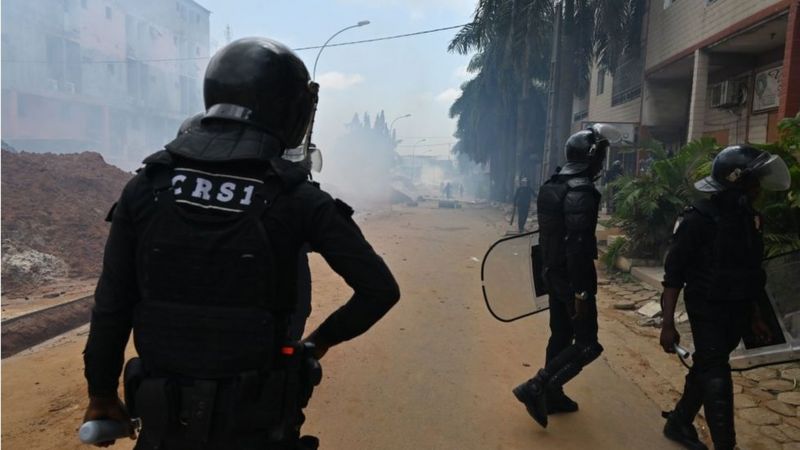
At least two monitors from the independent election group Indigo Côte d'Ivoire were attacked, the Washington Post reports. It quotes the group as saying 21% of polling stations were closed during the day.
But the electoral commission head called the disturbances on Saturday "minimal", saying they "only affected 50 polling stations out of 22,381".
Some 35,000 security officers were deployed across the country to transport election materials and ensure safety, the security minister said.
After voting in Abidjan on Saturday, Mr Ouattara called for an end to the protests.
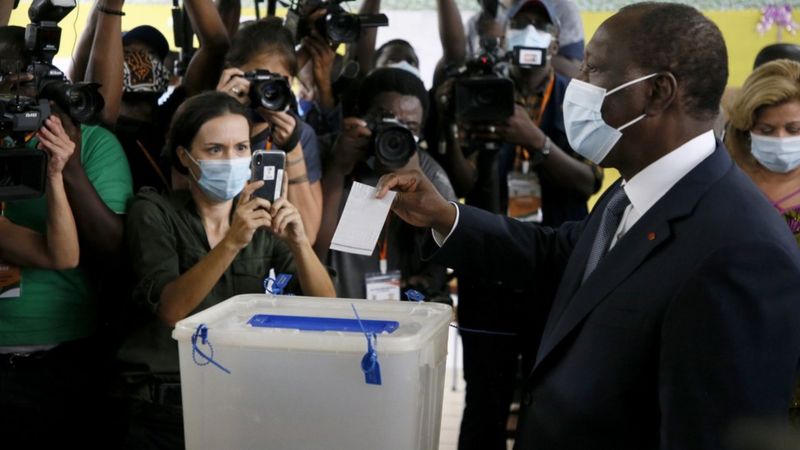
"I call on those who called for civil disobedience, which led to the loss of life, to stop," he said.
"They should stop because Ivory Coast needs peace, these are criminal acts and we hope that all this can stop, so that after the election this country may continue on its course of progress, which it has enjoyed over the last few years."
Why is it so controversial?
According to the constitution, Ivory Coast has a two-term presidential limit. Mr. Ouattara - who has been elected twice - initially said he would stand down.
But, in July, the ruling party's previous presidential nominee, Prime Minister Amadou Gon Coulibaly, died of a heart attack.
Mr Ouattara subsequently announced that he would run for president after all.
His supporters argued that a constitutional change in 2016 reset the clock and that his first term did not count.
His opponents do not share that view, arguing instead that it is illegal for Mr Ouattara to run for a third term.
What's the background to the tension?
There has been a decades-long quarrel between some of the country's leading political figures.
In 2010, Laurent Gbagbo, who was president at the time, refused to concede to Mr Ouattara following the election that year. This sparked a bitter civil war.
More than 3,000 people were killed in the five months of violence.
Mr Gbagbo also put himself forward to stand in this year's election but the electoral commission blocked him because he had been convicted in the Ivorian courts.
He was one of nearly 40 potential candidates who were turned down by the commission.
Who are the four presidential candidates?
- Alassane Ouattara, 78, economist. Became president in 2011, serving his second term after years in opposition. Party: Rally of Houphouëtists for Democracy and Peace (RHDP)
- Henri Konan Bédié, 86, career politician. Served as president between 1993 and 1999, deposed in coup. Party: Democratic Party of Ivory Coast (PCDI)
- Pascal Affi N'Guessan, 67, career politician. Served as prime minister between 2000 and 2003 under then-President Laurent Gbagbo. Party: Ivorian Popular Front (FPI) faction
- Kouadio Konan Bertin, 51, career politician, known as KKB, was once youth leader in the former ruling Democratic Party of Ivory Coast, is now an MP. Independent candidate
Latest Stories
-
Ghana’s reputation must not be dented by self-centred individuals – Madina MP on cocaine seizure
14 minutes -
MTN Ghana pushes digital growth for SMEs as sixth business clinic ends in Accra.
17 minutes -
Black Maidens confident of WAFU B title defense ahead of Burkina Faso clash
21 minutes -
5 players who deserve a Black Stars call-up for AFCON 2027 qualifiers
37 minutes -
Photos: Vice President Jane Naana reviews changing of guard as Ghana Air Force takes over at Presidency
38 minutes -
Africa’s richest man launches continent’s biggest share sale
39 minutes -
Why Ghana’s MSMEs must rethink human capital investment: Seven strategic benefits
39 minutes -
Asutifi South Assembly forms taskforce to stamp out illegal NHIS fees
44 minutes -
GBA not politically aligned, we criticise all governments – Deputy Secretary
49 minutes -
Environmental groups demand National Park status for Atewa Forest over illegal mining
50 minutes -
Three players in line to replace Partey in Queiroz’s next Ghana squad
54 minutes -
GBA leadership’s independence and consistency leave much to be desired – Deputy AG
1 hour -
Deputy AG accuses GBA of selective criticism over Chief Justice’s comments
1 hour -
Africa must remove visa restrictions to unlock jobs, opportunities – Gabby Otchere-Darko
1 hour -
87-year-old man remanded over alleged defilement of 9-year-old girl at Ofankor
2 hours