

Audio By Carbonatix
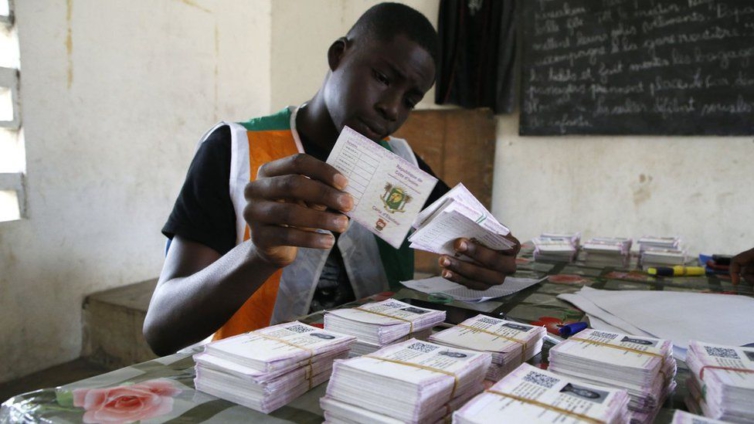
Vote counting is underway in Ivory Coast, following a presidential poll that was boycotted by the opposition.
At least 16 people have been killed since riots broke out in August after President Alassane Ouattara said he would run again following the sudden death of his preferred successor.
Police say two people were killed during Saturday's vote.
Several polling stations were ransacked in opposition strongholds and election materials were burned.
In the eastern town of Daoukro, protesters erected roadblocks. Meanwhile, tear gas was used to push away demonstrators who gathered close to where the president cast his ballot in the main city, Abidjan.
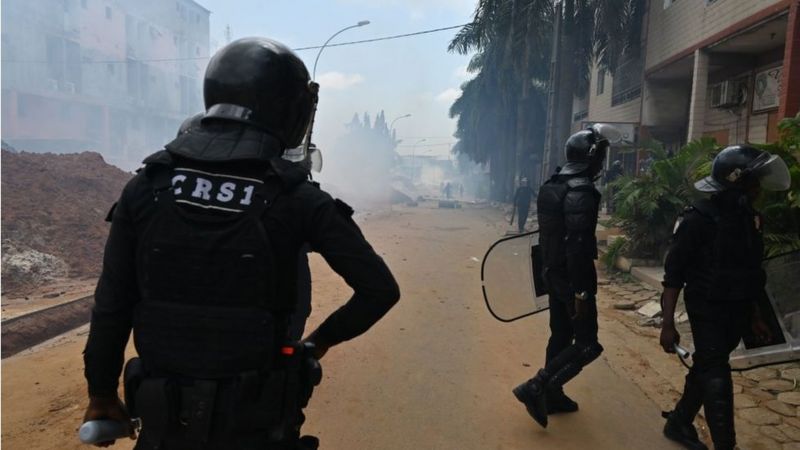
At least two monitors from the independent election group Indigo Côte d'Ivoire were attacked, the Washington Post reports. It quotes the group as saying 21% of polling stations had yet to open during the day.
But the electoral commission head called the disturbances on Saturday "minimal", saying they "only affected 50 polling stations out of 22,381".
Some 35,000 security officers were deployed across the country to transport election materials and ensure safety, the security minister said.
Ahead of the poll Ivory Coast's main opposition candidates, Pascal Affi N'Guessan and Henri Konan Bédié, said it was illegal for Mr Ouattara to stand for a third term as it violated constitutional term limits. They boycotted Saturday's vote and called for civil disobedience.
Several opposition figures have already branded the presidential election a failure - including Mr N'Guessan who told a press conference at Mr Bédié's house: "The electoral coup has been a failure. The Ivorian people succeeded in halting this election."
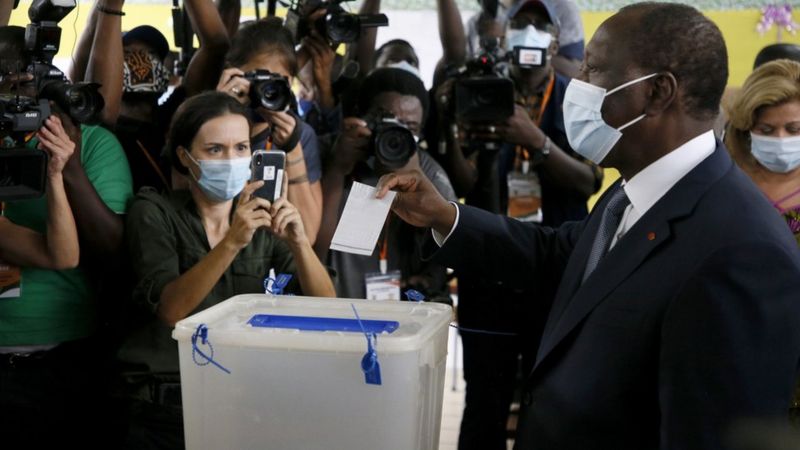
After voting in Abidjan on Saturday, Mr Ouattara called for an end to the protests.
"I call on those who called for civil disobedience, which led to the loss of life, to stop," he said.
"They should stop because Ivory Coast needs peace, these are criminal acts and we hope that all this can stop, so that after the election this country may continue on its course of progress, which it has enjoyed over the last few years."
Why is it so controversial?
According to the constitution, Ivory Coast has a two-term presidential limit. Mr. Ouattara - who has been elected twice - initially said he would stand down.
But, in July, the ruling party's previous presidential nominee, Prime Minister Amadou Gon Coulibaly, died of a heart attack.
Mr Ouattara subsequently announced that he would run for president after all.
His supporters argued that a constitutional change in 2016 reset the clock and that his first term did not count.
His opponents do not share that view, arguing instead that it is illegal for Mr Ouattara to run for a third term.
What's the background to the tension?
There has been a decades-long quarrel between some of the country's leading political figures.
In 2010, Laurent Gbagbo, who was president at the time, refused to concede to Mr Ouattara following the election that year. This sparked a bitter civil war.
More than 3,000 people were killed in the five months of violence.
Mr Gbagbo also put himself forward to stand in this year's election but the electoral commission blocked him because he had been convicted in the Ivorian courts.
He was one of nearly 40 potential candidates who were turned down by the commission.
Who are the four presidential candidates?
- Alassane Ouattara, 78, economist. Became president in 2011, serving his second term after years in opposition. Party: Rally of Houphouëtists for Democracy and Peace (RHDP)
- Henri Konan Bédié, 86, career politician. Served as president between 1993 and 1999, deposed in coup. Party: Democratic Party of Ivory Coast (PCDI)
- Pascal Affi N'Guessan, 67, career politician. Served as prime minister between 2000 and 2003 under then-President Laurent Gbagbo. Party: Ivorian Popular Front (FPI) faction
- Kouadio Konan Bertin, 51, career politician, known as KKB, was once youth leader in the former ruling Democratic Party of Ivory Coast, is now an MP. Independent candidate
Latest Stories
-
At least 22 dead after two boats collide on Congo river, official says
1 hour -
Heavy rains lead to Senegal floods, government reports several deaths
1 hour -
FTBLRLIFE targets Ghana in expansion of global grassroots football network
3 hours -
Former ‘American Idol’ contestant sentenced to life without parole for wife’s murder
4 hours -
Education Ministry commends Ghanaian teachers on World Teachers’ Day 2026
4 hours -
NPP can reconcile with aggrieved members who want to return – Nana Akomea
5 hours -
Tamale Child Deaths: Vehicle owner arrested as IGP deploys homicide team
5 hours -
From ShattaFest to MoMo Fest: Entertainment takes centre stage in youth engagement
5 hours -
Nigerian military aircraft crashes, killing 32
5 hours -
MTN encourages Ghanaians to use MoMo for saving, investing and financial planning
5 hours -
Absa Bank Ghana names Stephen Ato Frimpong as Board Chair
5 hours -
Pickford ‘almost caused crash’ with careless driving
5 hours -
Author and former politician Jeffrey Archer dies aged 86
5 hours -
No education reform can succeed without teachers – Education Ministry
5 hours -
Gauff condemns racist abuse after China Open win
6 hours