

Audio By Carbonatix
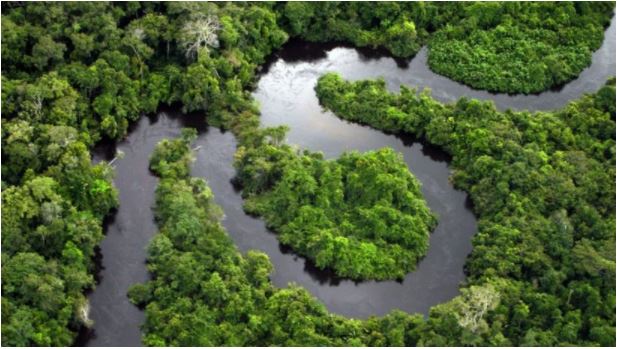
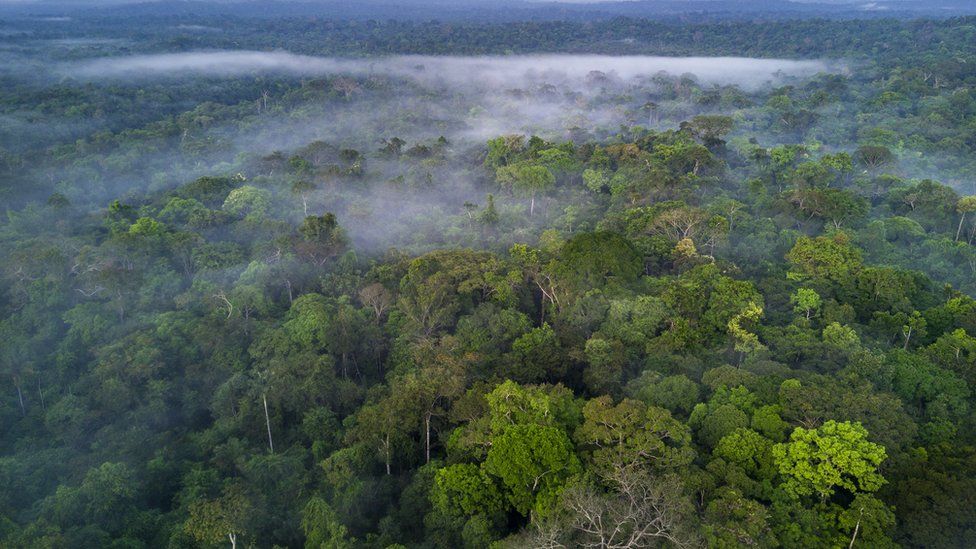
Parts of Brazil's Amazon rainforest are being illegally sold on Facebook, the BBC has discovered.
The protected areas include national forests and land reserved for indigenous peoples.
Some of the plots listed via Facebook's classified ads service are as large as 1,000 football pitches.
Facebook said it was "ready to work with local authorities", but indicated it would not take independent action of its own to halt the trade.
"Our commerce policies require buyers and sellers to comply with laws and regulations," the Californian tech firm added.
The leader of one of the indigenous communities affected has urged the tech firm to do more.
And campaigners have claimed the country's government is unwilling to halt the sales.
"The land invaders feel very empowered to the point that they are not ashamed of going on Facebook to make illegal land deals," said Ivaneide Bandeira, head of environmental NGO Kanindé.
No certificates
Anyone can find the illegally invaded plots by typing the Portuguese equivalents for search terms like "forest", "native jungle" and "timber" into Facebook Marketplace's search tool, and picking one of the Amazonian states as the location.
Some of the listings feature satellite images and GPS co-ordinates.

Many of the sellers openly admit they do not have a land title, the only document which proves ownership of land under Brazilian law.
The illegal activity is being fuelled by Brazil's cattle ranching industry.
'No risk'
Deforestation in the Brazilian Amazon is at a 10-year high, and Facebook's Marketplace has become a go-to site for sellers like Fabricio Guimarães, who was filmed by a hidden camera.
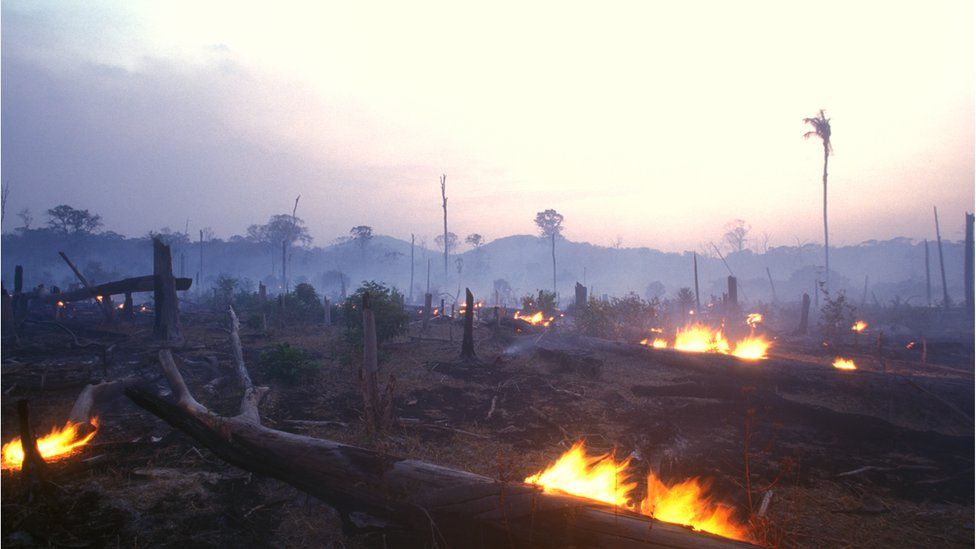
"There's no risk of an inspection by state agents here," he said as he walked through a patch of rainforest he had burnt to the ground.
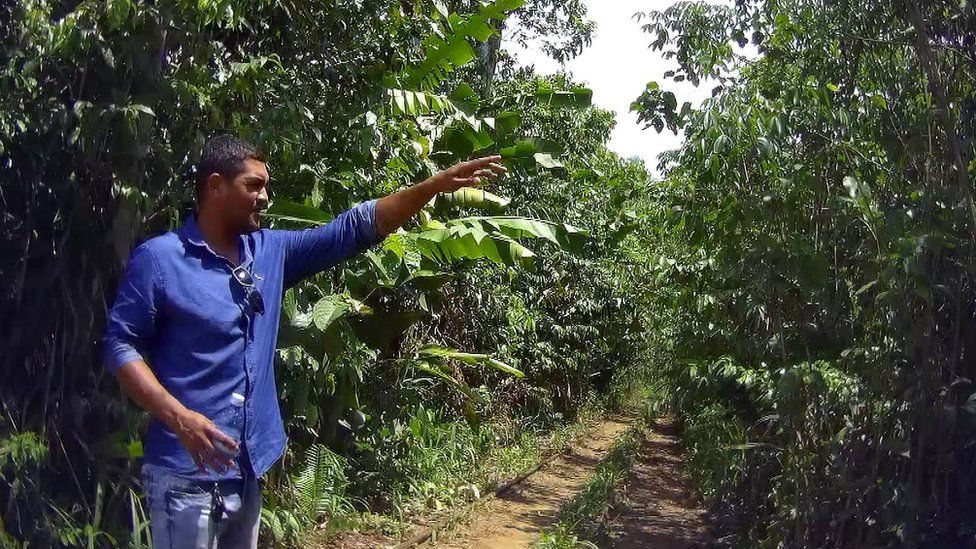
With the land illegally cleared and ready for farming, he had tripled his initial asking price to $35,000 (£25,000).
Fabricio is not a farmer. He has steady middle-class job in a city, and views the rainforest as being an investment opportunity.
The BBC later contacted Fabricio for his response to its investigation but he declined to comment.
Going undercover
Many of the ads came from Rondônia, the most deforested state in Brazil's rainforest region.
The BBC arranged meetings between four sellers from the state and an undercover operative posing as a lawyer claiming to represent wealthy investors.
One man, called Alvim Souza Alves, was trying to sell a plot inside the Uru Eu Wau Wau indigenous reserve for about £16,400 in local currency.
It is the home to a community of more than 200 Uru Eu Wau Wau people. And at least five further groups that have had no contact with the outside world also live there, according to the Brazilian government.
But at the meeting, Mr Alves claimed: "There are no Indians [sic] there. From where my land is, they are 50km [31 miles] away. I am not going to tell you that at one time or another they are not walking around."
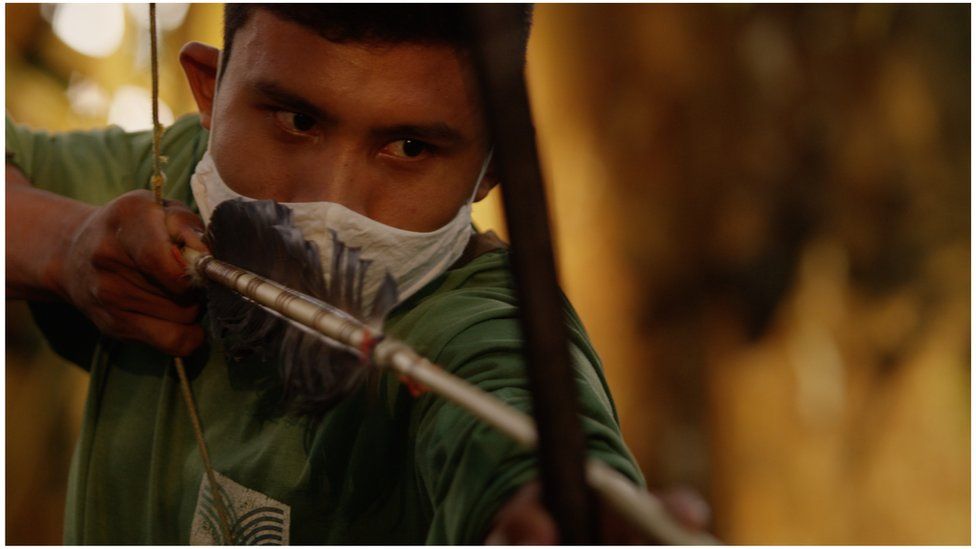
The BBC showed the Facebook ad to community leader Bitaté Uru Eu Wau Wau.
He said the lot was in an area used by his community to hunt, fish and collect fruits.
"This is a lack of respect," he said.
"I don't know these people. I think their objective is to deforest the indigenous land, to deforest what is standing. To deforest our lives, you could say."
He said the authorities should intervene, and also urged Facebook - "the most accessed social media platform" - to take action of its own.
Changed status
Another factor driving the illegal land market is the expectation of amnesty.
Mr Alves revealed he was working with others to lobby politicians to help them legally own stolen land.
"I'll tell you the truth: if this is not solved with [President] Bolsonaro there, it won't be solved anymore," he said of the current government.
A common strategy is to deforest the land and then plead with politicians to abolish its protected status, on the basis it no longer serves its original purpose.
The land grabbers can then officially buy the plots from the government, thereby legalising their claims.

Mr Alves took the BBC's undercover reporter to meet a man he described as the leader of the Curupira Association. Brazil's federal police have described the group as being an illegal land-grabbing operation focused on invading indigenous territory.
The two men told the reporter that high-profile politicians were helping them set up meetings with government agencies in the capital Brasília.
They said their main ally was congressman Colonel Chrisóstomo, a member of the Social Liberal Party, which Mr Bolsonaro used to be a member of until he founded his own party in 2019.
When contacted by the BBC, Colonel Chrisóstomo acknowledged having helped arrange meetings, but said he did not know the group was involved in land invasions.
"They didn't tell me," he said. "If they invaded [the land], they don't have my support anymore."
When asked if he regretted setting up the meetings, he said: "No."
The BBC contacted Mr Alves for his response but he declined to comment.
The BBC also approached Brazil's Minister of the Environment, Ricardo Salles.
He said: "President Jair Bolsonaro's government has always made it clear that his is a zero-tolerance government for any crime, including environmental ones."
The government has cut the inspections budget for Ibama, the federal agency that in charge of regulating deforestation, by 40%.
But Mr Salles said the coronavirus pandemic had hampered law enforcement in the Amazon, and that state governments also bore responsibility for the deforestation.
"This year the government has created operation Verde Brasil 2, which seeks to control illegal deforestation, illegal fires, and to join efforts between the federal government and the states," he added.
However Raphael Bevilaquia, a federal prosecutor based in Rondônia, said the situation had worsened under the current government.
"The situation is really desperate," he said. "The executive power is playing against us. It's disheartening."
For its part, Facebook claims trying to deduce which sales are illegal would be too complex a task for it to carry out itself, and should be left to the local judiciary and other authorities. And it does not appear to see the issue as being serious enough to warrant halting all Marketplace land sales across the Amazon.
Ivaneide Bandeira, who has been trying to combat deforestation in the state of Rondônia for 30 years, said she was losing hope.
"I think this is a very hard battle. It is really painful to see the forest being destroyed and shrinking more and more," she said.
"Never, in any other moment in history, has it been so hard to keep the forest standing."
Latest Stories
-
From working in his room to building a business group – Michael Bartlett-Vanderpuye’s journey
24 seconds -
DBG steps up textile industry financing with new investor-ready projects
11 minutes -
GPL: Hearts make emphatic winning start, Debibi United hold Kotoko
13 minutes -
Middle East conflict disrupts Ghana’s gold exports as first-half volumes dip
30 minutes -
BoG to roll out crypto guidelines soon, clear path for licensing – Asiama
46 minutes -
DBG lines up textile deals for credit approval, disbursement before year-end
58 minutes -
DBG channels billions into businesses private banks struggle to finance
1 hour -
Provident Insurance’s Ellen Amihere named Claims Professional of the Year
2 hours -
Kenya’s president orders Tata Chemicals to end operations in the country
2 hours -
Nigeria’s SEC approves about $1.6bn Dangote Refinery IPO
2 hours -
Gold eases as robust US payrolls boost rate-hike bets; inflation data in focus
2 hours -
Nigeria’s Dangote says refinery IPO to open within days
2 hours -
At least 37 dead in Nigeria pipeline incident, group says
2 hours -
At least 25 killed in bus crash on Cape Verde’s Fogo island, agency says
2 hours -
Niger blames France for inciting soldiers’ mutiny
3 hours