

Audio By Carbonatix
Remnants from a Chinese rocket are expected to fall back to Earth in an uncontrolled re-entry this weekend.
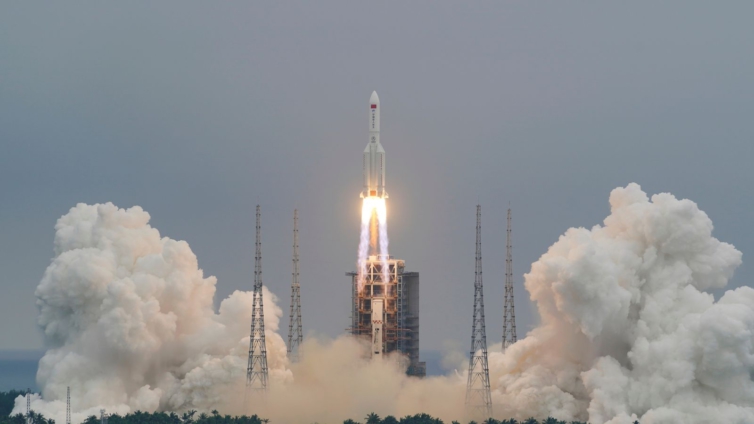
The rocket, called Long March 5B, was launched from Wenchang Space Launch Centre on 29 April to carry Tianhe - the first module of China's future space station - into orbit.
The spacecraft contains what will become living quarters for three crew on the space station and was the first of 11 missions needed to complete the station.

The body of the rocket is circling Earth and is about to enter the lower atmosphere.
Its exact point of descent "cannot be pinpointed until within hours of its re-entry", which is projected to occur on Saturday.
The US said on Thursday it was tracking the path of the object from the Vandenberg Air Force Base in California but that there were no plans to shoot it down.
"We're hopeful that it will land in a place where it won't harm anyone," US Defence Secretary Lloyd Austin said.
"Hopefully, in the ocean or someplace like that."
Mr Austin also indirectly criticised China, he said: "There should be a requirement to operate in a safe and thoughtful mode and make sure that we take those kinds of things into consideration as we plan and conduct operations."
Harvard-based astrophysicist Jonathan McDowell said potentially dangerous debris will likely escape incineration after streaking through the atmosphere at hypersonic speed but in all likelihood would fall into the sea.
Mr McDowell did add that there was a chance that pieces could fall over land, like in May 2020, when pieces from another Chinese rocket came down over the Ivory Coast, damaging several buildings but leaving no one injured.
Mr McDowell also said most countries design spacecraft in such a way as to avoid large, uncontrolled re-entries.
"It makes the Chinese rocket designers look lazy that they didn't address this," he said, calling the failure to do so "negligent."
Based on its current orbit, the debris trail is likely to fall somewhere as far north as New York, Madrid or Beijing and as far south as southern Chile and New Zealand, Mr McDowell said.
Chinese state media have played down fears that the rocket could cause damage as a situation "not worth panicking about" and suggested it will fall somewhere in international waters.
The rocket launch is part of China's increasingly ambitious space programme, with Beijing planning at least 10 similar launches to carry equipment into orbit.
The space station will be complete by 2022, with China also planning to build a moon base in cooperation with Russia.
China is a late entrant in space exploration, only sending its first astronaut into space in 2003.
Latest Stories
-
We must account for every cedi entrusted to us as public officials – Ato Forson
24 minutes -
Supreme Court rejects Solomon Asamoah’s bid to overturn Sky Train ruling
39 minutes -
Nungua Traditional Stool, WT Plastics partner to establish factory, create 1,400 jobs
41 minutes -
Mahama describes Ghana’s religious diversity as its greatest treasure, defends fairness to all faiths
46 minutes -
Police to arrest motorists who use pedestrian footbridges – ACP Obeng
47 minutes -
KNUST announces revised reopening dates, lectures begin October 19
1 hour -
GoldBod, military engineers partner to reclaim galamsey-damaged Tano Nimri Forest
1 hour -
NACOC educates 450 Koforidua SHS students on dangers of drug abuse
1 hour -
First-year students stranded as Obuasi SHTS remains closed over misconduct probe
1 hour -
Court halts promotion of 40 police officers pending IGP’s appeal
1 hour -
Gender Ministry deploys teams nationwide to monitor LEAP cash grant payments
1 hour -
GNFS contains Somoco warehouse fire; bushfire near TTU in Takoradi
1 hour -
Recurring teacher-student sexual abuse cases give cause for worry – Salaga South MP
1 hour -
D-Black shocked as only 16 radio and TV stations pay music royalties
1 hour -
Former SIC Savings and Loans MD Amma Frimpomaa Dwumah honours EOCO invitation
2 hours