

Audio By Carbonatix
The African Court on Human and People’s Rights says in strategic or public interest human rights litigation, the media are critical before, during, and after any successful justice process.
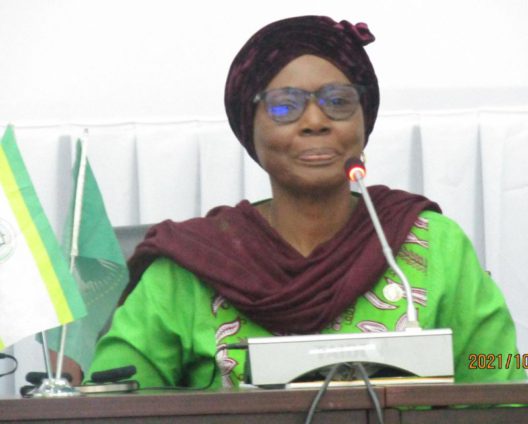
“Depending on how the stories are cast, presented, told and communicated, the media must, therefore, adopt innovative ideas on making human rights more attractive to the relevant stakeholders in the African context,” Lady Justice Imani D. Aboud, African Court President stated.
Lady Justice Aboud was speaking during a three-day African Court on Human and Peoples’ Rights Media Training for Senior Editors and Journalists in Dar es Salaam, Tanzania.
She said communication about the Court should be framed to meet the needs of its various stakeholders.
The African Court President noted that the training was also to empower the core senior editors and journalists to duly perform their mission in the chain of actions of the African Court.
“Whether for litigants to bring cases, for counsel to defend litigants, for academics or other knowledgeable institutions to act as amici curiae, for States to implement decisions or for regional organs to supervise the enforcement of the Court’s proceedings, the media plays a crucial role,” she said.
The African Court was established under Article 1 of the Protocol to the African Charter on Human and Peoples’ Rights.
The Protocol which was adopted by Member States of the then Organization of African Unity (OAU) in Ouagadougou, Burkina Faso, in June 1998 came into force on January 25, 2004.
African Court Media Network, therefore, questions the commitment of the African Union to the mandate of the African Court as currently only 31 AU Members States have ratified the Protocol to ensure the protection of human and peoples’ rights in Africa.
About 24 AU Member Countries have refused to ratify the African Court Protocol.

The countries which have ratified are Algeria, Benin, Burkina Faso, Burundi, Cameroon, Chad, Côte d’Ivoire, Comoros, Congo, Democratic Republic of Congo, Gabon, The Gambia, Ghana, Kenya, Libya, Lesotho, Mali, Malawi, Mozambique, Mauritania, Mauritius, Nigeria, Niger, Rwanda, Sahrawi Arab Democratic Republic, South Africa, Senegal, Tanzania, Togo, Tunisia, and Uganda.
However, only six out of the 31 State Parties to the Protocol had deposited the declaration, recognizing the competence of the African Court to receive cases directly from NGOs and individuals.
The six States are Burkina Faso, The Gambia, Ghana, Mali, Malawi, and Tunisia.
The African Court Media Network, therefore, challenged the AU member states to show commitment to the African Continental Court to protect the human rights of its people.
Latest Stories
-
Allround Baby Pants launched in Ghana to ease diapering for mothers
2 hours -
Aggrieved Gold Coast Fund Management Company customers to petition Mahama over locked-up funds
2 hours -
NSMQ 2026: PRESEC, Legon dethrones defending champions Mfantsipim in thrilling battle to book semi-final spot
2 hours -
NPP set to overhaul constitution as delegates prepare to vote on sweeping reforms
2 hours -
Ghana’s cashew industry faces processing gap as Côte d’Ivoire moves to capture more value
2 hours -
“Our greatest wealth is not in our soil but our people” — Upper West Minister
2 hours -
Luex Healthcare launches children’s health education book series with Luey the Lion
3 hours -
NAGRAT urges gov’t to communicate early if September deadline cannot be met
3 hours -
We trust government to meet September deadline on teachers’ promotions – NAGRAT
3 hours -
“We dare not fail” – Gov’t promises to honour teachers’ promotion pay deal
3 hours -
The GH¢19.8 billion mirage: Inside Ghana’s state enterprise turnaround
3 hours -
Luv FM High School Debate: KNUST SHS and Osei Adutwum SHS set up thrilling final after dramatic semi-finals
4 hours -
KNUST AI Coordinator urges structured adoption of AI in teacher education
4 hours -
Nepal rescuers blast hillside in search of hydropower workers as families wait anxiously
4 hours -
Teachers who pass promotional exam to get January 2026 start date after gov’t resolves promotion dispute – Dr Apaak assures
4 hours