


Audio By Carbonatix
Cobhams Asuquo is now one of Nigeria's leading music figures both for his production and singing, but he started his career behind the scenes because he didn't like the sound of his own voice.
Asuquo's tone is serious and measured when explaining his dislike of his own voice, almost as though he is describing someone else. That discomfort with the very thing he now showcases to his fans around the world was the major reason why he spent the first 13 years of his music career as a producer to some of Africa's biggest stars, he told the BBC.
Asuquo, 41, has worked with a string of Afro music stars, including Asa, on her hit 2007 album of the same name. As for his own music, which is a mix of soul, gospel, RnB and Afropop, his hit tracks include singles like We Plenti, One Hit and Ordinary People.
He is eloquent and lucid when talking about his love for music, but on the topic of his unease with his voice, he loses some of his fluency and cannot fully explain it.
He even goes so far as to use the word "hated", and then drifts off.
"There was something about it that just didn't sit well with me," he says thoughtfully.
It is a sentiment that is backed up by his best friend.
"He has always said that," Muyiwa Oyinlola concurred, but he added that Asuquo has always had an uncanny ability to imitate other people's voices.
Back in their school days at Lagos' prestigious King's College, Mr Oyinlola remembers that Asuquo, who is blind, had a radio recorder to help him in classes. He used to record the teachers on it, but not always for educational purposes.
"He would just have a mess around and imitate all the teachers and all the housemasters," Mr Oyinlola remembers fondly, describing Asuquo as the "life of the party".
'I get stage fright all the time'
It is that gregarious part of his personality that Asuquo wants to show his fans more of as he gears up to release a new album later this year, and marks 20 years in the industry.
Most of his tracks to-date are on the soulful side, as opposed to club bangers.
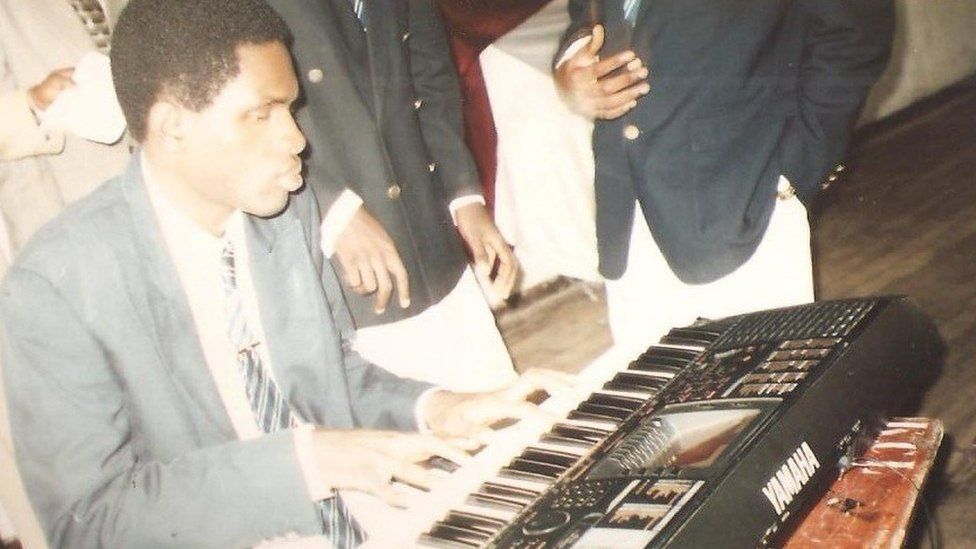
The new record, which will feature Afrobeats stars like Ladipoe and Bella Shmurda, will be accompanied by more performances, which he describes as "a lot more high-energy" and full of dancing.
He says that he eventually got into singing when he realised there were things he could do with his voice that other people couldn't.
But going on stage is not something Asuquo finds easy.
"I get stage fright all the time. I've never gone on stage without being nervous. Never," he says, with a note of humour in his tone.
He even jokingly says that as he steels himself to face the crowds, he sometimes swears to himself he will never go through the torture of another performance again.
He sounds animated when explaining what he does to temper the jitters, including jumping on one spot and prayer.
Upon the mention of prayer and faith, Asuquo becomes cerebral and real passion comes out. He describes an almost trance-like state when he actually starts the performance: "It's hard to get me off the stage sometimes," he says. "I'm in my zone."
Asuquo, who describes himself as a deeply spiritual person, says conversations with God played a pivotal role in his decision to dedicate his life's work to music, after trying out law.
Don't dwell on discrimination
Despite his current fame, Asuquo has not always had such a warm reception in the Nigerian music industry.
Blind from birth, early in his career he faced discrimination. He recalls an incident when one artist did not want him to produce his music.
"It was an A-list artist who is still very relevant today in the Nigerian music space, and we had a session booked and he was supposed to come in with the rest of his band."
The artist never showed.
"I was in the studio and I waited for eight hours."
Asuquo later learnt that the musician in question was uncomfortable working with a blind producer on his band's next single.
But these kinds of incidents are not ones Asuquo likes to dwell on.
"I more or less felt like [it was] his loss.
"I pretty much just moved on and that's my general disposition."
Prior to entering the world of music full time, Asuquo also faced closed doors in his attempt to study at an American university. He had a scholarship and everything was set up, his friend recalls.
"Last minute, I think it was withdrawn."
The university worried "a blind person from a developing country" would not be able to cope. Although it was a tough period for Asuquo, as per his disposition, he brushed it off and moved on, Mr Oyinlola says.
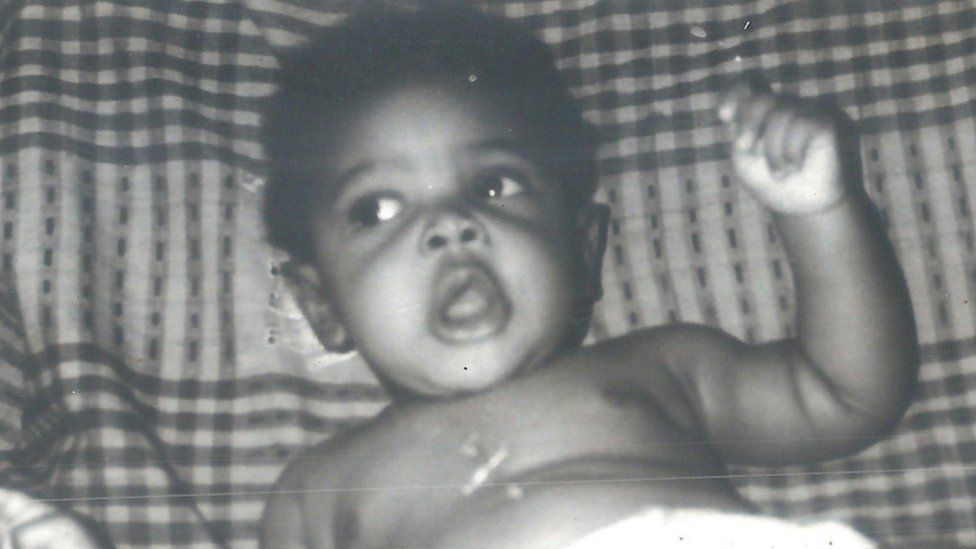
Asuquo credits his positive attitude to his upbringing.
"I am who I am because of the kind of love I was shown by my family."
Even though at times they did not know how to navigate the "unfamiliar terrains of raising a blind child, I feel like they did all they knew to do at the time", he says.
Faced with the challenge of not being able to attend school until the age of 10, Asuquo said his family made an intentional effort to treat him like any other child, and created a sense of "normalcy".
His parents taught him that being blind was just another descriptive adjective - like being "fair-complexioned or dark", or tall or "not so tall".
Asuquo learnt to play the piano by ear on a little toy instrument at a young age. A friend gave him his sister's toy piano, but warned Asuquo to never play it outside because his sister hadn't wanted to give the instrument away, despite not playing it herself.
His fond memories of childhood drive him in his work as Nigeria's first national Unicef ambassador in 15 years.
Any issues regarding children's rights or disabled children's rights are symptomatic of the country's leadership problem, Asuquo says, bemoaning the dearth of "honest, responsible" leaders in the country.
He thinks that his background can help him in his quest to improve the lot of Nigeria's children, saying music can be "a very important tool for social change, for social justice, [and] for social re-engineering".
Latest Stories
-
Vice President in Kigali for Africa Mindset Forum
18 seconds -
Ghana Gas looks beyond profits as PURC backs fresh investment in infrastructure
8 minutes -
GoldBod bans export of unrefined gold dore, effective 1st September
24 minutes -
Ban on unauthorised use of sirens still in force – Deputy Interior Minister
27 minutes -
NDC Upper West Youth & TEIN Retreat: Saankara declares national bid as party stalwarts demand equity
41 minutes -
$1.7bn loss could fund completion of Agenda 111 project – NPP
45 minutes -
NSMQ 2026: See the schools battling in 27 One-Eighth stage contests
48 minutes -
Political vigilantism now an organised threat to Ghana’s elections – National Security Coordinator
49 minutes -
Mzbel faces backlash over comments about 19-year-old man
56 minutes -
Youth Employment Agency setting up EV ‘bike’ delivery brigade
56 minutes -
Russian stadium says it won’t host Kanye West gigs
1 hour -
EOCO, Engage Now Africa rescue 20 Burkinabè nationals from suspected trafficking network
1 hour -
Women could take over the world in 10 to 15 years – Ahuofe Patri
1 hour -
Vigilante mobilisation has moved online through social media, encrypted chats – National Security
1 hour -
Trump envoy calls for Sudan-wide arms embargo as drone attacks escalate
1 hour