


Audio By Carbonatix
Founder and Chief Executive Officer (CEO) of the COA Research and Manufacturing Company says his outfit is close to a research breakthrough in plant medicine from which the country could realise not less than $32 billion annually.
Prof Samuel Ato Duncan added that funds generated from the medicine would bring some economic relief to the country when it turns out successful.
Speaking at the re-launch of the COA Mixture on Wednesday, May 25, he added that the medicine can also offer treatment to some diseases the world is still struggling to treat.
“This is what I want to achieve for mother Ghana as part of my Global Peace Mission Project,” Prof Duncan explained.
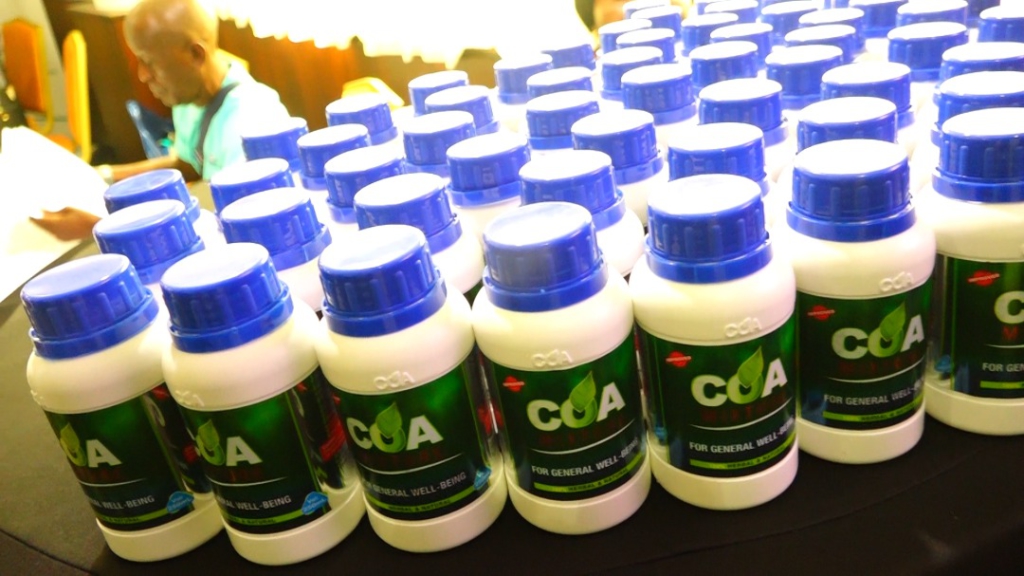
He noted that the re-launched COA Mixture is an upgrade in drug development and after going through processes at the Food and Drugs Authority (FDA), it has been upgraded from a food supplement to a herbal medicine for general wellbeing.
However, “it is not an HIV and AIDS drug. COA Mixture is for healthy living; it is a 100 per cent natural product from plants and without any artificial preservatives.

“COA Mixture is one of the best medicines the world has ever produced because of the numerous evidence-based testimonies from users.”
Need for collaboration
Prof Samuel Duncan called on government, research institutions and investors to collaborate with the Company in order to make its visions achievable.
Although the Company has acquired 1,000 acres of land to cultivate raw materials in the Ashanti Region, he said they would need an additional 9,000 acres of lands to produce COA products that would meet international market demands.

A cash donation of ¢100,000 was made to the Ghana Federation of Traditional Medicine Practitioners Associations (GHAFTRAM) to help members go through some evaluation and registration processes for the certification of their medicines.
Prof Ato Duncan also appointed the Asantehene, Otumfuo Osei Tutu II to be the Patron of the COA Mixture because of his support for the product.
Pharmaceutical sector
The Trade and Industry Minister, Alan Kyerematen, revealed that government is investing in the pharmaceutical sector in the quest to diversify the economy.
“For the country to depend on only two commodities — cocoa and gold — for over 100 years is clearly not sustainable. So we need to diversify our economy.
“The country produces only about 30 per cent of our required medicines, so we import almost 70 per cent of our required drugs, which is unacceptable,” he posited.

The Trade Minister also used the opportunity to urge manufacturers to follow laid down protocols to build public confidence and get their products accepted.
“If you want to become like COA, you have to be able to subject your products to various processes, including therapeutic analysis.
“If you want to do mass production that will earn you income, then you need to expose your processes to technology,” he stressed.
Latest Stories
-
GAEC must retain nuclear scientists for Ghana’s nuclear ambitions – Minister
22 minutes -
Man reportedly mistaken for game and shot by hunter dead in forest
24 minutes -
19-year-old mason jailed 15 years for defiling seven-year-old pupil
28 minutes -
Ghana’s banking sector assets rise 20.47% to GH¢500.2bn – BoG Governor
33 minutes -
22 injured as Sprinter bus overturns at Sege after tyre burst
34 minutes -
UN housing expert urges Ghana to strengthen Rent Control Department amid housing affordability concerns
42 minutes -
Delta-BCI partnership reaches 166,000 people with breast cancer education
52 minutes -
Power restoration fault suspected in Kumasi Central Market fire
6 hours -
The 7-foot giant of Ngleshie Amanfro: Seven-foot Ghanaian Ephraim Saawa dreams of joining the national basketball team
7 hours -
Government promises support for Kumasi Central Market fire victims
7 hours -
Vibes The Movie: Big Ghun’s Ghanaian film earns five nominations at 2026 REFFA
7 hours -
‘I’m a fulfilled man’—Justice Korbieh on missing out on Supreme Court despite two nominations
7 hours -
MamaCare CEO warns unresolved conflicts among health workers could undermine maternal and neonatal care
8 hours -
Health professionals urged to translate medical knowledge into practice to save mothers
8 hours -
Retired judge Justice Francis Korbieh charges 1,568 new lawyers to uphold integrity
9 hours