

Audio By Carbonatix
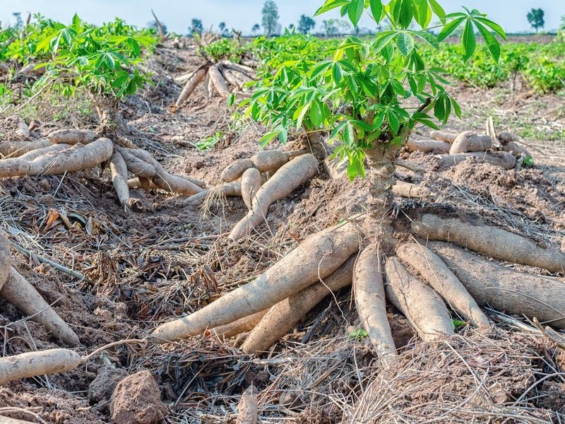
The Chief Executive Officer of Bankyekrom Limited, Sarpei Kwadey, has revealed that a high percentage of cultivated cassava -10 million tons - remain un-uprooted while only 0.5 per cent of the annual 18 million metric tons is processed.
He said more than 70% of farmers in Ghana produce cassava, and the sector contributes about 22% of agricultural GDP. He added that at least 18 varieties of improved cassava are produced in commercial quantities for various uses.
Currently, Ghana ranks among the top five cassava producers in Africa, with an annual average production of 18 million metric tons.
"We need huge tracts of land to cultivate cassava on a large scale, as well as skilled labour, mechanisation and planting materials," he added.
Mr. Kwadey revealed this at the maiden Cassava Multi-Stakeholder Forum held in Accra organised by the Ghana Incentive-based Risk-sharing System for Agriculture Lending (GIRSAL), in partnership with the Development Bank Ghana (DBG) and the Ghana Industrial Cassava Stakeholder Platform (GICSP).
The forum was held to identify opportunities and key challenges facing the national agenda of industrialising the cassava ecosystem and the key interventions that would support solutions for an effective and efficient value chain pivoted around major, small and medium processors.
The participants also discussed issues of food security, employment creation, reduction in importation and the provision of a channel for consistent financing of specific products.
Also present was the Chairman of the GICSP, Chris Quarshie, who noted that the high starch in cassava root is an important characteristic that makes the crop a potential industrial cash crop.
However, the lack of varieties in cassava crop prevents starch production in large quantities and therefore local ethanol consuming industries use imported raw materials for production due to inadequate supply.
He said, “This country consumes about eight million tons of cassava annually and records 10 million tons of annual surplus which is un-uprooted and left in the ground to rot. We have cassava but we need to get the variety which is high in starch, high yielding and will be of interest to industries," he said.
Mr. Quarshie added that cassava has low risk profile and matures between 20 and 24 months, depending on the variety. He, therefore, called for proactive policies, financing and capacity building for players in the industry.
On his part, the CEO of Development Bank Ghana, Kwamina Duker assured that the bank will collaborate with key stakeholders to help fund and support businesses to grow the cassava value chain.
According to him, this will be done by helping to unlock sectors with transformational potential and provide thought leadership on policy development to stimulate a conducive environment for agri-business. “This we will do through our holistic approach to combine finance, capacity building and market development”.
Mr. Duker explained that DBG focuses on four key sectors: agribusiness, manufacturing, ICT and high value services.
“The importance of unlocking value within key agri value chains cannot be understated. So, that explains why we are here today as a sponsor for this event”.
He added that DBG’s mandate is to grow the private sector and unlock growth for the economy, by working constructively with stakeholders to address the finance gap for long term capital in a catalytic way and deliver a beneficial Ghanaian credit market that works for everyone sustainably.
He called for urgent action of a joint effort to address the challenges faced in the cassava sector.
“We need to do it differently. What does this mean? We need to collaborate to set new standards together and this requires that we have authentic conversations. We are here this morning to roll up our sleeves and work together to come up with solutions that allow us to take the important next steps.”
Latest Stories
-
Government has improved sanitation in one-and-a-half years — Salaga South MP
1 hour -
Nkwanta North Assembly to appear before Parliament over DACF sanitation spending
2 hours -
Mourinho prints out ‘red card’ incidents after Real lose derby
2 hours -
Atletico beat 10-man Real in feisty Madrid derby
2 hours -
Twelve Tribes of Israel Ghana to mark 40 years with anniversary celebration
3 hours -
GPL 2026/27: Hearts held by Bechem as Kotoko, Samartex share spoils
3 hours -
My Story (Kwaku Antwi-Boasiako)
3 hours -
We expect growth rate to re-accelerate in second-half of 2026 – IC Insights
3 hours -
The ungodliness and unrighteousness underlying the National Cathedral mess!
3 hours -
T-bills auction: Government fails to achieve target; yield on 91-day-bill remains unchanged
3 hours -
It’s Ghana’s shame to denigrate Nkrumah when the whole world honours him as African of the Century – Asiedu Nketiah
4 hours -
No other nationalist can compare to Nkrumah – Asiedu Nketiah
4 hours -
Collateral Registry: Foreign banks accounted for GH¢19.9bn of secured credit in quarter 2, 2026
4 hours -
This government should expect scrutiny – Asiedu Nketiah
4 hours -
Two-year-old girl dies in domestic fire at Cantonments
5 hours