

Audio By Carbonatix
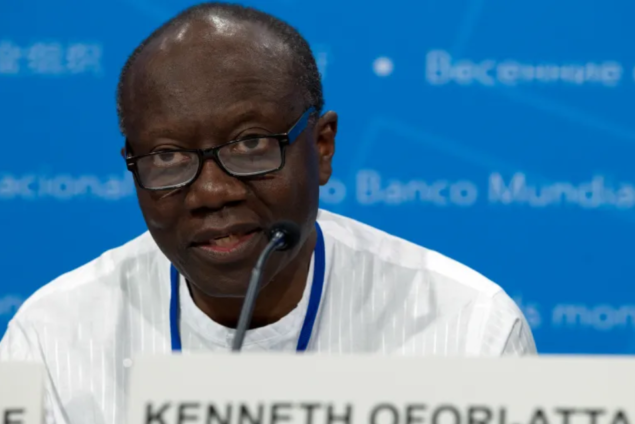
Finance Minister, Ken Ofori-Atta, is in Beijing to meet Chinese officials to discuss a proposed restructuring of Ghana’s external debt.
JoyNews checks revealed talks are likely to center on ways to lower Ghana's debt burden and obtain new finance guarantees for the country's economic programme.
Ghana is currently seeking to carry out a debt operation exercise on its external debt which China holds about $2 billion of it.
In a lot of debt negotiations taking place within the developing world, China is the crucial missing component. Although it is the largest bilateral lender in the world, it is opaque about its lending policies and how it renegotiates with distressed customers.
According to the World Bank, the planet’s poorest countries faced $35 billion in debt-service payments to official and private sector creditors in 2022, of which 40% was due to China alone.
For Ghana, Chinese loans have been a reliable funding source for major projects since 2000; in two decades, Accra has racked up close to $5 billion from at least 41 Chinese loans. After several years of near-unbridled borrowing, Ghana is now debt-trapped and wading through its worst economic crisis in a generation, with a debt-to-GDP ratio exceeding 93% as of November 2022.
Africa’s self-styled Black Star managed to secure an IMF staff-level agreement in December 2022 for a $3 billion facility, but the final approval has been contingent on restructuring a $44 billion debt load, of which $29 billion (67%) is owed to foreign creditors.
At the domestic level, the government rolled out a Domestic Debt Exchange Programme (DDEP), which was touted as successful after it saw a more than 85% participation rate. Unlike domestic debt restructuring, external loans are governed by sophisticated rules and require more careful (often fraught) negotiations.
Although Ghana has requested a bilateral debt restructuring under the G20 Common Framework, it is still unclear if all creditors will be conciliatory at the negotiation table. In fact, the Common Framework, designed to allow for speedy debt reworks, has been widely criticised for its glacial progress.
The West has repeatedly criticised China for delaying developing country debt restructurings, which it disputes. As of September 2022, Ghana’s external debt was held by the following groups: China alone ($1.7 billion), Eurobonds ($13 billion), Multilateral ($8 billion), Paris Club countries ($1.9 billion) and other creditors ($3.2 billion).
The breakdown makes Beijing the single largest holder of Ghanaian debt. With such a huge debt portfolio to China, it is impossible to restructure Ghana’s external debt stock without China at the negotiation table. The request made by Ghana for a bilateral debt restructuring under the Common Framework is an indication of the significant economic impact that the COVID-19 pandemic has had on developing countries. The Group of 20 major economies established the Common Framework to help these countries deal with debt crises resulting from the pandemic.
The fact that Ghana has sought assistance through this plank underscores the importance of this initiative and why China can’t be excluded from this exercise. The role of China in debt relief talks for developing countries is crucial.
As the world’s largest creditor nation, China has a significant stake in the global economy and is well-positioned to provide much-needed relief to countries facing debt crises. The outgoing World Bank boss’s call for China to be more active in debt operation talks for developing nations in debt crises is, therefore, timely and necessary.
China’s participation in Ghana’s debt discussions is important for several reasons. First, Beijing’s lending to Ghana has increased significantly over the years, and its debt has become a major concern for any other creditor hoping to reach any restructuring agreement with Accra.
Second, China’s participation in debt relief talks would help ensure that any debt relief measures put in place are sustainable and do not compromise Ghana’s medium and long-term economic development targets, which include reducing inflation to 25% from 52% and its debt-to-GDP to about 50% in the shortest possible time. Third, China’s participation would demonstrate its commitment to the global economy and its willingness to work collaboratively with other countries in a time of heightened geopolitical competition.
For instance, Chad, Ethiopia and Zambia signed up for the G20 Common Framework in early 2021. While Chad secured a deal with creditors in November, Zambia is still in talks. Ethiopia’s progress was held up by civil war, and Ghana is currently at a crossroads. China is a major factor in how all three countries proceed on a path to fiscal sustainability.
Beijing has shown it is willing to play ball with its debtors during restructuring talks even if the loans involved are interest-free. Between 2000 and 2019, China forgave 23 interest-free loans to 17 African countries, including Ghana. Interest-free loans account for less than 5% of the $843 billion in Chinese loan commitments incurred by 165 governments between 2000 and 2017. The bottom line is that China will likely grant debt relief if the loan is interest-free. It is not a given in all cases.
In 2019 when the Congo Republic wanted to restructure $1.3 billion of loans owed to China, Chinese creditors only agreed on the condition of lengthening maturities and increasing interest rates. This new arrangement increased Congo’s indebtedness by 23.07% to $1.6 billion after the restructuring. Zambia’s debt operation has been delayed because China refused a write-down — they preferred increasing the maturity period.
In Ghana’s case, failure to reach a deal with China could end the entire external debt operation exercise as other creditors watch closely for clues. In addition, with a budget deficit of almost $5 billion, failure to resolve the debt issue could result in further pressure on the cedi, rising inflation, an extension of high maturity rates and the further depletion of the country’s already drained foreign reserves.
Latest Stories
-
Madina MP Francis-Xavier Sosu prioritises road rehabilitation, education and healthcare
4 minutes -
Valco-Kpone road turns nightmare as motorists fume, tanker drivers threaten fresh strike
4 minutes -
STC cuts net loss by 93% to GH¢5.18m despite 12% revenue decline
11 minutes -
Tanker drivers threaten strike over deplorable VALCO-TOR-Kpone road
17 minutes -
NPA surplus jumps 76% to GH¢447m in 2025 – SIGA
20 minutes -
Railway workers push for completion of Takoradi-Nsuta line by 2027
24 minutes -
Police arrest 6 suspected notorious armed robbers in Kumasi
27 minutes -
Opinion: GHS1m is welcome, but Ghana Premier League’s biggest problem remains unsolved
28 minutes -
Stylen Boy’s ‘Adole’ featuring Kurl Songx hits No. 1 on Ghana iTunes
31 minutes -
CBG’s assets rise to GH¢17.86bn as deposits, revenue and equity grow in 2025 – SIGA Report
34 minutes -
KNUST SHS considers slashing admissions over infrastructure deficit
39 minutes -
GEXIM Bank’s capital adequacy ratio rises to 75.3% in 2025 – SIGA Report
43 minutes -
CPC’s revenue plunges 47% as net loss widens to GH¢144m — SIGA
43 minutes -
Ghana Water turns GH¢3.06bn loss into GH¢635.23m profit in 2025 – SIGA Report
44 minutes -
Challenging Heights rescues 25 trafficked children from Lake Volta in weekend operation
59 minutes