

Audio By Carbonatix
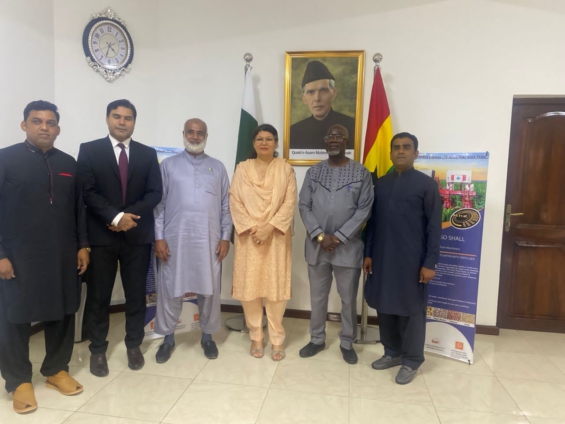
A four-member Pakistani business delegation led by the Director of Sales and Marketing of KNZ Enterprise Ghana Limited, Zafar Yab Anjum has urged the government to promote agriculture through the deployment of machinery.
The team said this would help the government in its agricultural flagship policies to maximise production and enable farmers to reap higher dividends while applying mechanisation.
The delegation gave the advice in an interview with the Ghana News Agency when members called on the Pakistan High Commissioner to Ghana, Farhat Ayesha to welcome her and to formally apprise her of the setting up of KNZ Enterprise Ghana Limited.
Other members of the delegation and shareholders of the company were Muhammad Yasir, Rehmatullah Kashif, Director and Mr Ali Nuhu Abeka, the Chief Executive Officer and the only Ghanaian member.
They are into the competitive sale of a wide range of modern agricultural machinery.
Mr Anjum encouraged the government and Ghanaian business entities to tap into economic opportunities in Pakistan to promote mutual cooperation in trade and business.

He said Pakistan was also an agrarian country, where agricultural universities were creating advanced knowledge and human resources necessary for the progress of the agricultural sector in the technological age.
Mr Anjum said by prioritising farm mechanisation, Ghana could unlock its agricultural potential and pave the way for sustainable development in the years to come.
According to him, Pakistan has made significant advancements in the field of agriculture technology, especially in areas like irrigation, mechanisation and crop management, adding that Ghana could benefit from adopting these technologies to improve the fortunes of agriculture through partnership.
The leaders stated that sharing knowledge, expertise and best practices between the two countries could lead to improved agricultural techniques, crop varieties and pest management strategies.
Speaking on collaborative research projects between Ghana and Pakistan, he said the two countries could lead to the development of crop varieties better adapted to local conditions in both countries.
Mr Anjum appealed to the government to reduce taxes on agricultural machinery to boost their purchases and thereby increase productivity.

He emphasised the importance of processing agricultural products to add more value to the products than exporting them in their raw state.
On her part, Ambassador Ayesha said the business relationship between Pakistan and Ghana remained a topmost priority.
She said there was a lot of potential for the future of both countries as far as trade in light machinery, surgical instruments, sports goods and textiles was concerned, adding that the textile industry remained a backbone of Pakistan's economy.
According to her, the presence of a Pakistan High Commission in Ghana was ample evidence of the warm relationship between the two countries.
Diplomatic relations between the two countries, she said, dated back to 1958, adding that the embassy has been in Ghana since 1964.
"We want to promote and take this relationship to another level in all spheres of cooperation," she stated.
Ambassador Ayesha expressed her delight with the advent and the operation of KNZ Enterprises in Ghana which would add value to Ghana's economy in the area of food security.
She said the High Commission had rolled out scholarship programmes for Ghanaian students offering Mechanical and Electrical Engineering, particularly students at the Kwame Nkrumah University of Science and Technology.
She indicated that the scheme would be announced every year, therefore students within the domain should avail themselves for such opportunities.
Mr. Abeka, who had a lengthy period of his education and studies in Pakistan, described the country as hospitable with warm people and full of economic opportunities unknown at face value to most people.
He said Pakistan had some of the best agricultural universities in addition to organizing professional training in engineering and medicine, adding Ghana could benefit from their expertise.
According to him, manual farming was a predominant feature of farming in Ghana, which, however, retards productivity and taking advantage of these modern machineries would change the narrative to a large extent.
He said agricultural Institutions could leverage the opportunity and deploy mechanization to boost their intended objective with proper coordination.
Ghana, he said, was a peaceful country and it was hoped the Pakistan partners would enjoy the business climate towards a fruitful partnership in the foreseeable and distant future.
Latest Stories
-
Police arrest suspect over jewellery theft during fire outbreak
55 minutes -
EOCO returns Hanan’s £6,700, GH¢2,750 and devices after defence challenge
1 hour -
Opplift Youth Entrepreneurs Summit 2026 equips entrepreneurs with skills, mentorship and support
1 hour -
Rival clubs want range of punishments for Man City
1 hour -
Tear gas in Paris and Marseille as school protests grow across France
2 hours -
Kane inspires England to win over Czech Republic in UEFA Nations League
2 hours -
Finland orders halt to work on two Google data centres
2 hours -
Substitute Merino scores twice as Spain win in Croatia
2 hours -
Ronaldo wants Portugal ‘punishment’ but not retiring
2 hours -
White House defends Trump comment to let Iran ‘take out’ LA and San Diego
2 hours -
Asos confirms hackers sent ‘unauthorised’ notification to app users
2 hours -
US televangelist Jim Bakker, disgraced from sex scandal and fraud, dies at 86
3 hours -
Congolese-born golfer to represent Ghana at Turkish Airlines World Cup grand final
3 hours -
Amazon wins global rights to stream Emmys in six-year deal
3 hours -
European Film Festival returns to Ghana after a 5-year break
3 hours