

Audio By Carbonatix
Schmidt Agricola is a large agricultural company producing soybeans, corn and cotton in Bahia, Brazil, one of the country's new-frontier agricultural areas fit for large-scale, high-tech farming. It recently added a new crop to its fields: cocoa.
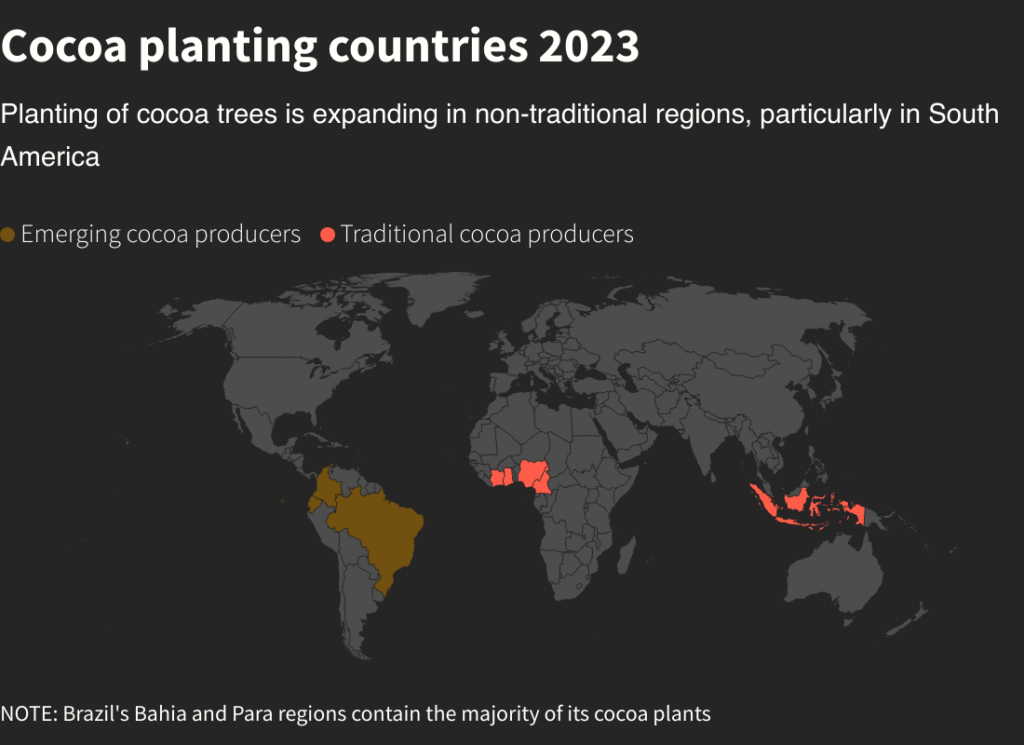
Production of the chocolate-making ingredient is expanding outside of the main growing area in West Africa as farmers in places such Brazil, Ecuador and Colombia see potential profit in the crop.
The rally in prices to the highest level in nearly 50 years is boosting that trend, which could alleviate the current supply tightness in the global cocoa market. It also poses a threat to the livelihood of small farmers in Africa since recently planted orchards such as the ones in South America are more productive, reducing the overall cost of production.
As environmental concerns rise globally, the fact that cocoa is a native species from the Amazon region makes planting it in South America a type of reforestation, while in Africa native forests are being razed to open space for cocoa orchards.
Brazil - an agricultural powerhouse and the top global exporter of soy, corn, coffee and sugar - has seen cocoa plantations spreading over degraded pastureland in the Amazon region, as well as in large farms in the highly developed grain belt.
The country was once the second only to Ivory Coast in cocoa production, but a devastating fungus in the 1980's known as Witches' Broom sharply reduced production. Nearly four decades later, crops are recovering.
Brazil's government projects output could grow to 300,000 metric tons by 2025 and to 400,000 tons by 2030, from around 200,000 tons currently, which would turn the country from a net importer to a regular exporter of the commodity.
In Ecuador, annual production has risen to between 400,000 and 430,000 tons in 2022-2023 (Oct-Sept) from 287,000 tons five years ago, according to estimates by the International Cocoa Organization (ICCO) and Ecuador's exporting group Anecacao.
Ecuador has become the third largest global grower, behind Ghana which produces around 750,000 tons. The top grower is Ivory Coast with 2.2 million tons.
Anecacao, which last July received record attendance of around 70 buyers from Asia, the United States and Europe for a trade and expo conference in Guayaquil, estimates production could continue to grow to as much as 800,000 tons by 2030.
LARGE-SCALE FARMING
Some of the new plantings in South America look huge when compared to the small holdings in Africa. Most producers in Ivory Coast and Ghana have around 5 hectares.
Schmidt Agricola has planted 429 hectares with cocoa, fully irrigated.
"I believe that the new profile of cocoa production will be large-scale," said Moises Schmidt, one of the owners.
"You will need technology, you need to seek higher yields to be more profitable. Grains and fiber (cotton) will continue to be the main crops for us, but we see cocoa gaining more area in the next five years."
High-tech, irrigated areas such as Schmidt's have produced as much as 3,000 kg of dry cocoa beans per hectare (ha), while the new areas in Brazil's Amazonian state of Para produce around 2,000 kg/ha.
That is much higher than the Ivory Coast's average yield pf 500 to 600 kg/ha, which is similar to Ecuador. Ghana's is smaller at around 400 kg/ha.
Jeroen Douglas, director of the Netherlands-based non-profit Solidaridad, which targets more sustainable supply chains, sees Brazil's role in the market growing, in the same way it has with other agricultural commodities such as soy and corn.
"On Brazil, once the mindset is: 'yes, we want to get into this commodity', there's no way of stopping them. That mindset is not there yet, but I think we are getting to a tipping point," Douglas said.
BACK TO FARMING
Brazil's Amazonian state of Para is undergoing a revival in cocoa growing.
"There are people coming back to the farms, people that left in the past to try jobs in towns," said producer Jose Garcia, who farms cocoa on 70 hectares (172 acres) that used to be pasture in the municipality of Medicilandia, Para state.
Those new orchards in the Amazon region would have an advantage in the European market since new EU legislation restricts commodity imports from areas that have been deforested for planting crops.
"If you plant cocoa trees there (Amazon region), it is considered reforestation," said Douglas.
He said that a reforestation project with cocoa, along with other trees, is part of strategies underway to strengthen the Amazon canopy.
Organizations such as UN's International Fund for Agricultural Development (IFAD), on the other side, seek to preserve the market share of small farmers, including African cocoa producers.
IFAD's head Alvaro Lario said it was important for smallholders to improve productivity, distribution and marketing. The agency organizes training on agricultural techniques to increase production per hectare.
A broker at an international commodities trader, who asked not to be named due to the sensitivity of the topic, believes that chocolate companies are willing to source more cocoa away from Africa due to sustainability issues related not only to deforestation, but also to child labor.
"They (companies) are tired of trying to defend their business there, and certainly considering moving some of that business elsewhere", the trader said.
Latest Stories
-
GAUA to communicate decision on strike suspension after Tuesday
3 minutes -
Moody’s upgrades Ghana’s credit ratings to B3, but changes outlook to stable
8 minutes -
‘I want to raise well-rounded individuals, not just men’ – Kate Addo on parenting boys
13 minutes -
Yaa Konadu Agyeman’s ‘Exceptionally Yours’ is the perfect romance read for the holiday season
22 minutes -
‘You have to man up’ – Kobby Kyei on the hidden cost of silence for Ghana’s boys
25 minutes -
DVLA extends regional office hours to 10pm under 24-Hour Economy
30 minutes -
‘Ghanaians are becoming like Kweku Ananse’ – Agyinasare warns against culture of lies
31 minutes -
‘The nation failed us’ – Okada Riders’ PRO defends young riders caught between survival and the law
32 minutes -
DVLA plans demerit point system, real-time monitoring of testing stations
33 minutes -
Health Committee Chair lauds NHIA’s swift disbursement of insurance claims
33 minutes -
Okada Association says it’s preparing training centre as gov’t works on new regulations
34 minutes -
Imperial General Assurance backs Team Auto Racing Ghana ahead of historic Angola showrun
42 minutes -
Before they failed the BECE, did Ghana fail them?
43 minutes -
Photos: Mahama swears in Emelia Afi Agbenyo, Joseph Kwaku Asamoah as EC Deputy Commissioners
45 minutes -
Centre for CSR, West Africa partners with Climate x Culture Summit to champion corporate sustainability at Google AI Centre
51 minutes