

Audio By Carbonatix
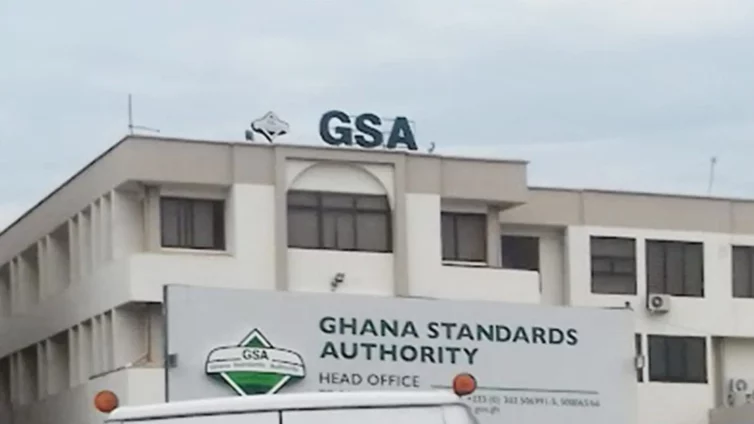
The Ghana Standards Authority (GSA) has shut down the operations of three cement manufacturing companies due to the use of inferior materials in their cement production.
The companies are Xin An Safe Cement Ghana Ltd, located at Ejisu, Kumasi Cement Ghana Ltd, located at Offinso, and Uniceme Cement Ghana Ltd, located at Bekwai, all in the Ashanti Region.
The move is part of a larger effort to crack down on substandard cement production across the country. The crackdown is being spearheaded by the GSA under the auspices of the Ministry of Trade and Industry.
In addition to the closure of the companies, the clampdown exercise covers prohibiting the construction of new cement factory, pending a streamlined permit issuance process by regulatory institutions.
The Director-General of the GSA, Professor Alex Dodoo, told the Daily Graphic, in an interview, that the exercise was to address the government’s concerns about standards, quality assurance, and environmental safeguards in cement production.
“What we are doing is ensuring fair trade and stability in the manufacturing space. We stand a chance of making this country a hub for manufacturing for the global market and trust is key for any major player who wants to invest in the country,” the Director-General said.
Prof. Dodoo stressed the importance of streamlining industries that created the real sustainable jobs that drove growth.
Fail test results
Prof. Dodoo said as part of the ongoing cement quality audits and surveillance, officers from GSA visited the factories to inspect and sample bagged cements as well as constituent materials (raw materials) used for the production of cement for laboratory tests.
The test results from Xin An Safe Cement Ghana Ltd indicated that limestone did not conform to the requirements for Calcium Carbonate content in the product, and mineral identification analysis also showed that the sample was Feldspar and Quartz.
“In view of this, you are instructed to cease operation/production henceforth until the use of the approved raw materials,” a letter from the GSA to Xin An Safe Cement stated.
Similar letters were sent to the other two companies.
Prof. Dodoo explained that Feldspar and Quartz were not recommended major constituents of cement and, as such, their use as major constituents by some cement manufacturers should be stopped forthright.
At the Kumasi Cement Ghana Ltd, official test results indicated that Gypsum did not conform to the requirements for per cent Calcium Sulphate as required in the standard, GS C22/C22M-00 (2015), while limestone did not conform to the requirements for Calcium Carbonate content as required in the standard, GS 1118:2016.
Similarly, test results from samples taken at the Uniceme Cement Ghana Ltd indicated that limestone did not conform to the requirements for Calcium Carbonate content, and mineral identification analysis showed that the sample was Feldspar.
“This is despite the fact that Feldspar is not a recommended major constituent of cement and as such, its use as a major constituent was problematic and unsafe,” the director-general stated.
Reducing clinker imports
Prof. Dodoo revealed that plans were underway to establish factories to manufacture a substitute for clinker with local resources to help reduce the importation of clinker, which is a major component for the manufacturing of Portland cement in the country.
"We have published a few papers on how we can use local substitutes to replace a significant proportion, probably 50 per cent of the clinker we use. I am happy to note that two giants are actually establishing a factory to produce this,” Prof. Dodoo said.
Substituting clinker with calcined clay in cement production will have immense environmental benefits, he added.
Globally, cement production accounts for about 7.5 per cent of carbon dioxide (CO2) emissions.
Using calcined clay to minimise the need for traditional, carbon-intensive clinker, therefore, would be a major advancement towards eliminating the negative environmental footprint from cement production, Prof. Dodoo explained.
Industry in line
The Chief Executive Officer (CEO) of the Chamber of Cement Manufacturers, Ghana (COCMAG), Rev. Dr George Dawson-Ahmoah, when reached, said COCMAG was collaborating with the Ministry of Trade and Industry to develop optimal environment, safety and cement quality standards and to combat unfair trade practices whenever they arose.
That would ensure the growth of the country’s cement industry, Rev. Dr Dawson-Ahmoah said.
The cement industry has companies such as Ghacem, Diamond Cement, Dangote Cement, CIMAF, Savannah Cement, Gyata Cement and CBI Ghana.
Latest Stories
-
Henderson scores twice as Chelsea thumb Bournemouth
4 minutes -
Photos: Mentapulse Africa convenes health and labour summit to address talent retention
17 minutes -
Mahama inspects Nkokɔ Nketenkete plant, eyes Bechem as chicken capital
23 minutes -
Ghana not seeking full BRICS membership, applying as Partner Country – Ablakwa
24 minutes -
Woman injures three people in third Poland school knife attack in a week
26 minutes -
Ghana should join BRICS as partner, not member – NPP Bono East Regional Secretary
27 minutes -
Ghana High Commission warns nationals in South Africa over protests in Johannesburg, Durban
27 minutes -
Mahama praises Roads Minister for keeping Big Push contractors on their toes
32 minutes -
World Cup Visa Scandal: ‘My client has not collected money for visas’ – Ampofo Ankrah’s lawyer
44 minutes -
US immigration officials defend ICE agents who shot man in same car as child
54 minutes -
Commentator Katie Zacharia picked as new White House press secretary
57 minutes -
Drone strike by Sudan paramilitary kills 41 near Ethiopian border, rights group says
1 hour -
King warns malicious online actors are evolving tactics
1 hour -
Several injured as Saudi capital airport reportedly hit again
1 hour -
Christa Pike discharged from hospital and returned to prison, her lawyers say
1 hour