

Audio By Carbonatix
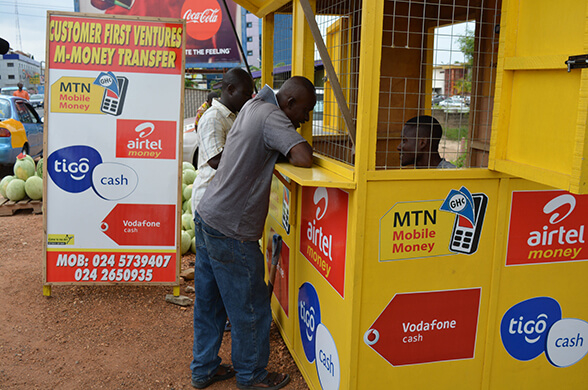
The Institute of Statistics, Social, and Economic Research has indicated that the new restriction on mobile money (MoMo) transactions could derail the digitisation of micro, small, and medium-sized enterprises and progress in the cash-lite economy.
In a press statement, the Institute acknowledged that the proposed rate would have a minimal impact on small-value transactions.
However, ISSER noted that the move would adversely impact micro, small, and medium enterprises that rely on MoMo for their financial transactions.
“Worthy of attention is the potential impact on micro and small enterprises, especially traders and farmers within the agricultural value chains concentrated in rural areas.
"For these segments, especially traders and transporters of foodstuffs who rely on MoMo to address security concerns with carrying cash across the country, an increase in cost is likely to be transferred to consumers,” the statement said.
This move, the institute said, could be a trigger for both food and non-food inflation.
The institute raised concern that beyond the move to restrict MoMo transactions, the developing social media-driven e-commerce ecosystem, which relies on MoMo for payment, would also see the transfer of the revised charges to consumers.
“As service providers on the various e-commerce platforms will pass on the charges to consumers in the form of increased prices of goods and services,” the statement said.
In a joint statement copied to the media, MoMo agents around Ghana said they would implement a temporary measure that limits cash withdrawals to GH¢ 1,000 per transaction from December 1.
ISSER said that the potential impact of the restrictions might be significant, particularly for neglected and last-mile populations.
“On average, 76 per cent of mobile money agents are within 30 minutes of consumers in rural areas. On the other hand, it takes two hours for over 50 per cent of rural dwellers to reach an ATM, with only about 40 per cent being able to reach a bank or microfinance in two hours,” the statement said.
This situation ISSER said that many MoMo users in rural areas, where ATMs, banks, and microfinance institutions were not an option, would be confronted with the option of either enduring the high transaction costs or resorting to cash.
Latest Stories
-
Young woman found dead at Kasoa Peace Town
27 minutes -
Livestream: The Law examines lawful arrest in Ghana
51 minutes -
Mahama urges African governments to treat healthcare as an investment, not budget cost
1 hour -
Bawumia congratulates John Boadu and new NPP executives, pledges support ahead of 2028
1 hour -
‘No talent should be left out’ – Bawumia pledges inclusive NPP campaign for 2028
2 hours -
Prof. Mike Oquaye recounts how he blocked Special Prosecutor’s attempt to arrest Bawku Central MP
2 hours -
Make health sovereignty a priority for Africa – Mahama
2 hours -
Dorimon Naa, Wa West DCE lead massive clean-up exercise; threaten sanctions against recalcitrant residents
2 hours -
Photos from Adom FM Y2K Jam
2 hours -
Praye Tiatia steals the show at Adom FM Y2K Jam [Watch]
2 hours -
Boakye Agyarko congratulates John Boadu, pledges support for NPP leadership
3 hours -
Antwi HiMight thrills fans with Antwi ne Antwi hits at Adom FM’s Y2K Jam [Video]
3 hours -
Amb. Edward Boateng congratulates Boadu, Kodua on election wins
3 hours -
John Boadu pledges to rebuild NPP from grassroots and restore ‘winning machinery’
3 hours -
Ashaiman Assembly deploys monitoring system to curb dumping in storm drain
4 hours