

Audio By Carbonatix
North Korea has fired its most advanced long-range missile, South Korean authorities confirm, defying UN curbs.
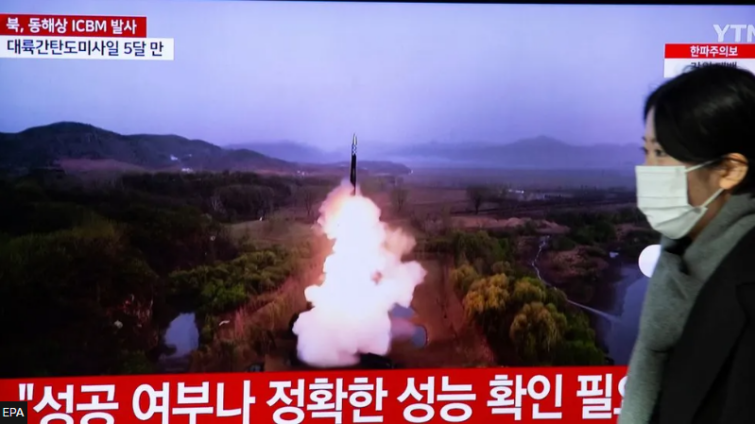
The launch of the solid-fuel intercontinental ballistic missile drew immediate condemnation from the West. It landed west of Hokkaido in Japan.
It comes after South Korean and US defence officials met last week to update plans on how to respond to a nuclear attack from the North.
Pyongyang had said in response it would take "more offensive countermeasures".
The isolated state launched the long-range missile on Monday morning about 08:24 local time (23:24 Sunday GMT) from the Pyongyang area.
South Korean and Japanese officials said the missile travelled for 73 minutes, covering about 1,000km (621 miles).
ICBMs have the range to reach the North American continent. Monday's launch is North Korea's fifth successful launch of an ICBM this year.
Tensions between the North and the South flared last month when Pyongyang successfully launched a spy satellite into orbit, in violation of United Nations sanctions.
Seoul responded by partially suspending a military agreement with the North that was meant to limit military activity along the border and reduce the likelihood of clashes.
Pyongyang then withdrew from the agreement entirely. North Korea has since rearmed its soldiers in previously unarmed areas of the Demilitarised Zone.
Last week, South Korea's national security advisor Kim Tae-hyo said he was expecting the North to launch an ICBM at some point in December.
On Monday, South Korean national security officials confirmed the ICBM launched was a solid-fuel missile. Such missiles can be fired with less warning, as they do not need to be fuelled prior to launch.
The North had tested its Hwasong-18 missile in July following a first successful flight in April.
North Korea is also working to develop a new solid-fuel medium-range ballistic missile. Last month it claimed to have successfully tested the engine, but the missile had not yet been successfully launched.
As North Korea continues to refine and add to its arsenal of nuclear weapons, South Korea and the United States are stepping up their defence of the region.
In a meeting in Washington on Friday, officials updated their contingency plans for how to respond to a North Korean nuclear attack. The two countries also agreed to war-game the use of nuclear weapons in their military exercises next summer.
Latest Stories
-
Black Stars: Seven years of decline while hashtagging love
13 minutes -
Today’s front pages: Thursday, October 1, 2026
13 minutes -
Gov’t to suspend GH¢1 D-Levy on diesel for October and November
46 minutes -
Fire destroys belongings in Akweteyman apartment
1 hour -
Baffour Awuah to turn himself in to EOCO today – JoyNews sources
1 hour -
Government identifies payment discrepancy holding up teachers’ strike resolution
2 hours -
BoG signals no FX intermediation for October as GoldBod plans $1bn support for banks
2 hours -
When share ownership becomes personal: The African mindset of the Dangote IPO
2 hours -
Why MFWA Legal Fund matters to Ghana’s democracy
2 hours -
Fuel prices to rise from October 1; diesel could hit GH¢19.60 – COMAC
2 hours -
Parliament must investigate how 3.9 tonnes of cocaine left Ghana undetected – Samuel Jinapor
2 hours -
Government pledges to pay striking teachers as payment dispute is resolved
2 hours -
Government cannot investigate drug exports under its own watch – Abu Jinapor
2 hours -
Government extends GH¢2 diesel subsidy for two more months
2 hours -
GTEC flags over 100 tertiary institutions as unrecognised
2 hours