

Audio By Carbonatix
Dr Johnson Pandit Asiama, Governor of the Bank of Ghana (BoG), says a consultative and listening-based leadership approach has played a key role in shaping policies that have supported Ghana’s ongoing economic recovery.
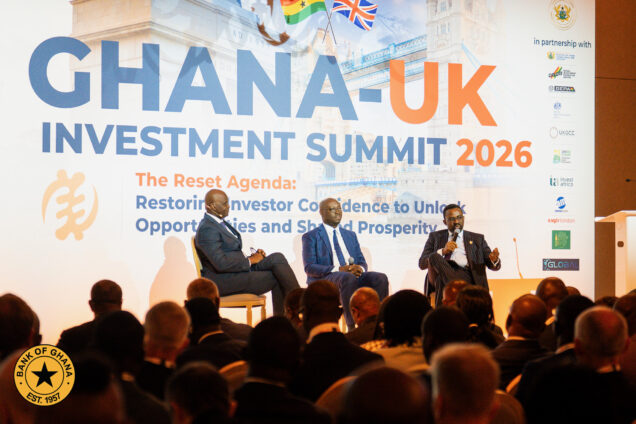
Dr Asiama speaking at the Ghana-UK Investment Summit in London, said one of the major changes introduced since he assumed office was the decision to “demystify” the central bank and deepen engagement with stakeholders across the economy.
He said his years outside the Bank of Ghana exposed him to public concerns and criticisms about the institution, lessons he carried with him upon his return as Governor.
According to him, the Bank now regularly engages trader associations, financial institutions, businesses and other groups to better understand challenges confronting the economy.
Dr Asiama cited consultations with the Ghana Union of Traders’ Associations (GUTA) and other stakeholders, which informed reforms to the foreign exchange market framework.
He said the central bank had also responded to concerns raised by digital content creators and influencers who experienced difficulties receiving payments from international online platforms.
The Governor noted that direct engagement with the affected groups enabled the Bank to identify operational challenges and implement solutions that restored payment flows.
“We listen more because good policy comes from understanding the problems people face,” he said.
Dr Asiama said the Bank and the Ministry of Finance entered office with a shared understanding of the economic challenges confronting the country and had worked closely to implement reforms.
He noted that one of the first major decisions taken by the Monetary Policy Committee was to increase the policy rate to curb inflationary pressures and restore confidence in the economy.
He said the hardest decision was the hike in the first MPC from 27 per cent to 28 per cent which then made the easing that followed credible.
The Governor explained that the Bank subsequently pursued a four-pillar strategy comprising tight monetary policy, liquidity management, reserve accumulation and financial sector strengthening.
He said reforms in the remittance sector also helped improve foreign exchange inflows by ensuring that remittance proceeds entered the formal financial system.
According to him, remittance inflows reached nearly US$8 billion last year, providing significant support for the economy and exchange rate stability.
Dr Asiama said the Bank was also developing investment products targeted at the Ghanaian diaspora, including plans to tokenise gold-backed investment instruments.
He described the diaspora as an important source of investment capital that could contribute significantly to national development.
The Governor reiterated that maintaining macroeconomic stability remained central to the Bank’s mandate and expressed confidence that ongoing reforms would strengthen Ghana’s economic resilience.
Latest Stories
-
Hotline Documentary: ‘Silent Football’ to air on JoyPrime and JoyNews today
49 minutes -
NDPC examines how evidence shapes Ghana’s development planning and policy decisions
49 minutes -
Education Ministry calls urgent talks to break GAUA strike deadlock
52 minutes -
NCCE engages women in North East Gonja on rule of law, anti-corruption
1 hour -
NDPC reviews 2004 planning guidelines to reflect changes in decentralised system
1 hour -
Trade Ministry commends Prisons Service for using art to drive inmate rehabilitation
1 hour -
Books, brushes and second chances: Dr Abena Asomaning launches three titles to support prison outreach
1 hour -
Treasury bill auction oversubscribed by 53.5% as yields fall across maturities
1 hour -
NPP warns aspirants premature campaigning could jeopardise eligibility for primaries
1 hour -
Ghana courts investors in Bangkok after exit from $3bn IMF bailout
2 hours -
8 arrested over alleged internet fraud initiation assault in Bono Region
2 hours -
SSNIT says Labadi Beach Redevelopment will create local economic opportunities
2 hours -
BoG proposes 30-day liquidity buffer requirement for banks
2 hours -
BoG plans reviews of banks’ cybersecurity compliance
2 hours -
GRA cautions taxpayers against attacking tax officials
2 hours