

Audio By Carbonatix
President John Mahama has said no African country can successfully navigate the growing geopolitical and economic challenges facing the world alone.
He argued that stronger unity across the continent has become a strategic necessity.
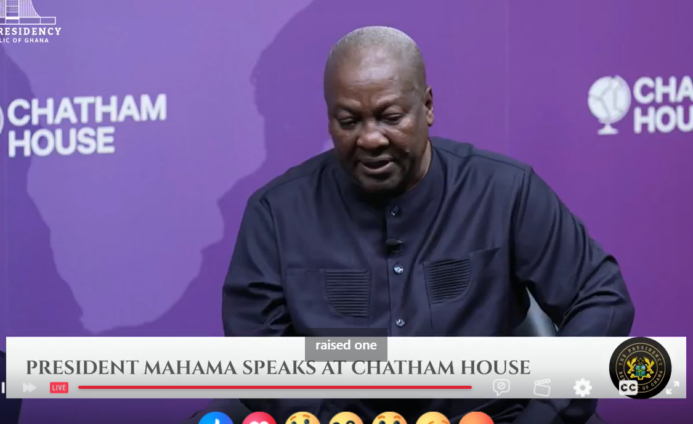
Speaking at Chatham House in London, the President said the rapidly changing global landscape requires African nations to work together more closely to protect their interests and strengthen their position on the world stage.
"In today's global environment, no African country, regardless of size or resource, can effectively navigate geopolitical and economic complexities in isolation," President Mahama said.
He said that African unity should no longer be seen merely as an ideal political objective but as an essential strategy for survival and progress.
"African unity is, therefore, no longer simply a political aspiration. Like I said, it's a strategic imperative," he added.
President Mahama noted that while partnerships with foreign countries remain important, African nations must ensure such relationships are balanced and beneficial to all parties involved.
According to him, Ghana continues to value its longstanding ties with traditional partners while also expanding cooperation with emerging economies and new centres of global influence.
"Ghana believes that partnerships remain indispensable, but they must be increasingly balanced, pragmatic, and mutually beneficial," he said.
The President explained that Ghana's foreign policy is based on national interests rather than ideological considerations.
"Our foreign policy approach is guided neither by ideological rigidity nor by dependence, but by strategic pragmatism rooted in Ghana's national interest," he stated.
Mr Mahama said countries capable of building relationships across different geopolitical blocs would be better positioned to thrive in an increasingly divided world.
"In a fragmented world, countries that can build bridges across geopolitical divides will be more strategically relevant," he said.
He explained that Ghana is pursuing partnerships that will open up markets, encourage technology transfer, create jobs for young people, support industrialisation, and drive economic transformation.
At the same time, he reaffirmed the country's commitment to international cooperation, peaceful coexistence, and engagement through multilateral institutions.
President Mahama also said that responsibility for global stability should not rest solely with powerful nations.
"The preservation of global stability cannot depend solely on the actions of major powers," he said.
"Middle powers and developing nations also bear responsibility for upholding the principles of cooperation, restraint, and international legality."
He further linked a country's international influence to the strength of its institutions and economy at home, describing domestic resilience as a key factor in navigating an evolving global order.
"Our ability to navigate a changing global order is inextricably linked to the strength of our democratic institutions, economic governance, productive capacity, and human capital," he said.
President Mahama highlighted Ghana's democratic record as one of the country's greatest assets, saying constitutional governance, the rule of law, and peaceful transfers of power remain critical to long-term stability and development.
Latest Stories
-
Ghana High Commission celebrates Sabah Zita Benson on 20th legal anniversary
5 minutes -
Deaths of three children in Tamale vehicle now being treated as murder – Police
24 minutes -
Catholic Bishops urge stronger action against tramadol, marijuana abuse
26 minutes -
Health experts warn women against unregulated breast enlargement products, herbal remedies
30 minutes -
Kenya confirms its first Ebola death as outbreak spreads
33 minutes -
Assemblies of God World Congress: Ghana to host first African edition from October 14 to 16
35 minutes -
Humanity Haven Foundation supports 100 pupils in Wiamoase with educational supplies
35 minutes -
LA 2028: Black Queens arrive in Mauritius for Olympic Games qualifier first leg
56 minutes -
Local Government Service HR practitioners urged to embrace digital systems
1 hour -
Lawyer highlights gaps in Ghana’s rape law regarding male victims
1 hour -
Nigeria declares three days of mourning after military aircraft crash kills 32
1 hour -
CPP’s Kwame Nkrumah Botsio calls for legally binding MOU to end teacher strike
1 hour -
Vice President hopeful of swift end to teacher strike
1 hour -
KGL U17 Colts 2026: Prempeh Elite Academy, Brong Ahafo lead groups after Matchday Two
2 hours -
Tullow Oil posts $101m half-year loss despite production gains
2 hours