

Audio By Carbonatix
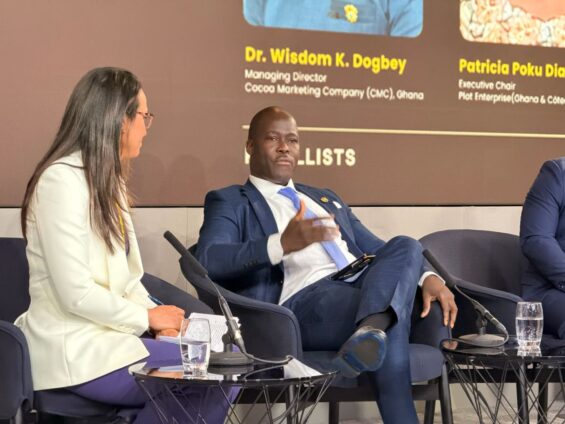
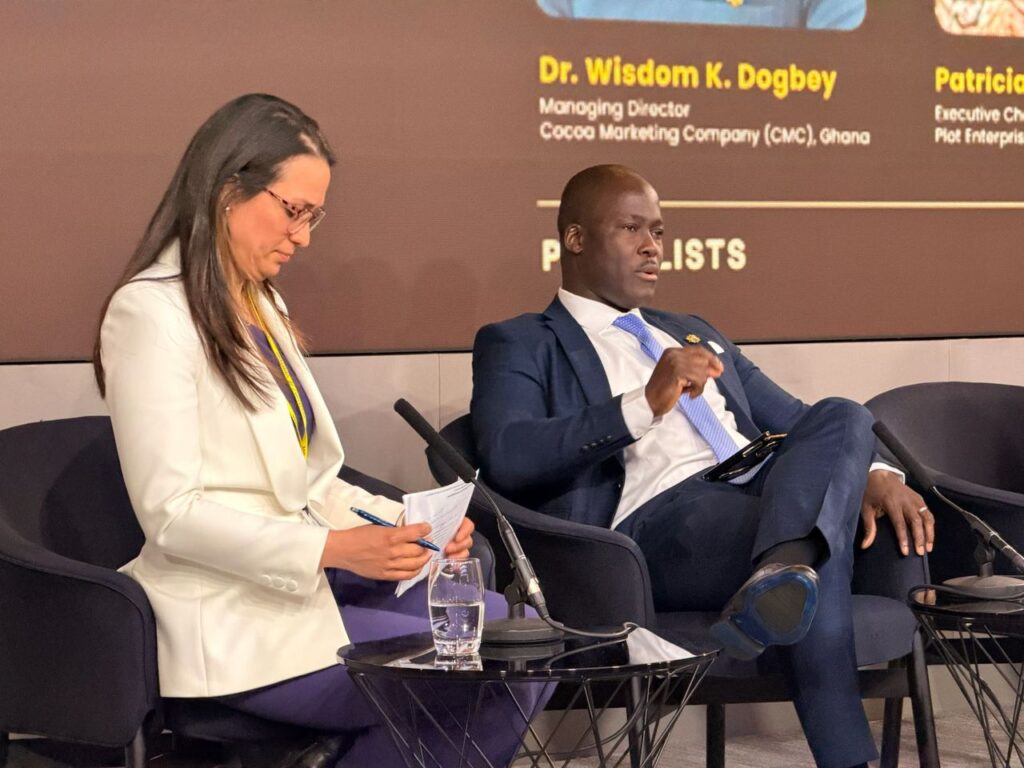
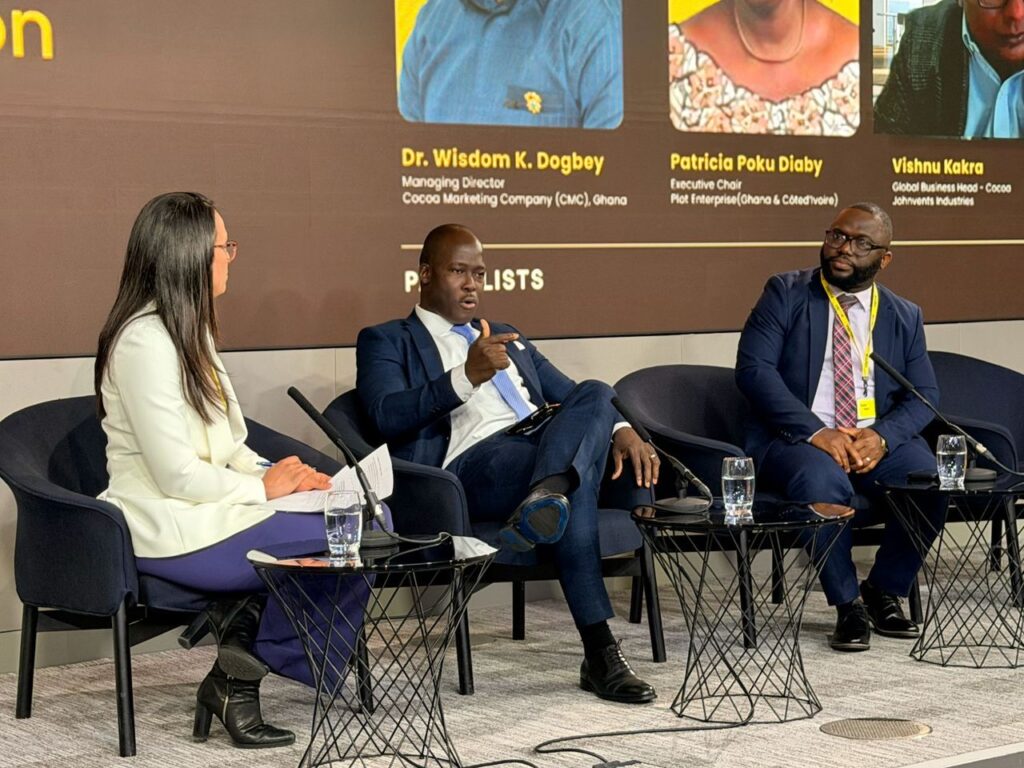
In a bold and strategic appearance before some of the world's most influential cocoa traders, commodity financiers, and processing industry executives, the Managing Director of Ghana's Cocoa Marketing Company (CMC), Dr Wisdom Kofi Dogbey took centre stage at the London Stock Exchange on Wednesday, making a forceful and data- driven pitch for global investment support behind President John Mahama's landmark 50% domestic cocoa processing policy.
Speaking at the Africa Cocoa Finance and Investment Forum (ACFIF) 2026, hosted at the London Stock Exchange, the CMC MD delivered what observers described as one of the most substantive and commercially grounded presentations on cocoa sector reform to come out of West Africa in recent years.
A Policy Whose Time Has Come
Ghana produces between 650,000 and 800,000 tonnes of cocoa in a good season, yet for decades, approximately 70% of that harvest has left the country as raw beans, surrendering the higher-value grinding and refining margins to European processors. That, the CMC MD told the forum, is precisely what President Mahama's administration is determined to change.
"Ghana has thirteen processing companies with 500,000 tonnes of combined installed capacity, and they are running well below potential. Not from technical deficiency, but from lack of reliable, commercially priced bean supply," the CMC Managing Director told the investors and industry players. "The 50% domestic processing policy, commencing 2026/27, is the government of Ghana's decision to correct that."
The Numbers Make the Case
Responding to pointed questions from the forum floor on whether cocoa processing can genuinely be profitable at origin, the CMC MD presented a three-point commercial case that appeared to resonate strongly with the gathering.
First, Ghana's policy covers a deliberate bean mix that includes main crop beans at zero ICE discount alongside light crop and remnant grades carrying 20% and above discounts on the international market, creating a commercially viable blended margin. Ghana's bean quality has also improved markedly, with better bean size and higher fat content. Second, the country offers domestic processors its light crop beans at their discounted international price, yet these beans meet main crop standards in several markets; a direct and meaningful input cost advantage over European competitors. Third, processors operating under Ghana's Free Zone framework enjoy a full ten-year corporate income tax holiday, followed by a 15% rate thereafter- well below the standard rate of 25%.
The CMC MD also pointed to a structural argument often overlooked: Ghanaian processing plants currently running at 30 to 40% of installed capacity absorb fixed costs across too few tonnes and bleed money even on a sound margin. A guaranteed bean allocation under the new policy would push utilisation toward 75 to 80%, at which point those same factories become genuinely profitable.
The Untapped Value of Cocoa
Perhaps the most striking passage of the CMC Managing Director's remarks came when he turned to the broader question of Africa's share of the global cocoa value chain, and what the continent stands to gain by moving up it.
"The global chocolate market is worth approximately $130 billion a year. Africa produces 70 to 75% of the raw cocoa that feeds it. Africa earns less than 10% of that $130 billion. That gap is the untapped value," he told the forum.
But the CMC MD went further, urging investors and industry players to look beyond confectionery. Cocoa butter, he noted, commands premium prices as a sought-after ingredient in global skincare and personal care products; moisturisers, lip products, and body lotions sold by the world's largest beauty brands. It also features prominently in pharmaceutical manufacturing. There is equally a fast-growing global market for cocoa- based health and wellness products, built on the crop's naturally occurring compounds linked to cardiovascular health and anti-inflammatory properties.
"We are not talking about a better price for cocoa. We are talking about Ghana supplying the global beauty, healthcare, and food manufacturing industries, not just the confectionery trade," the CMC Managing Director added.
CMC's Three-Point Delivery Plan
On the practical question of implementation, how exactly CMC intends to operationalise the 50% target, the Managing Director outlined a three-track approach already underway ahead of the 2026/27 crop season.
From 2026/27, CMC will direct defined volumes to named domestic processors, including Cocoa Processing Company (CPC), WAMCO, Niche Cocoa, Plot Enterprise, and TF Commodities among others, as a first priority under auditable commercial terms, giving processors a guaranteed feedstock entitlement for the first time. Simultaneously, a domestic bond programme currently being finalised will seed Licensed Buying Companies (LBCs) with the liquidity needed to purchase beans promptly at the farmgate, enabling COCOBOD to pay those contractors on delivery. The benefit to factories, the CMC MD stressed, is a faster and more reliable bean pipeline, translating into consistent throughput and lower unit costs.
The third strand is perhaps the most immediately attractive to investors in the room: CMC is actively working to secure long-dated offtake agreements between selected Ghanaian processors and international buyers, including participants at the ACFIF forum itself. A confirmed offtake from a creditworthy counterpart, the CMC chief noted, fundamentally
transforms a processor's risk profile and unlocks access to commercial bank financing that has not previously been available to most Ghanaian processing companies.
Confronting the Constraints Head-On
The CMC Managing Director did not shy away from the challenges. Asked directly what the biggest constraints are for Ghanaian processors competing with their European counterparts, he gave a candid answer: finance; access to it, and the cost of it.
"A European processor borrows to buy beans at close to base rate. A Ghanaian processor pays rates several multiples higher, not because the plant is poorly run, but because Ghana's sovereign and currency risk is priced into every loan regardless of the factory's own creditworthiness. That premium erodes the processing margin and makes origin processing appear uneconomic, when the real problem is the financing cost, not the processing," he said.
He acknowledged further secondary constraints: structurally higher energy costs in Ghana, port logistics that add cost and lead time, and compliance costs associated with the European Union Deforestation Regulation (EUDR), though COCOBOD's existing traceability systems are helping manage the latter. Yet he was unequivocal on the conclusion: "None of these constraints, individually or together, is a reason not to proceed. They are reasons to proceed with adequate support, which is exactly why we are at the London Stock Exchange today."
A Forum Whose Timing Is No Accident
The choice of the London Stock Exchange as the venue for this year's Africa Cocoa Finance and Investment Forum was pointed and deliberate. London remains the epicentre of global commodity finance, and the Paternoster Square address carries a weight that signals seriousness of intent. For the Mahama administration, which came to office promising a new chapter in Ghana's economic management, staging this conversation in the heart of the global financial system was a statement as much as it was a strategy.
Industry observers at the forum noted that the CMC Managing Director's presentation stood out for its combination of policy conviction and commercial granularity; a blend not always associated with state-enterprise presentations on the international circuit. The direct engagement with profitability numbers, bean quality data, tax incentives, and financing structures appeared to land well with an audience accustomed to cutting through political rhetoric to assess investable propositions.
With the 2026/27 crop season approaching and the operational machinery of the 50% processing policy now being put in place, the message from Accra, delivered with boldness on the floor of the London Stock Exchange, was unambiguous: Ghana is open for cocoa investment, and the economic architecture to support it is being built in real time.
Latest Stories
-
GES working around the clock to get teachers back to class, says Daniel Fenyi
3 hours -
French PM warns against escalation of school protests after 164 arrested
3 hours -
UK tries to stop Trump’s diesel export ban
3 hours -
Late Olise goal gives France win over Belgium
3 hours -
Mancini enjoys first win since return as Italy boss
3 hours -
Interest payments to average a high 20% of government revenue over next 4 years
4 hours -
Anthropic warns AI may pose ‘existential risks to humanity’ in IPO filing
4 hours -
Joe Hart trusts Man City chair Al Mubarak over ruling
4 hours -
Strategy of accumulating foreign reserves, gold carries high fiscal cost – S&P Global
4 hours -
Weak institutional arrangements, high debt servicing constrain Ghana’s rating – S&P
4 hours -
Man City CEO defiant over Premier League charges
4 hours -
Infantino makes bigger cash pledge to Fifa members
4 hours -
Bond market: Turnover declined by 28% to GH¢1.56bn
4 hours -
Volta Region National Public Speaking contest advances drug prevention conversation
4 hours -
New health training facility at Ampoma-Jema to address admission shortfalls, but Minister flags missing amenities
5 hours