

Audio By Carbonatix
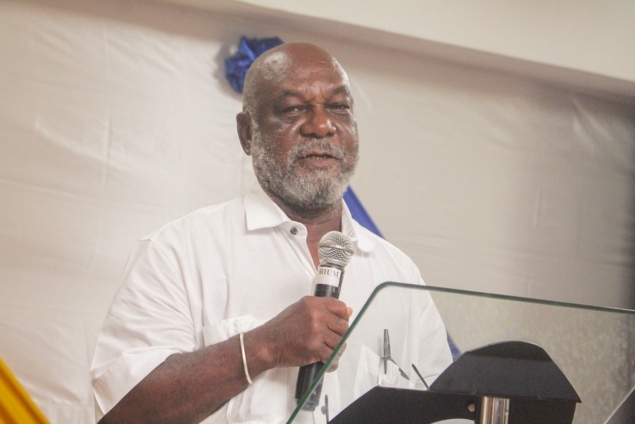
Journalism Professor Kwame Karikari says the media has the right to exercise its discretion and blackout any newsmaker or public official whose actions are deemed disrespectful to the media profession.
According to him, the 1992 Constitution guarantees the independence of the media, describing it as offensive to the constitutional provisions should newsmakers, particularly, politicians assault a media practitioner.
Professor Karikari contended that if a public official, especially a minister, engages in behaviour that disrespects the principles of journalism and fails to rectify such actions, the media is well within its rights to impose a blackout.
He argued that this approach serves as a powerful tool for the media to protect its integrity and uphold journalistic standards.
"For a minister to behave like that to any sector of the media and without rectifying that action, then the politician deserves to be simply blacked out," Professor Karikari said on JoyNews' PM Express on Monday.
He drew attention to the fact that in the current media landscape, politicians can boycott specific media houses and not invite certain media teams to their programmes. Therefore, he argued, the media should also have the right to reciprocate such actions.
Last two weeks, the Ghana Journalists Association (GJA) imposed a total media blackout on the Fisheries and Aquaculture Development Minister, Mavis Hawa Koomson.
The GJA directed journalists to avoid covering any activities involving the Awutu Senya East MP following an attack on a journalist allegedly by the MP's thugs during the NPP’s parliamentary aspirants’ vetting in Cape Coast.
The Yendi MP, Farouk Aliu Mahama, has also been included in this total blackout after he was reported to have assaulted a Citi FM reporter during the NPP Parliamentary elections.
Although some have criticised the strategy as one which is not in the public interest, Prof Karikari clarified that while media blackout of key institutions like Parliament and the Presidency would be highly inappropriate, individual politicians who engage in disrespectful behavior towards the media should face the consequences of being blacked out.
"When you assault a journalist, you are telling the media 'We don’t want you,' so what business does the media have rendering a service that you claim you do not want? So for me, the media blacking out anyone is within their right."
On the same show, the Information Minister, Kojo Oppong Nkrumah urged the GJA to ensure that thorough investigations are carried out before the blackout policy is implemented.
He noted that although the directive is a laudable one, it can be abused if left unchecked.
Latest Stories
-
GPL 2026/27: Medeama ease past Basake Holy Stars
32 minutes -
Appiah Adomako writes: Why DVLA must stop treating every expired licence holder as delinquent
35 minutes -
Localization must transfer decision-making power, not just project responsibilities
44 minutes -
Modernising Ghana’s traditional markets through the 24-Hour Economy markets initiative
47 minutes -
New economy will boost local production and create jobs – Finance Minister
53 minutes -
Real-Time VAT on cross-border digital services – not a new tax and does not violate double taxation principle
2 hours -
Digitalisation, AI key to Ghana’s tourism transformation – GHATOF
2 hours -
Stronger GTA-private sector partnership needed to grow tourism – GHATOF
2 hours -
Amazon eyes Ghana for broadband expansion after talks with Mahama
3 hours -
National Investment Quiz 2026: Six schools qualify for quarter-finals
3 hours -
‘Do not let Russia pay for its madness with lives of your people’ – Zelensky to Ghana, 46 other countries
3 hours -
6,079 promotion cases fully processed and paid – CAGD says amid nationwide teachers’ strike
4 hours -
Teacher unions to meet government Monday over nationwide strike
4 hours -
Photo story: Republic Bank-JoyNews Habitat Fair clinic wraps up after three days of housing solutions, expert engagement
4 hours -
National Peace Council urges investment in youth to sustain Ghana’s peace
4 hours