

Audio By Carbonatix
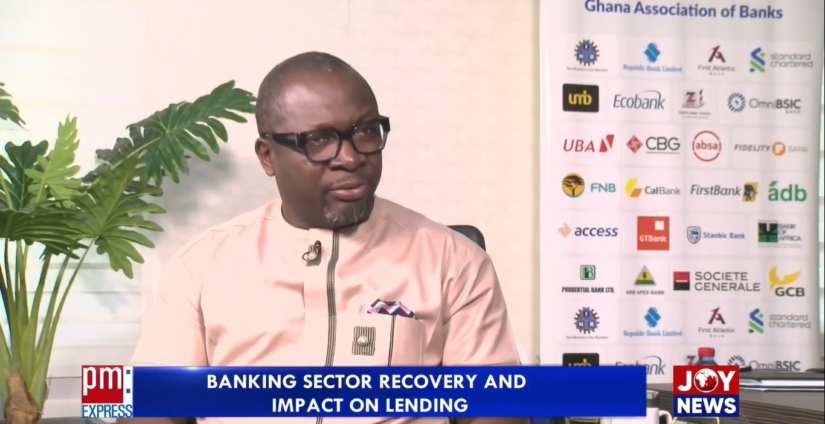
The Chief Executive Officer of the Ghana Association of Banks, John Awuah, has highlighted the pivotal role of the banking sector clean-up in weathering the challenges posed by the Covid-19 pandemic and the subsequent economic crisis.
Speaking on JoyNews' PM Express on Thursday, Mr Awuah said the exercise was a proactive measure in safeguarding the stability and functionality of the financial industry.
He emphasised the significant contribution of the banking sector to Ghana's successful negotiation of an IMF-assisted programme during these trying times, an action he believes would have been impossible if the sector was not resilient enough.
Reflecting on the resilience of the banking industry, Mr Awuah pointed out that the massive clean-up of the banking sector in 2017 served as a crucial shock absorber.
This clean-up, he stated, played a pivotal role in mitigating the negative effects on the banking industry, ultimately enabling it to navigate the complexities of the economic downturn and the pandemic.
"The banking sector clean-up provided a shock absorber for the industry, and that perhaps is the key enabling force that helped the banks to come through these difficult periods that we’ve had," he told the host, George Wiafe.
Banking sector clean-up
Former Finance Minister, Ken Ofori-Atta supervised the banking sector clean-up from mid-2017 to January 2020 in a bid to restore confidence in the banking and specialised deposit-taking sector.
The government said the action was one of the contributory factors for the country’s high debt stock.
The clean-up saw a reduction in the number of banks from 34 to 23, whilst 347 microfinance institutions, 15 savings and loans, and eight finance houses had their licences revoked.
While some of the commercial banks were merged to form the Consolidated Bank Ghana Limited, state-owned GCB was allowed to swallow others.
The Securities and Exchange Commission (SEC) also announced the revocation of the licenses of 53 Fund Management Companies.
A number of these institutions were found to have varying degrees of corporate governance lapses.
The total estimated cost of the state’s fiscal intervention, excluding interest payments, from 2017 to 2019 was pegged at GH¢16.4 billion.
Vice President, Dr. Mahamudu Bawumia in 2020 claimed that the government spent about GH¢21 billion on the banking clean-up exercise.
Nonetheless, the clean-up faced massive criticisms with the opposition party suggesting that the closure of some of the banks were purely political, and has caused massive job losses.
The argument has been that, government could have spent less in saving the banks instead of spending more to close them down.
Some of the affected financial institutions also sued the government for the action.
Latest Stories
-
Mfantsipim must cultivate more business leaders, entrepreneurs – Nana Awuah
1 minute -
MOBA must reduce reliance on donations to protect Mfantsipim’s future – Patrick Kittoe
2 minutes -
GCB extends Customer Service Week into month-long customer engagement
3 minutes -
Africa risks widening inequality if it fails to build AI expertise – Kweku Awotwi
4 minutes -
Women’s Voices Matter Movement petitions Gender Ministry over women’s rights and development
5 minutes -
Ronaldo leaves Portugal camp after coach denies rift
5 minutes -
Huel ad banned for suggesting its products could replace all meals
16 minutes -
Global InfoAnalytics poll puts John Boadu, Justin Kodua and Titus Glover ahead in NPP executive race
2 hours -
Ghana to establish skills development university with $50m from German support package
2 hours -
Baffour Awuah under EOCO investigation over alleged financial loss and money laundering – Deputy AG
2 hours -
How healthy is Ghana’s health sector?
2 hours -
HACSA Tech4Girls graduates 80 young women with digital and technology skills
2 hours -
Arrest of Manhyia South MP should involve Parliament, not police station – Kpebu
3 hours -
Two Nigerians sentenced to 189 months in US prison over $2.4m cyber fraud
3 hours -
Cristiano Ronaldo leaves Portugal’s training camp after rift with Head Coach
3 hours