

Audio By Carbonatix
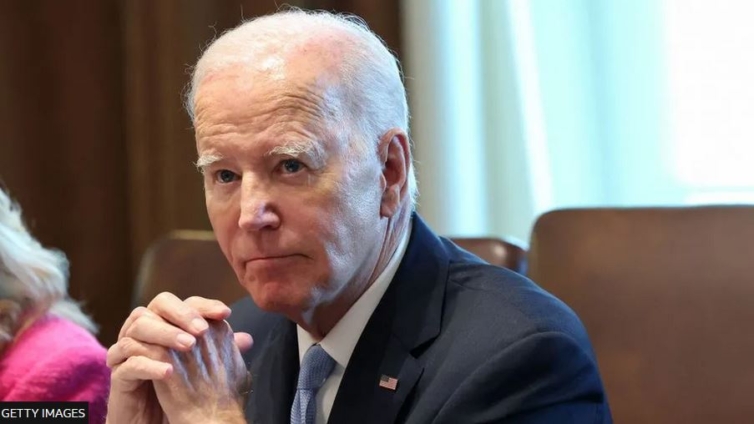
Iran's brazen attack directly targeting Israel on Saturday means that the one thing President Biden most feared and desperately sought to avert in the wake of the 7 October Hamas attack has happened - an escalation of the conflict to the wider region.
For the US president, the tightrope he was walking on the Israel-Gaza war has got even thinner, as he seeks to both de-escalate the situation and deter Iran, while facing domestic pressure from both left and right over the relationship with Israel. Any ceasefire deal in Gaza, meanwhile, hangs in the balance.
Just two weeks ago, it appeared that the US-Israel relationship - once the closest of close allies - was in serious trouble.
President Biden was expressing not just frustration but also outright anger at the lack of humanitarian aid getting into Gaza and the killing of seven aid workers in a strike by the Israel Defense Forces.
The level of disagreement was such that the administration made clear it could reconsider its stance towards Israel, and possibly even withhold arms exports.
But Iran's action at the weekend seems to have changed all that.
The barrage of more than 300 missiles and drones fired at Israel prompted a highly successful, hand-in-glove military action by the US and Israel to defend the country.
The co-ordinated action has seemingly rekindled some of the old warmth. And the White House will now be hoping it can capitalise on that to influence Israel's response.
Officials are not so naive as to think there will be no response at all, but they want it calibrated in such a way that it can be viewed as an act of restraint.
But the weekend's joint military success also masks a fundamental and worrying change in the regional situation, according to former US envoy Dennis Ross, a 40-year veteran of US diplomacy in the Middle East.
Iran's direct retaliation against Israeli territory for the targeting of its elite Quds Force officers in a strike on the Iranian consulate in Syria has "rewritten the rules" of the Israel-Iran relationship, he says, further destabilising an already precarious situation.
Iran has spent years building up proxy forces sworn to Israel's destruction, while funding and arming Palestinian groups including Hamas, as well as the Shia militant group Hezbollah in Lebanon.
But Saturday marked the first time since the Islamic Revolution in 1979 that Iran has attempted to launch a direct attack on Israel. And so, no matter how you spin the success of the military technology that effectively neutralised Iran's actions, a Rubicon has been crossed.
That, says Mr Ross, means there was a "failure of deterrents" towards Iran.
Mr Biden now faces an uncomfortable paradox, he says. The president has to simultaneously lower the temperature with Iran, but at the same time, make Tehran understand there is a cost to its actions.
In the wake of Saturday's attack, the White House made clear it would not join any Israeli military retaliation against Iran, while asserting its commitment to Israel's security remained "ironclad".
Iran's direct involvement in the current war will also make reaching a ceasefire deal in Gaza and the release of hostages kidnapped by Hamas significantly harder.
American diplomats have been working around the clock to get Israel to agree to a six-week pause in fighting to allow for the release of both hostages from Gaza and Palestinian prisoners in Israeli jails.
The agreement would also facilitate the movement of desperately needed aid into Gaza, where starvation is looming. Before the weekend, they had Israel's buy-in and the pressure was on Hamas.
All that is now in jeopardy as the world waits to see how Israel will respond.
The domestic complications for the president are meanwhile ever present. There's pressure from parts of the left to distance himself from Israel; and accusations from the right of weakness in not standing up to Iran forcefully enough.
"I understand that in an election year. One wants to keep things contained. It's perfectly understandable," says Mr Ross, who played a key role in the Middle East peace process in both the George HW Bush and Clinton administrations.
"But by the same token, we have an Iran that took a step that it hadn't taken before. And by taking that step it is showing a readiness to cross certain thresholds and the more they cross certain thresholds, they get more used to doing that. And the region becomes far more dangerous as a result."
All this of course is ripe with the potential for misunderstanding and miscalculation.
One misstep could set off a chain reaction that could quickly spiral out of control.
The region is a notorious tinderbox and could catch light even further at any time.
The world is holding its breath.
Latest Stories
-
Ghana Mineworkers Union demand suspension of contract mining directive, threaten industrial action
22 minutes -
ADB Ghana Medicals constructing and equipping new Cardiothoracic Centre at Komfo Anokye
29 minutes -
AFREIKH Summer School challenges Africa to harness critical minerals
39 minutes -
Government plans 2,000-acre pharmaceutical innovation park in Osudoku to boost local drug production
41 minutes -
Partey undergoes medical ahead of Al Shabab move in Saudi Arabia
43 minutes -
Today’s front pages: Friday, August 21, 2026
1 hour -
Power outages could drive up cost of digital services — NITA
1 hour -
Patients face basic sanitation gaps in West African health facilities — WHO / UNICEF
1 hour -
Competence has no age; let’s stop punishing new businesses
1 hour -
JoyNews Republic Bank Habitat Fair 2026 opens today at Achimota Mall
1 hour -
What Is Wrong With Us: The roads that keep counting our dead
2 hours -
MTN condemns recent xenophobic attacks on Ghanaians in South Africa
2 hours -
Philip Nai: What happens at your front desk can make or break your brand
2 hours -
Ghana’s mining deaths fall sharply, but Chamber insists ‘three deaths are too many’
3 hours -
Tatale Sanguli officials destroy expired food products, warn traders
3 hours