


Audio By Carbonatix
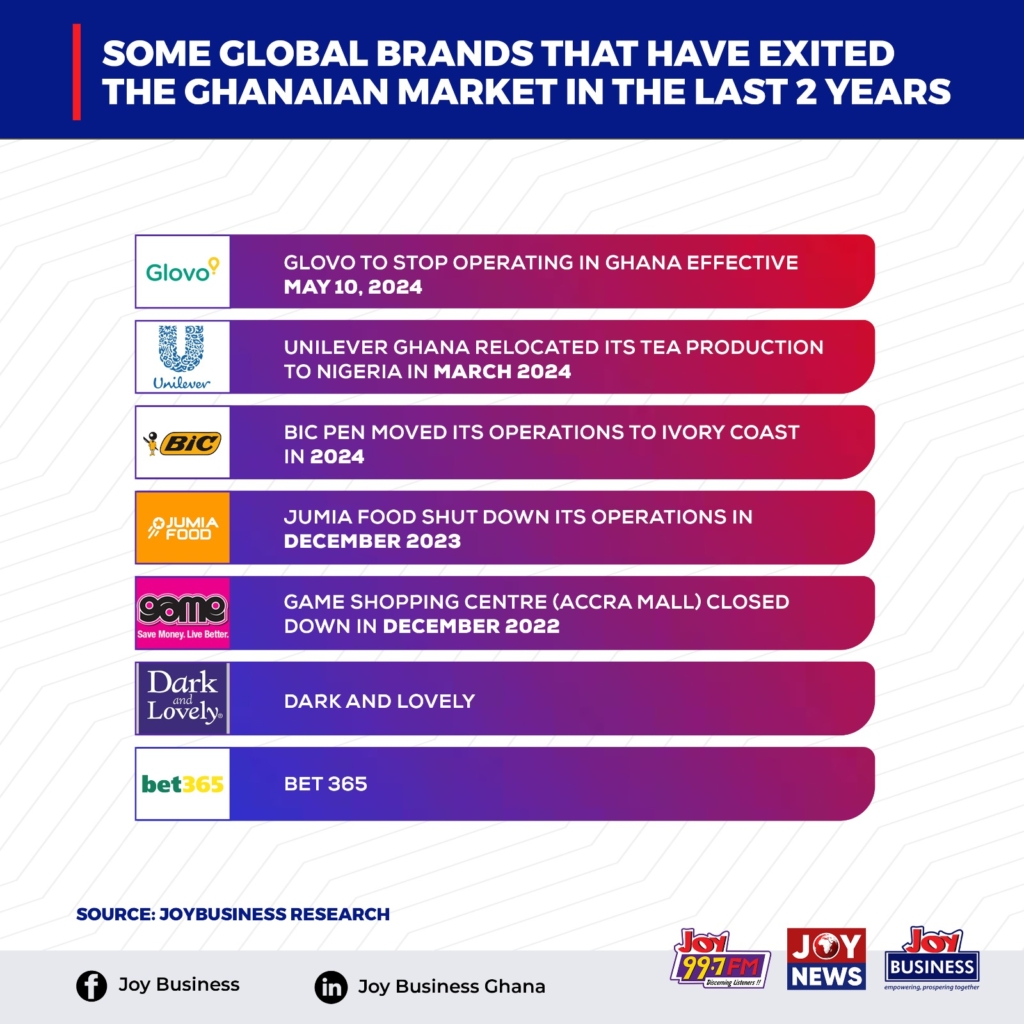
More businesses are working on moving out of Ghana and also cut down on their workforce as part of measures to deal with the challenging economic environment, the General Secretary of the Food and Beverages Association, Samuel Aggrey has said.
He made the revelation on PM Express Business Edition with host George Wiafe on May 2, 2024.
“It has been a very difficult decision for most of these businesses, and if government does not take steps to deal with their concerns, they will not be left with any option than to relocate”, he warned.
He added that companies that have already left, took the decision, after several engagements with government and other agencies, which however, did not yield the desired outcomes.
Mr. Aggrey pointed out for example that, the cedi’s perennial depreciation has also not been helpful, a major contributory factor to the businesses exiting.
He disclosed that government has not done enough to support firms that are operating in the country from the negative impact of cheap imports.
“The situation is getting very bad, most of these firms have to comprehend , with unreliable utility supply”, he said.
Impact on economy and recommendations
Speaking on the same programme, Senior Economist at the Institute of Statistics Social and Economic Research (ISSER) Prof. Robert Darko Osei noted that that businesses will only go where profit is guaranteed.

“We should understand that for most of these businesses, it’s all about the profit and if the situation is not good for them in a country they operate, then they have to take some action”.
“We should also understand that most of these moves have been influenced by the economic environment and how it is impacting on their operations”, he added.
Prof. Osei expressed his displeasure about the number of taxes imposed on businesses.
“As a country we should realize that we cannot tax ourselves out of the current economic situation”, he said.
Expressing some optimism, Prof. Osei said if government could stick to the International Monetary Fund programme, then the much talked about stability could be achieved soon to improve the situation for businesses.
He pointed out that that the cost of doing business in the country is quite high compared to other countries in the region.
“If we want to keep these businesses, then we need to look at the tax system going forward”, he advised.
Prof. Osei noted that working hard to stabilize the economy and improving the fiscal situation will help deal with the challenge.
“Policy Prioritization is also very important in these times, to send some signals to these companies that government is committed to dealing with their issues” he said.
Latest Stories
-
Companies that delay AI adoption risk losing market opportunities – ALX Enterprise
7 minutes -
‘The future is bright’ – Gyan backs Black Princesses squad after U-20 World Cup exit
13 minutes -
We should treat AI has an opportunity rather than a threat – ALX Enterprise
21 minutes -
Malta and Ghana set sights on practical AI partnership
24 minutes -
2026 U-20 WWC: ‘Not all wishes come true’ – Gyan inspires Black Princesses after elimination
29 minutes -
‘I am not a magician’ – Zdravko Logarušić on Nations FC exit from Africa
43 minutes -
Three nights. 28 titles. Ultimate history made
53 minutes -
Ghanaian delegates at IYF 2026 could become bridges for stronger Russia ties – John Aggrey
58 minutes -
Nigeria: Over 30 dead, 50 hospitalised after consuming alcoholic substance in Ondo State
60 minutes -
UK lawmakers demand new law to address AI threat to human rights
1 hour -
WAFU B U-17 Girls Cup: Black Maidens depart Accra for tournament in Yamoussokro
1 hour -
Sweden’s center-left bloc narrowly ahead as election remains too close to call
1 hour -
GPL 2026/27: ‘We won ugly’ – Kotoko head coach unimpressed after Lions victory
1 hour -
7 out of 10 human trafficking cases in Ghana never reach prosecution — JoyNews Research
2 hours -
Music, football to converge at Music Meets Football Summit 2026 in Lusaka
2 hours