

Audio By Carbonatix
The Kwame Nkrumah University of Science and Technology (KNUST) is spearheading a public health surveillance system powered by Artificial Intelligence (AI) for early detection of potential disease outbreaks in Ghana.
The Principal Investigator of the project, Dr. Kingsley Badu from the Department of Biological Sciences, observes lack of a robust surveillance system makes unknown infections thrive in vulnerable populations until a pandemic looms, thereby overwhelming Ghana's health system.
"A risk-targeted early detection surveillance system supported by Responsible AI, edge computing and climate-driven predictive models, will identify novel circulating viruses in insect vectors, humans and animals before diseases become apparent on a scale that becomes difficult to contain," he said.
He added: “The project will use the surveillance system set up by the NMEP for malaria but this time the same system with our collaboration will detect all vector-borne diseases.”
Vector-borne diseases are human illnesses caused by parasites, viruses and bacteria that are transmitted by vectors. Vectors are mostly bloodsucking insects, which take up disease-causing germs during a blood meal from an infected host (human or animal) and later transmit it to a new host after they have multiplied.
According to the WHO, vector-borne diseases account for more than 17% of all infectious diseases, causing more than 700 000 deaths annually from diseases such as malaria, dengue, schistosomiasis, human African trypanosomiasis, leishmaniasis, Chagas disease, yellow fever, Japanese encephalitis and onchocerciasis.
At an inception and stakeholder engagement workshop in Kumasi, the Director of Public Health at The Ghana Health Service and project team member, Dr Franklin Asiedu-Berkoe was worried these diseases are highest in poor tropical and subtropical areas, like Ghana.
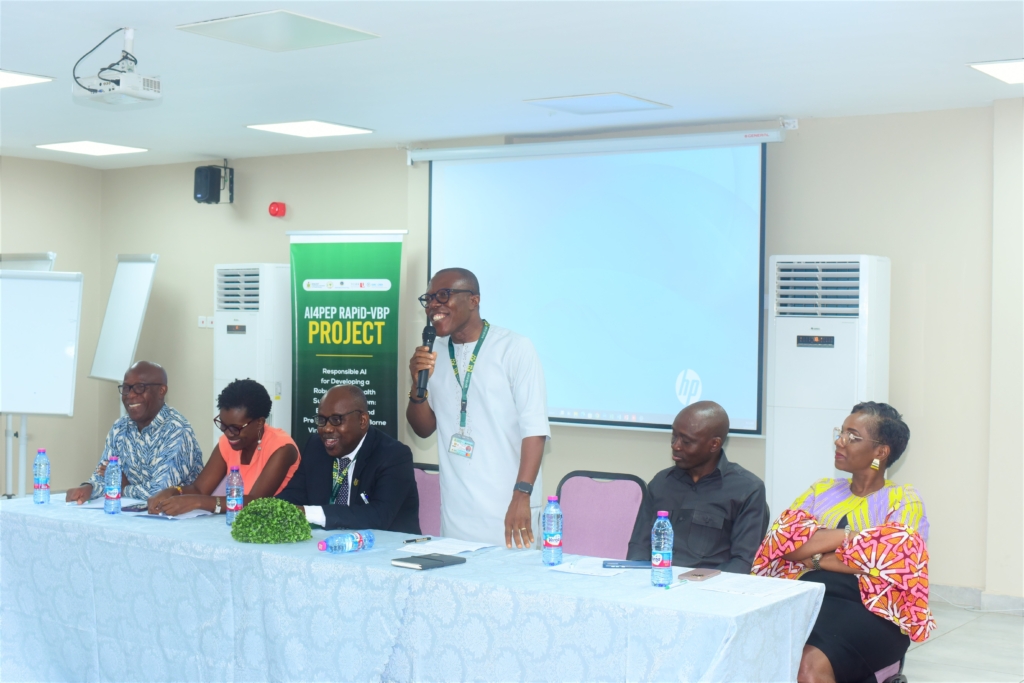
He expressed his outfit focus on early detection in controlling pandemics.
“No matter the type of pandemic, it can be controlled even with limited resources. So this project that is based on early detection of pathogens is dear to the heart of the public health division,” he said.
The project dubbed: Responsible AI for Developing a Robust Public Health Surveillance System: Early Detection and Prediction of Vector-borne Viral Zoonotic Pathogens (AI4PEP RAPiD-VBP) seeks to improve the capacity of public health systems to detect, prepare and respond effectively to threats.
The programme manager of the National Malaria Elimination, Dr Keziah Malm also promised to work closely with the team to achieve project objectives
Pro vice-chancellor of KNUST, Prof. Ellis Owusu-Dabo pointed out the ideals of the projects are in sync with the university’s mission towards societal development.
“The four pillars of this project, that is, early detection, early warning system, early response and passive development align perfectly with our mission and vision as a university, particularly in problem-driven solutions,” he said.
This project is in collaboration with Mahidol University, Thailand and supported by the IDRC of Canada and the University of York in Canada.
Latest Stories
-
‘My Police, Your Police, Our Police’: the Aboso fire and a lesson in Policing together
20 minutes -
Parliament backs OSP probe into alleged GH¢70k payment to Patricia Appiagyei
41 minutes -
Photos: Joy FM Back-to-School Fair buzzes with excitement, strong patronage on Day 2
50 minutes -
Dissolving inactive SOE boards is justified – Dennis Miracles Aboagye
1 hour -
John Boadu: I am not contesting for president; I am contesting to make Bawumia President
1 hour -
Zoomlion begins post-flood disinfection exercise in West Gonja to curb health risks
2 hours -
When Lady Justice Counted Eight Years
2 hours -
SIGA reporting should distinguish commercial performance from public service – Yaw Appiah Lartey
2 hours -
SOEs must hold AGMs, not just submit audited accounts – Deloitte Partner
2 hours -
There are errors in SIGA report that affected its conclusions – Miracles Aboagye
2 hours -
Joy FM Back-to-School Fair gains momentum as Day 2 gets underway
2 hours -
Bright Simons fires back, rejects claims he used AI to critique SIGA report
2 hours -
SIGA did not conjure or manufacture figures – Prof Kpessa-Whyte
3 hours -
Government just put a spin on SIGA report – Miracles Aboagye
3 hours -
Gideon Boako: Cocoa farmers deserve better support
3 hours