

Audio By Carbonatix
Scientists have for the first time discovered a cave on the Moon.
At least 100m deep, it could be an ideal place for humans to build a permanent base, they say.
It is just one in probably hundreds of caves hidden in an “underground, undiscovered world”, according to the researchers.
Countries are racing to establish a permanent human presence on the Moon, but they will need to protect astronauts from radiation, extreme temperatures, and space weather.
Helen Sharman, the first British astronaut to travel to space, told BBC News that the newly-discovered cave looked like a good place for a base, and suggested humans could potentially be living in lunar pits in 20-30 years.
But, she said, this cave is so deep that astronauts might need to abseil in and use “jet packs or a lift” to get out.
Lorenzo Bruzzone and Leonardo Carrer at the University of Trento in Italy found the cave by using radar to penetrate the opening of a pit on a rocky plain called the Mare Tranquillitatis.
It is visible to the naked eye from Earth, and is also where Apollo 11 landed in 1969.
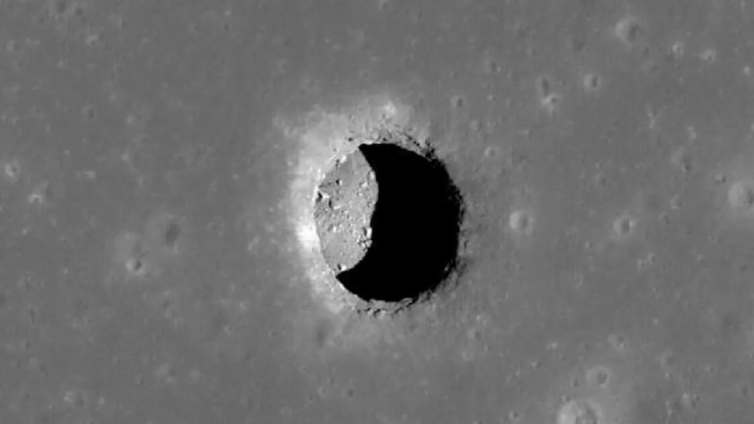
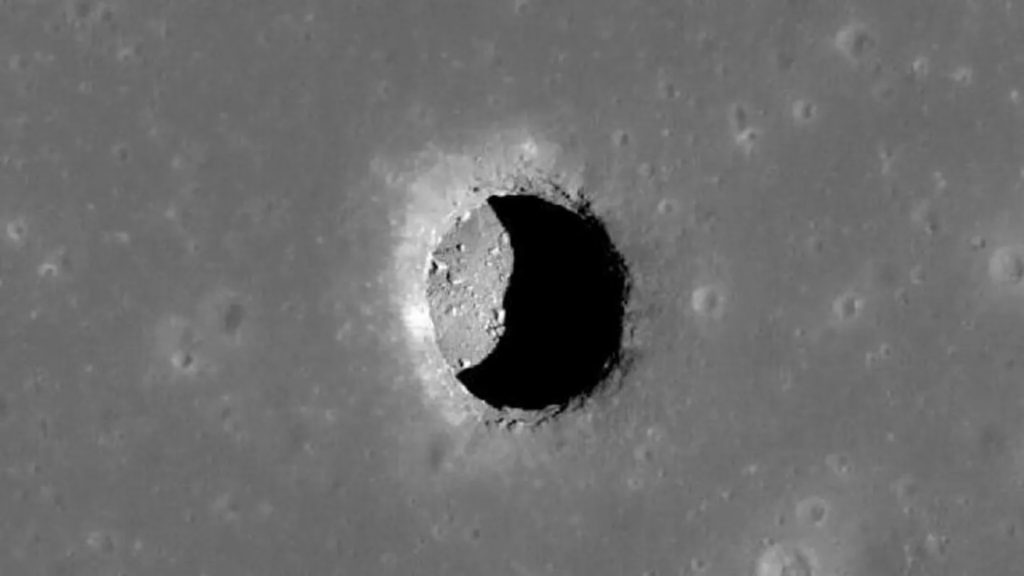
The cave has a skylight on the Moon’s surface, leading down to vertical and overhanging walls, and a sloping floor that might extend further underground.
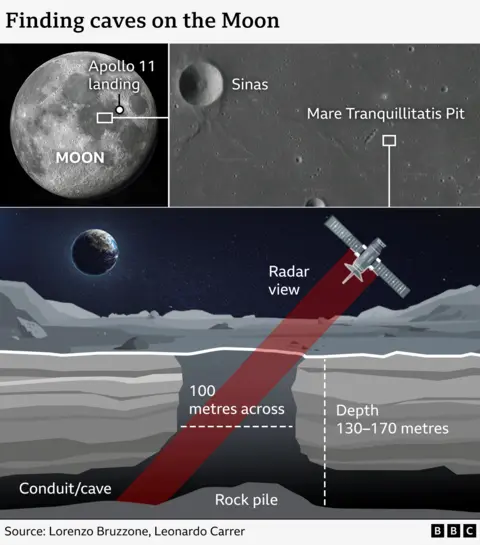
It was made millions or billions of years ago when lava flowed on the Moon, creating a tunnel through the rock.
The closest equivalent on Earth would be the volcanic caves in Lanzarote, Spain, Prof Carrer explains, adding that the researchers visited those caves as part of their work.
“It’s really exciting. When you make these discoveries and you look at these images, you realise you’re the first person in the history of humanity to see it,” Prof Carrer said.
Once Prof Bruzzone and Prof Carrer understood how big the cave was, they realised it could be a good spot for a lunar base.
“After all, life on Earth began in caves, so it makes sense that humans could live inside them on the Moon,” says Prof Carrer.
The cave has yet to be fully explored, but the researchers hope that ground-penetrating radar, cameras or even robots could be used to map it.
Scientists first realised there were probably caves on the Moon around 50 years ago. Then in 2010 a camera on a mission called the Lunar Reconnaissance Orbiter took pictures of pits that scientists thought could be cave entrances.
But researchers did not know how deep the caves might be, or if they would have collapsed.
Prof Bruzzone and Prof Carrer’s work has now answered that question, although there is much more to be done to understand the full scale of the cave.
“We have very good images of the surface - up to 25cm of resolution - we can see the Apollo landing sites - but we know nothing about what lies below the surface. There are huge opportunities for discovery,” Francesco Sauro, Coordinator of the Topical Team Planetary Caves of the European Space Agency, told BBC News.
The research may also help us explore caves on Mars in the future, he says.
That could open the door to finding evidence of life on Mars, because if it did exist, it would almost certainly have been inside caves protected from the elements on the planet’s surface.
The Moon cave might be useful to humans, but the scientists also stress that it could help answer fundamental questions about the history of the Moon, and even our solar system.
The rocks inside the cave will not be as damaged or eroded by space weather, so they can provide an extensive geological record going back billions of years.
The research is published in the scientific journal Nature Astronomy.
Latest Stories
-
Police arrest suspect over jewellery theft during fire outbreak
1 hour -
EOCO returns Hanan’s £6,700, GH¢2,750 and devices after defence challenge
1 hour -
Opplift Youth Entrepreneurs Summit 2026 equips entrepreneurs with skills, mentorship and support
2 hours -
Rival clubs want range of punishments for Man City
2 hours -
Tear gas in Paris and Marseille as school protests grow across France
2 hours -
Kane inspires England to win over Czech Republic in UEFA Nations League
2 hours -
Finland orders halt to work on two Google data centres
2 hours -
Substitute Merino scores twice as Spain win in Croatia
2 hours -
Ronaldo wants Portugal ‘punishment’ but not retiring
3 hours -
White House defends Trump comment to let Iran ‘take out’ LA and San Diego
3 hours -
Asos confirms hackers sent ‘unauthorised’ notification to app users
3 hours -
US televangelist Jim Bakker, disgraced from sex scandal and fraud, dies at 86
3 hours -
Congolese-born golfer to represent Ghana at Turkish Airlines World Cup grand final
3 hours -
Amazon wins global rights to stream Emmys in six-year deal
3 hours -
European Film Festival returns to Ghana after a 5-year break
3 hours