

Audio By Carbonatix
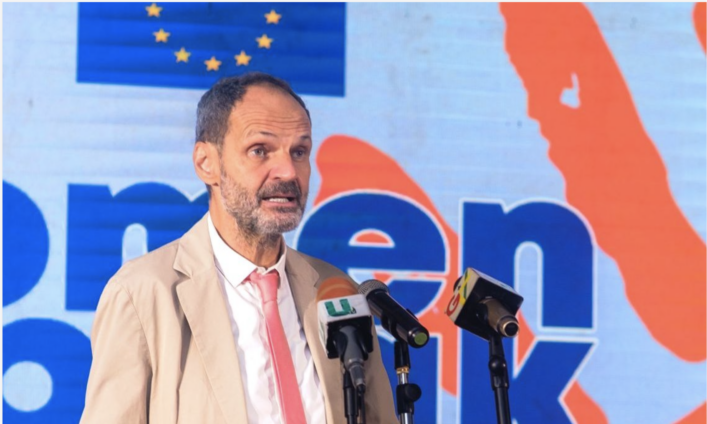
Massimo Mina, Head of Cooperation, European Union Delegation to Ghana, has said gender equality is not only a fundamental human right but also essential for achieving sustainable development and prosperity.
He said, “We are proud of the partnerships that we have built and remain committed to continuing investing in this vital work in the years ahead.”
Mr Mina was speaking at the “Women Speak” event and the commemoration of this year’s 16 Days of Activism Against Gender-Based Violence on the theme: “Beyond Beijing+30: Addressing Gender-Based Violence and Promoting Women’s Rights.”
The 16 Days Activism Campaign serves as a global platform to raise awareness, inspire action, and renew collective commitment to ending violence against women and girls.
He said nearly 30 years ago, the Beijing Declaration and Platform for Action established a comprehensive framework for advancing gender equality and empowering women.
He said since its adoption, progress had been made, but gender-based violence remained a significant obstacle to achieving gender equality.
“I am pleased that, finally, this country passed the Affirmative Action Bill, and the legislation marks a significant milestone in Ghana’s journey towards achieving gender equality and promoting women’s empowerment,” he said.
He said the European Union had been a long-standing partner to Ghana, and “we are proud to have supported the development of this bill.”
Mr. Mina said, “We examine the complexities of gender-based violence; let’s remember that each one of us has a role to play in creating a world free from fear and discrimination.”
The Head of Cooperation said with the Gender Action Plan III, the European Union had made a commitment that, by 2027, at least 85 per cent of all new external actions would have “gender equality and women’s and girls’ empowerment” as a significant or principal objective.
He said the delegation had long been committed to promoting this goal through a wide range of initiatives, with their work spanning across many sectors, including education, economic empowerment, social protection, and governance, always with a focus on improving the lives of women and girls.
He said the EU had also funded projects specifically designed to address and combat gender-based violence.
He said an example was the just-ended ENOUGH! Project, with an EU contribution of EUR 5 million, implemented by Oxfam in Ghana, Liberia, and Mali, with its project management unit based in Ghana.
Among the project’s achievements are the strengthening of multi-stakeholder collaboration and engaging men and boys to change social norms on sexual and gender-based violence.
Mr. Mina said another example was a EUR 400,000 project, the Women in Fisheries against Violence (WIFVES).
The project supports gender equality by advocating against gender-based discrimination and building the capacities of fishermen to prevent and respond to gender-based violence in fishing communities in Central and Western regions.
Madam Sheila Minkah-Premo, Senior Managing Partner at Apex Lawconsult, said to ensure that more women were present in decision-making positions, it would require the setting up of the Gender Equity Committee.
She said the Gender Equity Committee would be responsible for coordination as well as the preparation of a legislative instrument or regulations concerning women.
Currently in Ghana, the alternative action gender equity act has been passed as a law to enforce equity and gender involvement of women in the public and private sectors.
She said this must be implemented across all levels in strengthening the legal system, providing accessible legal services, fortifying police response, as well as ensuring that justice systems support survivors rather than re-victimising them.
She said additionally, survivors must have access to health care, mental health services, and societal and social support.
She said the Platform for Action calls for strengthening judicial and legal mechanisms to facilitate access to justice for victims of violence and providing comprehensive support services for survivors, including shelters, legal aid, health care, and psychosocial support.
She called for preventive measures through public education, community engagement, and awareness-raising campaigns to ensure that the world is prepared to celebrate Beijing Plus 30 in 2025.
Madam Minkah-Premo said it was important to reflect on what had been achieved and plan how to address gender-based violence effectively while also promoting women’s rights since women were the ones who suffered the most.
Latest Stories
-
GRIDCo restores power nationwide after August 20 blackout, says grid strengthening measures ongoing
6 minutes -
Journalism must prioritise public interest over attention — Kwesi Pratt
43 minutes -
Ghana Mineworkers Union demand suspension of contract mining directive, threaten industrial action
1 hour -
ADB Ghana Medicals constructing and equipping new Cardiothoracic Centre at Komfo Anokye
1 hour -
AFREIKH Summer School challenges Africa to harness critical minerals
1 hour -
Government plans 2,000-acre pharmaceutical innovation park in Osudoku to boost local drug production
1 hour -
Partey undergoes medical ahead of Al Shabab move in Saudi Arabia
1 hour -
Today’s front pages: Friday, August 21, 2026
2 hours -
Power outages could drive up cost of digital services — NITA
2 hours -
Patients face basic sanitation gaps in West African health facilities — WHO / UNICEF
2 hours -
Competence has no age; let’s stop punishing new businesses
2 hours -
JoyNews Republic Bank Habitat Fair 2026 opens today at Achimota Mall
2 hours -
What Is Wrong With Us: The roads that keep counting our dead
2 hours -
MTN condemns recent xenophobic attacks on Ghanaians in South Africa
2 hours -
Philip Nai: What happens at your front desk can make or break your brand
3 hours