


Audio By Carbonatix
The Ministry of Foreign Affairs of Ghana has issued a comprehensive advisory informing the public of the phased implementation of a new European border management system that will significantly alter how travellers enter and exit participating countries.
According to a statement issued on Thursday, April 9, the system, known as the Entry/Exit System (EES), has been introduced under Regulation (EC) No. 2017/2226, adopted by the European Parliament and the Council of the European Union.
It is being deployed across the Schengen Area, which comprises 27 European countries that have abolished internal border controls.
According to the Ministry, the EES officially began its roll-out on October 12, 2025, and is expected to be fully operational by April 10, 2026.
"The EES, rolled out on 12th October, 2025, was introduced to register the entry and exit data of third-country nationals (non-EU nationals) crossing the external borders of Member States. This means the data collection system will be gradually introduced at border crossings, with full implementation expected by 10th April, 2026."
The system is designed to digitally register the entry and exit of third-country nationals—travellers from outside the European Union, including Ghanaians—when crossing the external borders of Schengen member states.
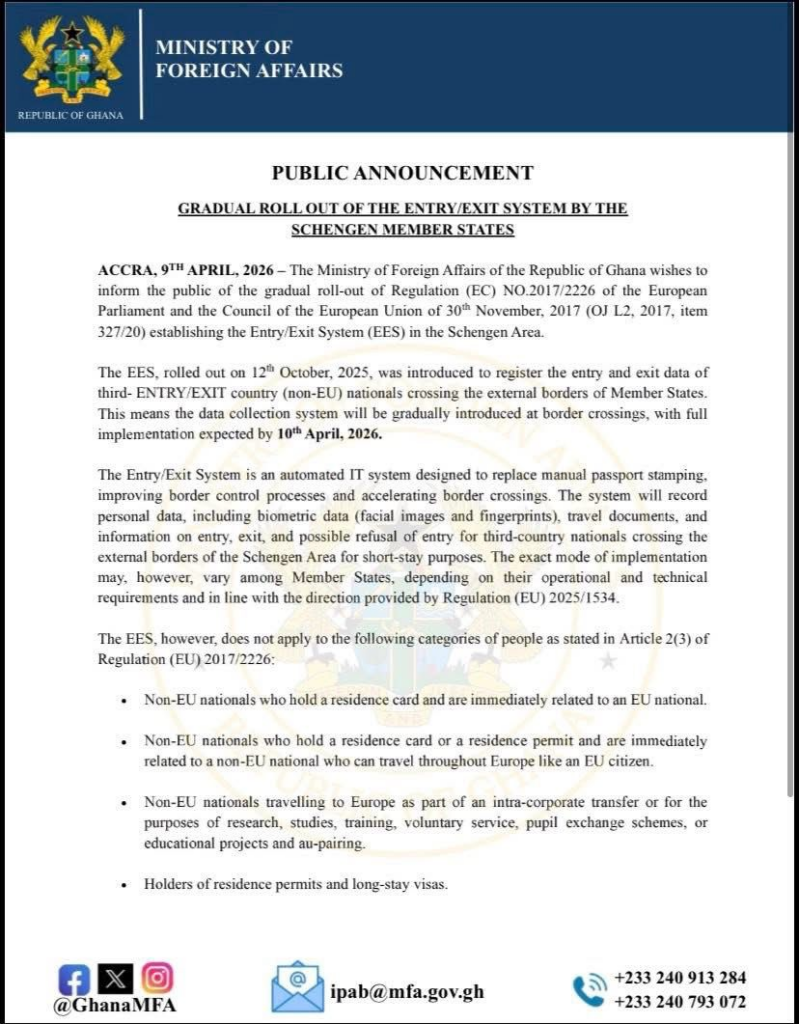
Replacing the long-standing practice of manual passport stamping, the automated system will collect and store a range of traveller information.
This includes personal details, biometric identifiers such as facial images and fingerprints, travel document data, and records of entry, exit, or refusal of entry.
Authorities say the move is intended to improve border efficiency, enhance security, and streamline passenger processing.
However, officials caution that the exact implementation may differ from one country to another, depending on each state’s technical readiness and operational requirements, in line with updated EU regulations.
Categories Exempt from the System
The Ministry also outlined specific categories of individuals who will not be subject to the EES requirements. These include:
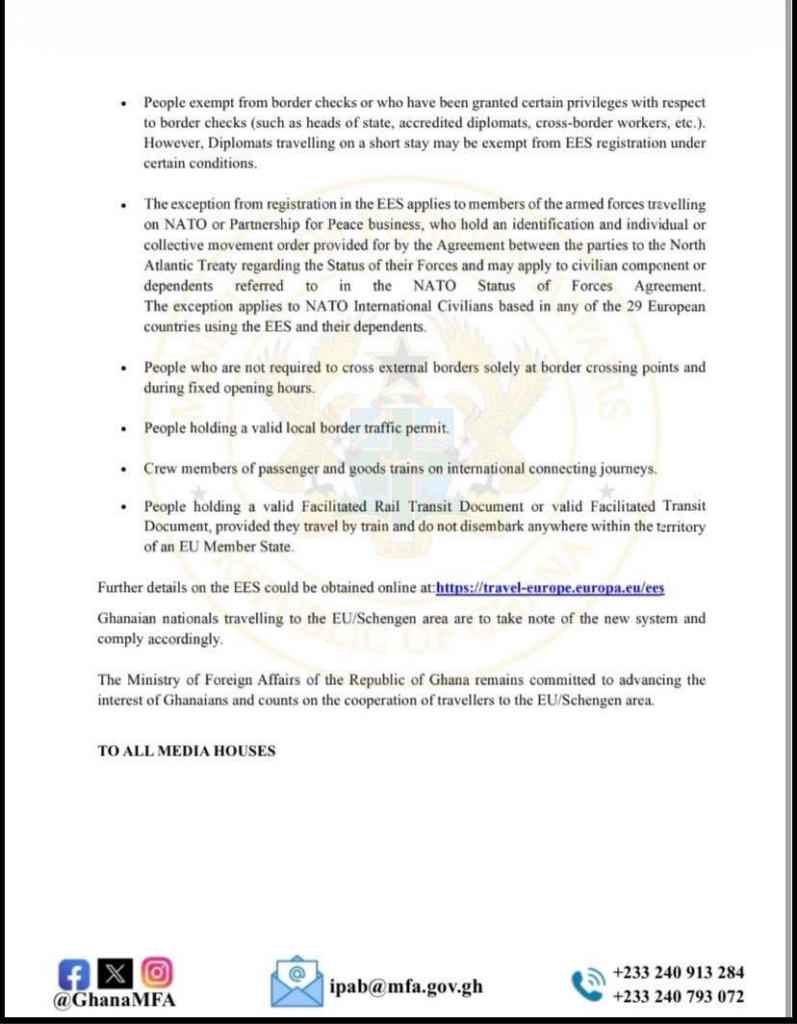
- Non-EU nationals holding residence cards who are immediate family members of EU citizens.
- Individuals with residence permits or cards linked to non-EU nationals who enjoy EU-wide travel rights.
- Travellers entering Europe for intra-corporate transfers or for purposes such as education, research, training, voluntary service, exchange programmes, or au-pair placements.
- Holders of long-stay visas or valid residence permits.
- Persons granted special privileges, including heads of state, accredited diplomats, and certain cross-border workers.
- Members of armed forces travelling under NATO or Partnership for Peace arrangements, along with eligible dependants.
- Individuals permitted to cross borders outside standard checkpoints or hours.
- Holders of local border traffic permits.
- Railway crew members on international routes.
- Travellers using Facilitated Rail Transit Documents who remain in transit within EU territory.
Advice to Ghanaian Travellers
The Ministry has urged Ghanaian nationals planning travel to Europe to familiarise themselves with the new system and ensure full compliance once it becomes operational.
Travellers are encouraged to stay informed through official European Union channels for further details.
Reaffirming its commitment to citizen welfare, the Ministry emphasised that it remains dedicated to protecting the interests of Ghanaians abroad.
It also called for cooperation from travellers to ensure a smooth transition as the new border control regime comes into force.
"The Ministry of Foreign Affairs of the Republic of Ghana remains committed to advancing the interests of Ghanaians and counts on the cooperation of travellers to the EU/Schengen area," the statement concluded.
Latest Stories
-
Kodua dismisses rift fears, says he and John Boadu are focused on NPP victory
1 hour -
Why Canada is preparing for a (long shot) US invasion
2 hours -
Dangote’s planned Kenya refinery faces legal challenge by consumer-rights group
2 hours -
Hawa Koomson stands by pepper spray plan, vows to bring rival on board
2 hours -
‘There is no competition’ – Justin Kodua confident of NPP General Secretary re-election
3 hours -
J100 Accra Doubles Champions : Kolesolva/ Ndukwa, Agarwal/Patel seal title victories
3 hours -
Sydney Wright crowned J100 Accra Champion
3 hours -
J100 Accra Boys’ Singles: Verma denies Beckles back-to-back titles to claim crown
3 hours -
Two friends fined GH¢12,000 for stealing
3 hours -
Son jailed for threatening to stab mother
3 hours -
Drive constitutional reform – GJA urges journalists
4 hours -
NPP Delagates Congress: Confusion delays voting at Ashanti Region TESCON centre
5 hours -
Fire ravages shops, houses near Koforidua Central Police Station
5 hours -
NPP Delegates conference: The wisdom of the masses will prevail – Napo
5 hours -
Flydubai co-pilot attacked captain with axe, UAE official says
5 hours