

Audio By Carbonatix
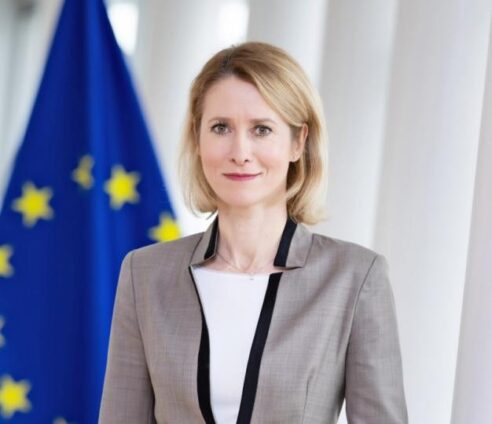
EU foreign policy Chief Kaja Kallas has arrived in Ghana for a landmark visit that signals a new chapter in relations with the European Union.
In the face of growing security pressures and shifting geopolitical dynamics, her first visit comes at a pivotal moment, both for Ghana and for Europe.
A Historic Milestone in EU–Ghana Relations
Ghana’s Vice-President, H.E. Jane Naana Opoku-Agyemang, will receive Ms Kallas as Acting President and sign a groundbreaking EU–Ghana Security and Defence Partnership, the first agreement of its kind between the European Union and an African country.
More than a symbolic step, the agreement reflects a strategic alignment in response to evolving security challenges, while reaffirming the EU’s commitment to Ghana as a trusted and reliable partner.
In a region marked by instability, Ghana has been a key voice for dialogue and cooperation across West Africa, one that the European Union sees as essential to building lasting regional peace.
The agreement spans a wide range of priorities: from counter-terrorism and crisis response to maritime security, cyber threats, and the fight against disinformation. Importantly, it reflects a broader understanding of security. Beyond military cooperation, the agreement places strong emphasis on conflict prevention, and mediation.
Walking the Talk
The visit is, however, not only about signing agreements—it is also about delivering tangible support.
High Representative Kallas and Ghana’s Vice-President will oversee the handover of a new tranche of non-lethal military equipment to the Ghana Armed Forces. The package includes drones, counter-UAV systems, motorbikes, and other specialised tools designed to strengthen Ghana’s response to emerging threats. The goal is to help keep the citizens of Ghana safe.
This latest delivery builds on substantial EU backing. Since 2023, €50M worth of equipment has been provided, with the total EU support for peace and security in Ghana exceeding €100 million. Further assistance is already planned for 2026, with a focus on strengthening capabilities on land, at sea, and in the air.
A Shared Commitment to Stability
The timing of the visit reflects a shared concern: stability can no longer be taken for granted. The spread of terrorism across the Sahel is increasingly casting a shadow over coastal states, including Ghana. Against this backdrop, cooperation between Accra and Brussels has taken on renewed urgency.
Security, both sides agree, does not stop at national borders. The partnership adopts an integrated approach—combining community engagement and mediation with tangible security support on the ground.
The EU and Ghana are keen to underline what the partnership is not: it does NOT involve the deployment of European troops or the establishment of military bases in Ghana. Respect for national sovereignty remains a core principle.
For both Ghana and the EU, the stakes are clear. A stable West Africa underpins democratic governance, supports international trade and economic growth, and helps address global challenges such as irregular migration.
Looking ahead, both sides expect to deepen cooperation not only in security, but also in multilateral settings such as the United Nations, as well as in training and education.
Broadening a Strategic Partnership
Security may dominate the agenda, but it is only one pillar of a much broader relationship. The EU remains Ghana’s largest export market, its biggest investor, and lead development partner. From infrastructure and education to job creation and sustainable growth, EU support plays a central role in Ghana’s trajectory.
At its core, the long standing partnership is built on mutual respect and shared interests—an approach both sides describe as one of equals.
In an increasingly uncertain world, Ghana and the EU align around a common vision: support for a rules-based international order, and a commitment to cooperation over confrontation.
High-Level Engagements
During her stay, High Representative Kallas will hold talks with Vice-President Jane Naana Opoku-Agyemang and key figures from Ghana’s security architecture, including representatives from the Ministry of the Interior, Ministry of Defence, and National Security.
A Reliable Partnership for the Future
As Ghana navigates an increasingly complex regional landscape, one message is set to resonate from the visit: Ghana can count on Europe as a credible and dependable partner.
Latest Stories
-
Manhyia South MP charged with conspiracy, financial loss and money laundering
2 minutes -
Attorney-General charges Manhyia South MP over alleged GH¢9.85m financial loss
5 minutes -
Food Security: Buffer Stock CEO calls for more investment in Agri-Tech
5 minutes -
Three missing children found dead in parked vehicle in Tamale
15 minutes -
Nana Akomea denies reports linking his absence from NPP executives’ introduction to Kojo Bamba
16 minutes -
2026 U-17 WWC: Black Maidens arrive in Morocco for tournament
18 minutes -
GSA suspends pre-shipment inspection of imported used vehicles
25 minutes -
Elevate Africa confirms presidents, vice presidents and ministers for 2026 Annual Convening in Accra
49 minutes -
Keta MP commissions 60-seater kindergarten facility to replace unsafe structure
54 minutes -
Salomey Awiti-Baffoe’s lawyers welcome GH¢100,000 bail after earlier rejection
55 minutes -
Domestic tourism and its impact on the local economy
1 hour -
Top-Up Pharmacy wins Community Pharmacy Chain of the Year at 2026 PSGH Pharma Excellence Awards
1 hour -
Nigeria military aircraft with 32 on board crashes
1 hour -
Black Stars need a coach who can inspire players to perform – Ignatius Osei Fosu
1 hour -
Revenue collector crushed to death on Kasoa-Winneba highway
1 hour