

Audio By Carbonatix
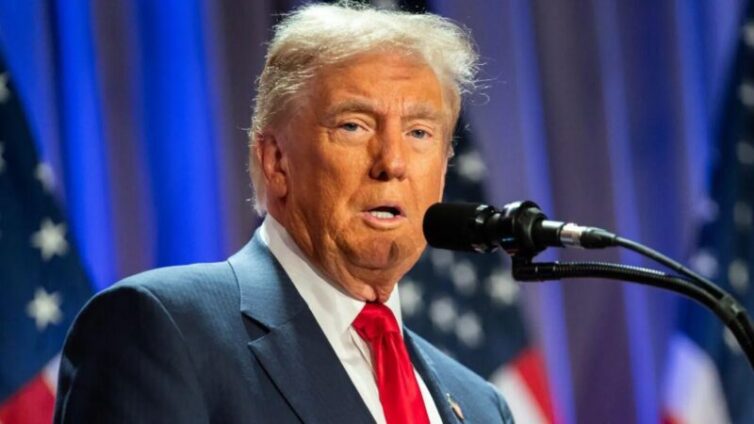
US President-elect Donald Trump has threatened to impose 100% tariffs on a bloc of nine nations if they were to create a rival currency to the US dollar.
"The idea that the BRICS Countries are trying to move away from the Dollar while we stand by and watch is OVER," Trump wrote on social media on Saturday.
Major world powers China and Russia is part of the Brics alliance, along with Brazil, India, South Africa, Iran, Egypt, Ethiopia and the United Arab Emirates.
During the US election, Trump campaigned on implementing widespread tariffs. He has escalated threats of steep levies in recent days.
This latest message from Trump, who will take office next year on 20 January, was aimed at the Brics, a bloc of mostly emerging economies.
Leading politicians in Brazil and Russia have suggested creating a Brics currency to reduce the US dollar's dominance in global trade. But internal disagreement has slowed any progress.
“We require a commitment from these countries that they will neither create a new Brics currency nor back any other currency to replace the mighty US dollar or they will face 100% tariffs and should expect to say goodbye to selling into the wonderful US economy,” Trump wrote on his social media platform Truth Social.
"They can go find another sucker," he said.
But some Trump allies have suggested his recent announcements have been negotiation tactics, meant as more of an opening bid than a promise.
Asked about the president-elect's proposed use of tariffs, Republican Senator Ted Cruz responded by noting the "importance of leverage".
"You look at the threat of tariffs against Mexico and Canada, immediately has produced action," the Texan said on CBS News' Face the Nation on Sunday.
On Friday, Canadian Prime Minister Justin Trudeau made an unscheduled trip to Trump's Florida estate Mar-a-Lago, seemingly to head off a potential 25% tariff on Canadian goods heading south.
Trump's pick for Treasury Secretary, Scott Bessent, has previously suggested that the president-elect's threats to impose major tariff hikes were part of his negotiating strategy.
“My general view is that at the end of the day, he's a free trader," Bessent said of Trump in an interview with the Financial Times before he was nominated for the role.
“It’s escalate to de-escalate.”
How do tariffs work?
A tariff is a domestic tax levied on goods as they enter the country, proportional to the value of the import. So a car imported to the US with a value of $50,000 subject to a 25% tariff, would face a $12,500 charge.
Tariffs are a central part of Trump's economic vision - he sees them as a way of growing the US economy, protecting jobs and raising tax revenue.
He has previously claimed that these taxes are "not going to be a cost to you, it’s a cost to another country".
This is almost universally regarded by economists as misleading.
The charge is physically paid by the domestic company that imports the goods, not the foreign company that exports them.
So, in that sense, it is a straightforward tax paid by domestic US firms to the US government.
Trump imposed a number of tariffs in his first term of office, many of which have been kept in place by his successor, President Joe Biden. Economic studies suggest most of the economic burden was ultimately borne by US consumers.
Latest Stories
-
He entered at eight. He is now 16: Ghana’s children growing up in prayer camps
4 hours -
‘Development must not always begin from Accra’ — Anwelle Foundation launched in Jirapa
4 hours -
PKO trio eye victories at Odwira Festival
6 hours -
346 Ghana Navy recruits pass out after 26 weeks of intensive training
6 hours -
Newsfile to discuss EOCO-MP arrest, drug trafficking, speech arrests and $235m water debt
7 hours -
JoyNews gets results as listeners raise GH¢40,000 to help 17-year-old student with cerebral palsy attend SHS
7 hours -
Vice President calls for stronger local pharmaceutical production to reduce medicine imports
8 hours -
The brewing tension at KNUST; Beware the Ides of October….
8 hours -
Health Ministry moves to integrate traditional medicine into mainstream healthcare
8 hours -
550 pupils in Kintampo South get educational lifeline as ‘Seeds of Hope’ reaches farming communities
9 hours -
Opoku Mensah urges Christian Council, House of Chiefs to speak up on democratic freedoms
9 hours -
Teacher unions’ strike: Minority demands immediate payment of teacher arrears, 20% deprived area allowance
9 hours -
The Accra-Kumasi Expressway: Building it right
9 hours -
Beyond gold exports: Building value and economic resilience from Ghana’s gold
9 hours -
2027 AFCONQ: Ghana under pressure as Gambia beat Somalia 2-1
10 hours