

Audio By Carbonatix
Stakeholders at the Greater Accra and Eastern Regional zonal sessions of the National Education Forum (NEF) have recommended other sources of funding education other than the over-reliance on the government.
They said the current model of public education funding, especially at the pre-tertiary level was unsustainable, compromised quality and further made it difficult for the government to equitably allocate its already stretched resources to other equally critical sectors.
The stakeholders were of the view that the government’s funding for education should be channelled exclusively into tuition, payment of salaries and infrastructure development while parents pay for school uniforms, feeding, examination fees and other necessities.
“Government cannot and should not fund all aspects of education,” the stakeholders said.
They included educationists, financial experts, civil society organisations (CSO), parents and policymakers, who make up the Education Financing Group of the NEF.
Presenting the recommendations at the session held at the University of Professional Studies, Accra (UPSA) last Friday, a member of the group, Edem Asase, an official from the Ministry of Finance, said education financing required a framework that ensured sustainability, accountability and inclusiveness.
To strengthen the government’s funding, the stakeholders called for the effective utilisation of the Ghana Education Trust Fund (GETFund).
“Funds such as GETFund should be used for the purpose for which they were established. GETFund is for infrastructure development, it should not be used for scholarships or other things not related to infrastructure,” Mr Asase said.
Again, the stakeholders recommended that policies and incentives should be put in place to attract funding from alumni associations, corporate bodies, religious groups and philanthropists.
The stakeholders, he said, observed that support from alumni groups was mainly at the senior high school level and, therefore, there was the need to encourage such associations to also support their alma mater at the basic education level.
However, the stakeholders cautioned the government about implementing lofty promises even as it searches for ways of cutting costs.
Other recommendations made by the stakeholders included the need to promote accountability and transparency in education financing to ensure value for money for the taxpayer.
“We must ensure that the scarce funds for education are properly utilised and accounted for properly. Those who account properly for them should be rewarded and those who do not should be sanctioned,” Mr Asase said.
The stakeholders further stressed the need for the country to wean itself from donor support for education and focus on self-financing with an innovative approach for the country to take control of its educational priorities.
Contributing to the issue of education financing earlier in the session, the Vice Chancellor of the UPSA, Prof. John Kwaku Mensah Mawutor, said funding was a major challenge which required a comprehensive and innovative approach.
In an interview with the Daily Graphic, the Chairperson of the Committee set up to organise the NEF, Prof. George K.T Oduro, said the forum was a crucial exercise meant to solicit ideas from all stakeholders on how best to address the challenges in the educational sector.
“The cross-cutting challenge is finance and no government can single-handedly fund education to ensure access, equity and quality. It therefore becomes necessary to seek collaborative opinions,” he said.
Education forum
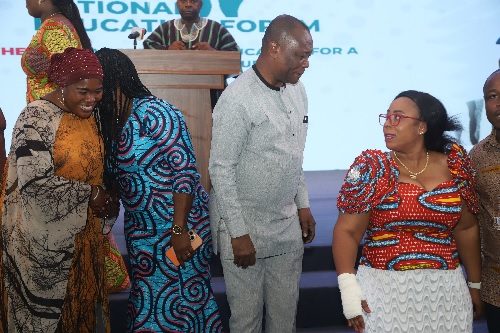
The NEF session in Accra was to allow stakeholders in education to brainstorm and come up with recommendations that would help address the challenges confronting education in the country.
Latest Stories
-
Catholic Bishops demand 20% quota for Catholics in mission schools
47 minutes -
GES releases outstanding 2023 Capitation Grant arrears to basic schools
1 hour -
TikTok used to recruit Ghanaian Girls into sex trade in mining communities – Challenging Heights
1 hour -
Recurrent brouhaha over SHS school placement: Which way out of the quagmire?
1 hour -
Auditor-General must explain missing Local Gov’t, Transport ministries Covid spending – Davis Ansah Opoku
2 hours -
COVID Audit: PAC Vice Chair says ‘no arrests’ yet over missing fumigation spending
2 hours -
Old farming practice is offering new hope for climate action in Zuuku
2 hours -
Auditor-General’s own audit objective raises questions over omission of Local Gov’t spending – Manasseh Awuni
2 hours -
Auditor-General reported GH¢96m, but Local Gov’t spent GH¢299m on fumigation – Manasseh Awuni
3 hours -
GH¢299m COVID fumigation spending audited but left out of report, says Manasseh Awuni
3 hours -
Telecel CEO Obo-Nai champions integrity in leadership
3 hours -
Novartis backs Ghana Medical Trust Fund, eyes partnership to expand specialist care
4 hours -
Oil falls as US crude inventories rise despite Saudi supply concerns
4 hours -
Magazine that was 132 years overdue returned to US library
4 hours -
All support acts on Ed Sheeran’s US tour quit after Macklemore dropped
4 hours