

Audio By Carbonatix
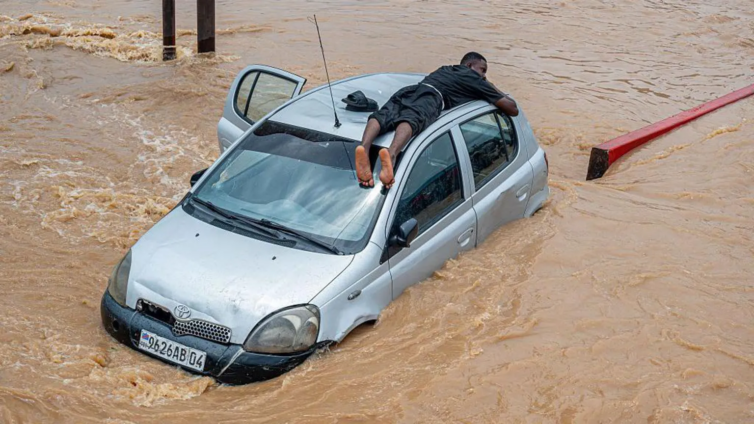
Torrential rains and floods have killed at least 33 people in Kinshasa - the capital of the Democratic Republic of Congo - according to officials.
"The republic will not abandon you," President Félix Tshisekedi promised victims on Monday, saying he had called a government crisis meeting.
Desperate residents are trying to flee the floodwaters by wading, swimming or paddling to safety in homemade canoes.
The city is home to 17 million people and sits on the Congo river, which is one of the biggest in the world and stretches across the country.
Flooding is common - the river recently reached its highest level in six decades.
Parts of the capital are prone to soil erosion and in recent years the Congolese president has warned that the climate crisis is making flooding worse.
Many homes in west Kinshasa were swept away following flooding overnight from Friday into Saturday.
About half of the city's 26 districts are affected in total, according to the capital's mayor, who says search and rescue teams have been sent out.
Worst affected are the city's outskirts as well as some of its poorest neighbourhoods.
"The water has reached 1.5 metres high. We have just managed to save ourselves, the rest is trapped in our homes," Christophe Bola who lives in the Ndanu area told the AFP news agency.
Other local residents have told reporters they are angry with the authorities, accusing them of being too slow to react and not sending enough help.
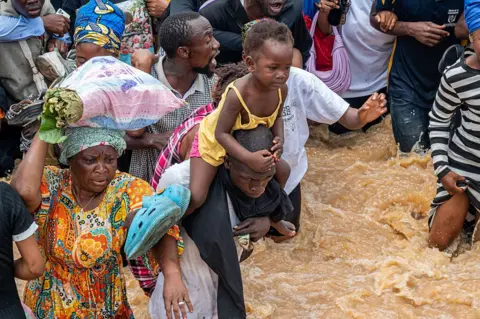
The floods have also left people across much of Kinshasa struggling with water shortages, after water treatment pumps in the city were themselves inundated.
The city's busiest road, which connects the centre with the international airport, is impassable, as is some of the motorway that connects the capital to the country's main port, Matadi.
At least one tributary leading off the Congo river - the N'djili river - has burst its banks, trapping many residents there, said Deputy President Jacquemain Shabani in a statement on Sunday.
It is said to be one of the more polluted rivers which Congolese scientists say contains high levels of fecal matter and other waste.
Sewage maintenance is poor in many areas of Kinshasa, and there is little evidence of town planning.
Last year the government announced plans to tackle this long-standing problem.
Further heavy downpours are expected in Kinshasa in the coming weeks, as well as in the eastern city of Goma, which was seized by rebel forces earlier this year.
The national meteorological agency also warns of heavy rains elsewhere, especially in the north and north-east of the country.
Latest Stories
-
Trump administration to admit primarily Afrikaners under new refugee proposal
60 minutes -
They should have Ghana first – Ntim Fordjour warns MPs against politicising drug crisis
1 hour -
We got more than 15% – Ntim Fordjour confirms support for Parliament recall over cocaine scandal
2 hours -
Wherever there is money laundering, it is linked to terrorism – Ntim Fordjour warns over drug crisis
2 hours -
Parliament Recall: Ntim Fordjour expects emergency sitting over drug-trafficking crisis
2 hours -
Oil falls on increased Gulf supply and hopes for US-Iran talks
2 hours -
South Sudan’s Kiir dissolves government, clears hurdles to delayed election
2 hours -
Ntim Fordjour accuses government of failing to act on Ghana’s drug crisis
4 hours -
Autopsy shows Hayden Panettiere died from a drug overdose
5 hours -
Earl Spencer should pull Diana book from shelves, Piers Morgan says
5 hours -
IMF tells advanced economies to ‘bring debt down’ as borrowing costs rise
5 hours -
‘I have never felt heat like that’ – a survivor on watching 33 cellmates die in Nigeria
5 hours -
16 arrested, 4 printing hubs busted in major counterfeit currency crackdown
5 hours -
Sir Jim Ratcliffe suspends production at key UK plants blaming high gas prices
6 hours -
Major US outlets suspend shared Trump coverage in protest at media ban
6 hours