

Audio By Carbonatix
A multi-stakeholder approach is being proposed in proffering solutions to challenges hindering cocoa production and its trade.
National Project Manager of Green Commodity Programme at UNDP, Mathias Edetor, believes empowering the local community is the first step towards dealing with environmental challenges hindering cocoa production among others.
He said it is the project’s firm belief that “when the grassroots is firm, we can work together to fight issues of unhealthy environmental practices and promote climate-smart cocoa production”.
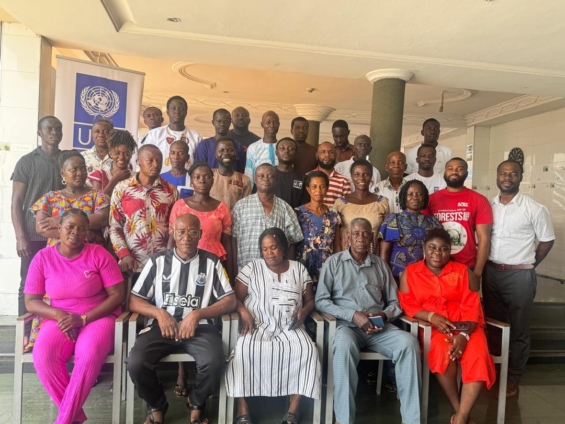
He spoke to JoyNews on the sidelines of a training event for executives within the Hotspot Intervention Areas (HIAs) under the Ghana Cocoa Forest REDD+ Programme aimed at building capacities to drive collaborative multi-stakeholder action.
Ghana produced 531,000 metric tons in the 2023/2024 cocoa season, an amount experts claim to be below the country’s capacity.
To Mr. Edetor, the decline could be attributed to multiple factors which include climate change and other environmental challenges in the landscape.
It was for these reasons the Green Commodities Programme with funding from the Swiss State Secretariat for Economic Affairs (SECO) teamed up with multiple stakeholders to identify solutions to improve cocoa production and trade as well as transformation of agricultural systems.
Mr. Mathias Edetor said equipping executives with adequate knowledge to deal with stakeholder analysis in the landscape would promote sustainable cocoa production.
Participants in the training programme also sharpened skills in reporting and data management skills, ability to leverage Information Communication Technologies (ICT) for the multi-stakeholder collaboration.
They were also trained to identify and leverage opportunities for sustainable investments that support both environmental conservation and economic development.
Also the training impressed the need for the HIA executives to effectively engage and manage farmer cooperatives, private sector actors, and government institutions.
Mr. Sylvester Mensah, a training beneficiary, enumerated some beneficiary communities that have derived from the Ghana Cocoa Forest REDD+ Programme (GCFRP) through education provided by the HIA executives’ education.
“Some communities have commenced afforestation, climate-smart agriculture and land restoration processes to enhance productivity and nature conservation,” he said.
Others include farming inputs and community projects, including potable drinking water and schools support.
Mr. Mensah is hopeful the supports provided them through the Green Commodities Programme will help them to work better with partners and stakeholders for the communities to derive more benefits under the GCFRP and other investments coming into the cocoa-forest landscape.
Latest Stories
-
Makola and Abossey Okai named in crime index as fake goods trade grows
2 minutes -
John Boadu, Justin Kodua, Nana B lead NPP’s race in latest survey
7 minutes -
Abdul-Rashid Pelpuo praises Mahama’s UNGA 81 address as bold and decisive
7 minutes -
Girls must have equal place in Ghana’s digital future – Vice President
19 minutes -
High Court issues EOCO warrant to arrest Manhyia South MP Baffour Awuah
24 minutes -
Ghana at the heart of global PR excellence
32 minutes -
Ghana Institute of Architects clarifies position on ARC-ASG dispute amid ongoing case
33 minutes -
NDC supporters storm Fomena constituency office over alleged disqualification of chairman aspirant
36 minutes -
NPA CEO assures tanker drivers of action on welfare concerns
37 minutes -
Karpowership seeks contract extension as Ghana’s power demand grows
40 minutes -
Gender Ministry inaugurates committee to drive early childhood development
42 minutes -
Four Schools, One Crown: Prempeh, Corpus Christi, Mfantsipim and St Augustine’s battle for NIQ trophy
42 minutes -
HIV status cannot be used to deny employment under Ghana law – Ghana AIDS Commission
43 minutes -
Buffer Stock calls for expansion of national storage capacity as it falls below 50,000 metric tonnes
44 minutes -
Central Regional Minister urges use of religious platforms to change environmental, sanitation practices
1 hour