

Audio By Carbonatix
French President Emmanuel Macron formally acknowledged France's role in violent repression during Cameroon's struggle for independence in a letter signed on July 30 but only disclosed on Tuesday.
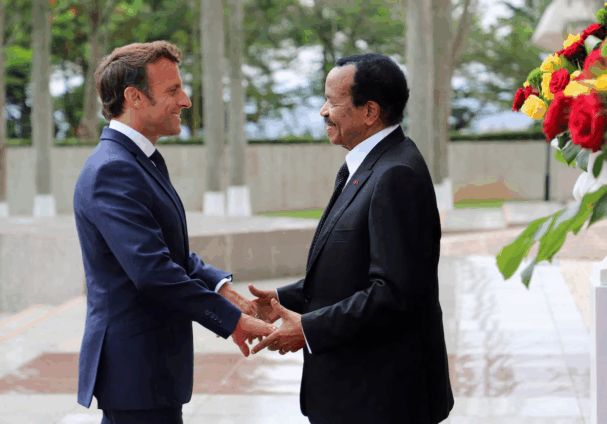
The letter, addressed to Cameroonian President Paul Biya, follows the findings of a joint Franco-Cameroonian commission that investigated France's role and involvement in the fight for independence between 1945 and 1971.
The Cameroon government did not immediately reply to a Reuters request for comment.
Cameroon was a German colony until it was split between Britain and France after World War I. Under United Nations trusteeship, the French-administered area gained independence in 1960, while the southern British Cameroons voted to join French Cameroon in a federation in 1961.
"The commission's historians clearly established that a war took place in Cameroon, during which French colonial authorities and military forces committed various forms of violent repression in several regions of the country, a war that continued beyond 1960 with France's support for actions taken by the independent Cameroonian authorities," Macron said in the letter.
Macron also acknowledged France’s responsibility in the deaths of independence leaders Ruben Um Nyobè, Paul Momo, Isaac Nyobè Pandjock and Jérémie Ndéléné, who were killed between 1958 and 1960 during military operations conducted under French command.
The French president pledged to open archives, support historical initiatives, and create a joint working group to implement the commission’s recommendations, aiming to reconcile historical memory and strengthen Franco-Cameroonian ties.
Starting with 17th-century outposts and expanding in the 19th century, France built a vast colonial empire, notably in Africa, lasting until the 1960s decolonisation.
The letter follows previous steps by Macron to confront France’s colonial legacy, including acknowledgements of French responsibility in the 1994 Rwandan genocide and the Algerian War.
These gestures come amid shifting dynamics in France’s relationships with African nations, at a time when its presence in parts of the continent, particularly the Sahel, is being increasingly contested.
Latest Stories
-
MTTD officers will remain on roads despite traffic technology rollout – Interior Ministry
13 minutes -
NPP backs Afenyo-Markin’s push for answers over reported GH¢22bn GoldBod losses
17 minutes -
NDC Upper West Chairman Bunas declares bid for re-election
21 minutes -
Ghana saves $500m from shift from liquid fuel to gas – Jinapor
22 minutes -
Mahama to cut sod for new multi-storey airport car park, hotels
23 minutes -
China warns it will protect its interests after US widens sanctions against Iran
24 minutes -
NSMQ 2026: PRESEC Legon eye ninth NSMQ title after last year’s quarter-final exit
26 minutes -
NPP Ashanti Regional Chairman urges media to clamp down on political insults
54 minutes -
HIV stigma could derail Ghana’s 2030 target – AHF Ghana
57 minutes -
NYA CEO urges Ghanaian youth to take an active role in decision-making
60 minutes -
How Ghana’s customs clearance process works – Revenue Officer explains
1 hour -
KNUST SHS, Church of Christ SHS book Luv FM Debate semifinal spots
1 hour -
Atta Akyea appears for Adu-Boahene in court after legal vacation concerns
1 hour -
Police arrest seven in Ashanti Region narcotics crackdown
1 hour -
Turf Club condemns Accra Race Course demolition, calls for Prez Mahama’s intervention
2 hours