

Audio By Carbonatix
The Attorney-General and Minister of Justice, Dr Dominic Akuritinga Ayine, says that prosecution of criminal trials is largely controlled by the judiciary and not solely by the prosecuting authorities.
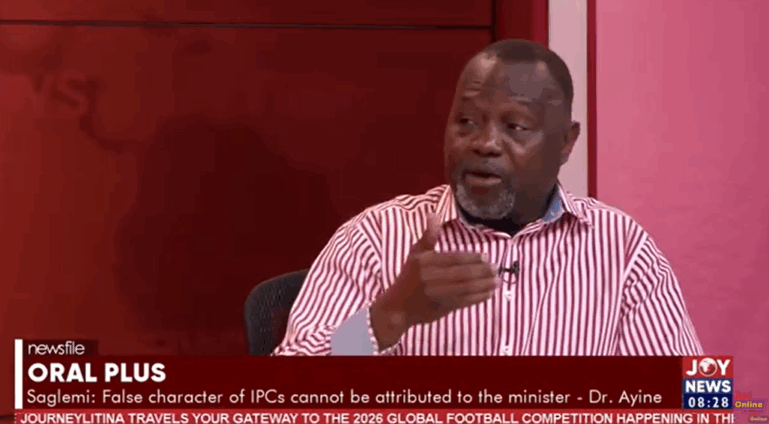
Speaking on JoyNews’ Newsfile on Saturday, January 10, Dr Ayine said he remains unable to proceed to court over matters relating to the National Cathedral project until he receives a forensic audit report, which he described as critical to any potential prosecution.
“And even the National Cathedral, for instance, I am still waiting for the forensic report. I cannot proceed to court on the National Cathedral unless the forensic report is given to me,” he stated.
His comments come after former Auditor-General Daniel Domelevo stated that the credibility of the anti-corruption fight now rests largely on how the Attorney-General handles high-profile cases submitted under the Operation Recover All Loot (ORAL) initiative.
Dr Ayine expressed surprise at criticisms from some individuals, including the former Auditor-General, who has called for quicker action on high-profile cases.
He argued that such criticisms often overlook the realities of criminal litigation.
“For people like Domelevo, I am a bit surprised that they know that even when I have filed a case in court, the speed of the case does not depend exclusively on me,” he said.
The Attorney-General explained that once a matter enters the courts, the conduct and pace of proceedings fall under the authority of the judiciary.
“What we have to understand is that, first of all, a criminal trial is a judiciary-controlled process,” he noted.
To illustrate his point, Dr Ayine cited the issue of adjournments, which are at the discretion of the presiding judge.
“If a judge says, ‘I am giving an adjournment of one month or two months’, and I plead with the judge or my lawyers plead with the judge to give a shorter adjournment and the judge refuses, what do I do in that case?” he asked. “I cannot compel the judge to give a shorter adjournment.”
While acknowledging public demands for swift justice, Dr Ayine said he is committed to expediting cases where possible, but cautioned against rushing prosecutions at the expense of thoroughness and legal soundness.
“And so if people like him say I should speed up, yes, I will speed up,” he said.
“But I don’t want to speed up and then trip along the line, and the same people will say, ‘well, Ayine didn’t do his work well; that is why he is tripping.’”
The Attorney-General stressed that his approach is guided by the need to build strong, defensible cases that can withstand judicial scrutiny, particularly in complex and high-profile matters such as the National Cathedral project.
Latest Stories
-
DVLA to expand mobile services to underserved communities in Ghana’s Eastern Corridor of the Northern Region
3 minutes -
GUTA urges GPHA to act swiftly to end Tema Port congestion to avert rising business costs
3 minutes -
Port congestion could undermine 24-hour economy policy – GUTA
4 minutes -
NSA opens three-day window to resolve national service biodata mismatches
13 minutes -
Abu Jinapor highlights increased gold exports after Domestic Gold Purchase Programme
18 minutes -
NPP UK branch calls for independent audit into gold purchasing operations and parliamentary probe
51 minutes -
Zanetor Agyeman-Rawlings pledges decisive action on climate change, galamsey and environmental degradation
55 minutes -
Bawumia was brainchild behind Domestic Gold Purchase Programme – Samuel Jinapor
57 minutes -
Fuel prices set to go up from September 1, Petrol to sell at GHC 16.69 and Diesel, GHC 17.90 – COMAC
59 minutes -
Our World Our People withdrawn due to curriculum duplication, not politics – Adutwum’s spokesperson
1 hour -
GANRAP is essentially a rebranding of Domestic Gold Purchase Programme – Abu Jinapor
1 hour -
I am tired of being in opposition, my goal is to win in 2028 – Boakye Agyarko
1 hour -
Ghana’s road maintenance funding gap deepens as only 37% of needs met – World Bank
1 hour -
Roland Europe Group appoints Opoku Sanaa as Head of Sales, Middle East & Africa
1 hour -
Sammyflex TV’s Roland Amartey girds up for 2026 Ghana Music Awards UK coverage
2 hours