

Audio By Carbonatix
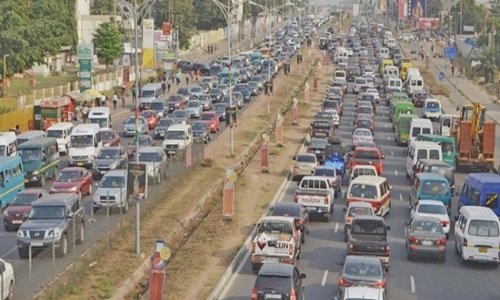
Ghana’s growing urban mobility crisis where commuters spend long hours in gridlocks during peak or productive hours, is costing the economy an estimated GH¢4.5billion per annum, according to findings from a study conducted by Glima Research—a leading research and consulting firm.
The study showed that traffic congestion, particularly along major ‘gridlock hotspots’ in Accra, has become a drawback to worker productivity, draining incomes and grossly impacting the quality of life in the capital.
In terms of breakdown, the findings showed that time lost in traffic accounted for approximately GH¢3.2 billion annually, representing about 71 percent of the total estimated losses.
Fuel waste contributed GH¢434 million, or roughly 10 percent, while productivity losses linked to stress and fatigue amount to GH¢815 million, representing about 18 percent of the total cost.
The research centered on the heavily congested Madina–37 corridor in Accra as a case study to project its national implications. The corridor was analyzed through data modeling to quantify time losses, fuel waste, and productivity impacts, which was then scaled nationwide using Gilma’s traffic multiplier model.
“Traffic congestion, particularly in Accra, is more than just a nuisance; it is a massive economic sinkhole quietly draining productivity, income, and quality of life,” the report highlighted.
It added: “This crisis is far from static - it is escalating; as Ghana’s urban population continues to rise, especially in key growth areas, so will the number of vehicles, the hours lost to traffic congestion, and the economic damage caused by traffic paralysis.”
Describing the situation as escalating rather than static, the report warns that Ghana’s rapidly growing urban population—particularly in key growth corridors—will only intensify congestion if urgent interventions are not implemented.
Beyond the economic toll, the environmental impact is equally alarming. The study estimates that preventable fuel waste from vehicles idling in traffic results in approximately 73,000 metric tons of excess carbon dioxide emissions each year nationwide—an environmental burden equivalent to wiping out the climate benefit of three million trees annually.
The study further revealed that congestion-induced stress and fatigue reduce effective productivity by about 30 minutes per commuter per day. On the Madina–37 corridor alone, this translates into an annual loss of GH¢72.8 million in reduced work output.
Other heavily congested routes—including Spintex Road, Mallam–Kasoa, and Circle–Achimota—face similar or even worse gridlock, particularly during peak hours, whilst several regional capitals grapple with varying degrees of traffic congestion, compounding the national economic impact.
To address the situation, the report proposed a number of interventions including widening roads along critical segments, an upgrade to inner and feeder roads to reduce pressure on major highways, and deployment of smart traffic lights.
“Urban mobility investments are no longer optional but urgent, high-return economic priorities essential to safeguarding Ghana’s productivity, environmental sustainability, and long-term development,” the report stated.
While widening can provide immediate relief, sustainable improvements will require a comprehensive, multi-pronged approach that anticipates future growth rather than merely responding to current pressure, it further suggested.

Other recommended interventions include graveling or concreting alternative routes in residential areas as well as decentralizing government services and business centers to reduce travel demand.
The report titled “The cost of gridlock: a policy brief on Ghana’s urban traffic crisis” was co-authored by a multidisciplinary team with deep expertise in engineering, analytics, and public policy comprised of lead research analyst Andy Sevordzi and Franklin Owusu-Kwakye, a seasoned geodetic engineer with extensive experience in transportation planning and infrastructure research.
Other team members were: Yussif Mohammed, a graduate of statistics with advanced data modeling skills and leadership in quantitative research; and Rudolph Djirackor, a biochemist and HSE specialist with proven track record in environmental health research and policy analysis.
Latest Stories
-
Three nights. 28 titles. Ultimate history made
5 seconds -
Ghanaian delegates at IYF 2026 could become bridges for stronger Russia ties – John Aggrey
4 minutes -
Nigeria: Over 30 dead, 50 hospitalised after consuming alcoholic substance in Ondo State
7 minutes -
UK lawmakers demand new law to address AI threat to human rights
16 minutes -
WAFU B U-17 Girls Cup: Black Maidens depart Accra for tournament in Yamoussokro
16 minutes -
Sweden’s center-left bloc narrowly ahead as election remains too close to call
26 minutes -
GPL 2026/27: ‘We won ugly’ – Kotoko head coach unimpressed after Lions victory
29 minutes -
7 out of 10 human trafficking cases in Ghana never reach prosecution — JoyNews Research
45 minutes -
Music, football to converge at Music Meets Football Summit 2026 in Lusaka
50 minutes -
Putin invites young global leaders to partner with Russia in shaping future world order
51 minutes -
Putin calls for ‘just world’, says every nation must be free to choose its own path
58 minutes -
IFY 2026 food festival to serve 20,000 meals showcasing global cuisines in Russia
1 hour -
Ghana has a Domestic Violence Act: But can a victim afford to use it?
1 hour -
Young artists from 100 countries showcase works at IFY 2026 in Russia
1 hour -
Russia opens neo-Nazism exhibition at International Festival of Youth 2026
2 hours