

Audio By Carbonatix
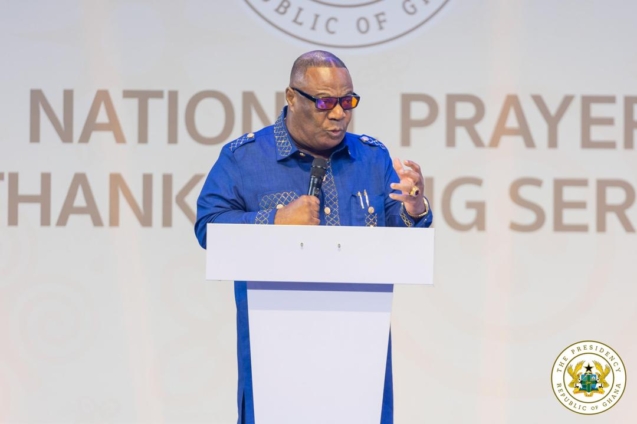
Nicholas Duncan-Williams, Founder and General Overseer of Action Chapel International (ACI), has weighed in on the growing controversy over prophecies linked to political elections, calling for deeper scriptural understanding when addressing such matters.
His comments follow a public apology by Bernard Elbernard Nelson-Eshun, an Accra-based preacher, whose widely circulated prediction that Kennedy Ohene Agyapong would emerge victorious in a recent internal party contest proved false.
The unexpected outcome reignited discussions about the role of prophetic declarations in competitive democratic politics.
Archbishop Duncan-Williams addressed the intense public reactions that surfaced before, during and after the primaries, during which several prophecies were publicly shared regarding the eventual winner.
Responding to a question about how spiritual leaders should navigate public scrutiny when prophetic words intersect with politics, he stressed the importance of distinguishing between Old Testament and New Testament prophecy.
According to him, in the Old Testament era, individuals were guided by prophets because the Spirit of God came upon selected persons but did not dwell permanently within them.
In contrast, he explained that under the New Testament dispensation, believers are led by the indwelling Holy Spirit.
Quoting Revelation 19:10, he stated that “the spirit of prophecy is the testimony of Jesus,” emphasising that authentic prophecy must ultimately affirm the Lordship of Christ.
He also cited Hebrews 1:1–2, noting that while God spoke through prophets in earlier times, He now speaks through His Son, Jesus Christ, who promised the Holy Spirit as the Spirit of truth.
The Archbishop suggested that many disputes surrounding election-related prophecies stem from limited biblical grounding rather than a lack of secular education.
He pointed out that prophets in ancient Israel addressed kings installed by God within a theocratic framework — a system fundamentally different from modern democratic governance.
He spoke on Channel One TV.
“Our countries and nations are secular. They are not the state of Israel,” he remarked, urging caution and discernment when applying biblical prophetic models to contemporary political contests.
While affirming that God continues to speak today, Archbishop Duncan-Williams maintained that prophetic ministry, especially in politically sensitive contexts, must be exercised with theological depth, wisdom and responsibility.
Latest Stories
-
“We are one house – let’s settle this at home” – Atomaase Royal family calls for unity, rallies behind Twafohene
17 minutes -
The Missing Middle and the Overlooked Small: Why Ghana Must Serve Both the ‘S’ and ‘M’ in MSME’s
30 minutes -
Mahama returns from Angola after AU extraordinary summit
60 minutes -
Ghana qualifies for quarterfinals of Africa Volleyball Nations Cup after beating Zambia
1 hour -
WAFU B WCLQ: Ampem Darkoa Ladies come from behind to beat Edo Queens
2 hours -
Photos: National Youth Authority Festival
2 hours -
Bawumia commissions St Jude’s Catholic Church he funded to completion at Weija
2 hours -
Government defends new beer exercise rates; sliding scale has not been abolished
2 hours -
Bolgatanga Assembly denies blanket ban on events beyond 8pm
2 hours -
Photos: Ghana Immigration Service removes 1,055 street beggars from Accra, Kumasi streets
2 hours -
‘He always comes to our aid’ – Fr. Campbell recounts Bawumia’s support for Church, poor
2 hours -
Remittances drop marginally year-on-year to US$3.65bn in half-year 2026
3 hours -
T-bills: Government exceeds target by 139%, interest rates tumble
3 hours -
Why Chelsea need more than a new goalkeeper to be title challengers
3 hours -
Outlook of Ghana’s external sector remains positive for second-half of 2026 – BoG
3 hours