


Audio By Carbonatix
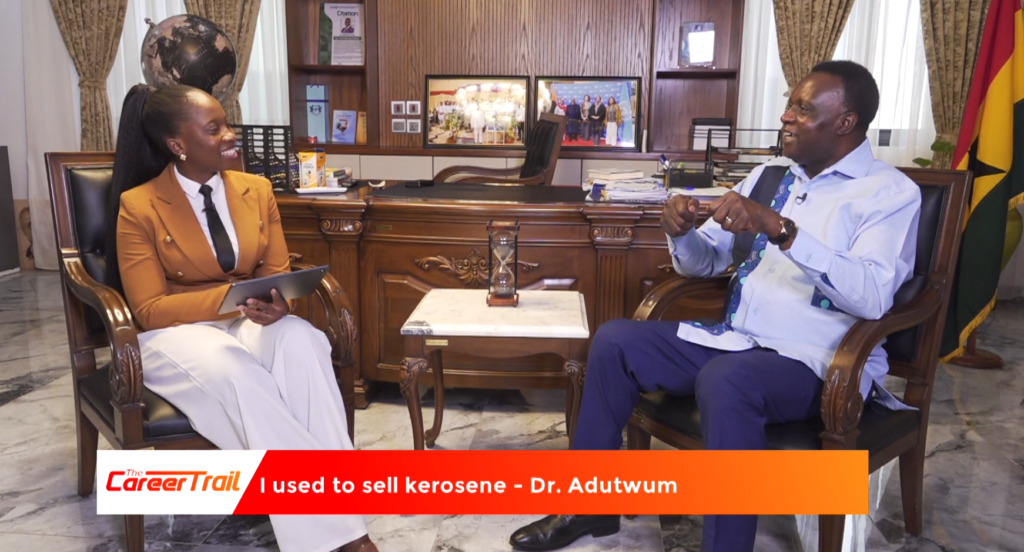
Former Education Minister Dr Yaw Osei Adutwum has opened up about his early life struggles, revealing how he engaged in several small businesses as a child, including selling kerosene in his village.
Speaking on The Career Trail on Joy Learning TV and JoyNews, he recounted growing up at a time when electricity was unavailable in his community, making lanterns and kerosene essential for daily life.
“I used to sell kerosene. In those days, there was no electricity in the village. Everybody used lanterns, and they depended on kerosene,” he recounted.
He described how he purchased kerosene in bulk and retailed it in smaller quantities to households, often in the evenings.
He added that payments were not always immediate, as many customers bought on credit and delayed settling their debts.
“So we would buy a gallon of kerosene and retail it. You get bottles, fill them, place them in a bucket, and go around the town in the evening calling out. Then people would call you,” he narrated.
Beyond kerosene sales, Dr Adutwum highlighted other childhood ventures, including snail hunting during the rainy season.
“There was a season when snails would come out. Early in the mornings, around 5 a.m. or 6 a.m., you pick them from under trees and sell them in town. People even came from Kumasi to buy,” he said.
He also spoke about making baskets from cane and transporting them to Kumasi for sale.
“I used to make baskets. You go into the bush to get cane, weave it, and take it to Kumasi. Sometimes, I had about 20 or 30 to sell,” he added.
Reflecting on how he used his earnings, he noted that his first purchase was educational. “The first thing I did with the money was to buy a book because there were no books in my house,” he shared.
“I would also go to the secondhand clothing market—what we call ‘Fos Line’ in Kumasi—to get clothes to wear and show off in the village,” he added.
He said these experiences taught him valuable lessons in entrepreneurship, including credit management, understanding customer behaviour, and discipline.
“When you look back, you realise it was all entrepreneurship—who to sell to on credit, who not to sell to. All those lessons were part of growing up,” he reflected.
Latest Stories
-
Ghana housing finance conference adopts communiqué to improve affordable housing access
2 hours -
Special Initiatives Minister urges Wa Technical Institute to enrol more girls as EU-backed solar training lab opens
2 hours -
In the matter of my first year at the Bar
3 hours -
ActionAid Ghana calls for an end to child marriage, greater investment in girls’ rights
3 hours -
Newsfile to tackle World Cup visa scandal, beach demolitions, education strikes, BRICS bid
3 hours -
UK-Ghana Trade & Investment Summit: Trade Resource Centre to help businesses maximise UK-Ghana trade opportunities
3 hours -
Embassy of Denmark celebrates World Maritime Day
3 hours -
Linking LEAP to productive inclusion could cut extreme poverty by 2030 – UNICEF
5 hours -
Trade Ministry backs use of creative arts to rehabilitate prison inmates
5 hours -
Negotiations with government to continue despite strike suspension – GNAT
5 hours -
‘Ghana cannot afford to waste public resources; every cedi has a job’ – Ato Forson
5 hours -
Ghana expects economic boost as World Assemblies of God Congress brings 10,000 delegates to Accra
5 hours -
Joy in Nayilifong as Farouk Aliu Mahama donates 100kVA transformer to improve power supply
5 hours -
Chief Justice urges employers to tackle mental health stigma in workplaces
6 hours -
Analysis: Ghana’s yellow fever numbers reveal a gap between vaccination and protection
6 hours