

Audio By Carbonatix
A million-dollar question arises: If we all become police officers, who will the police police?
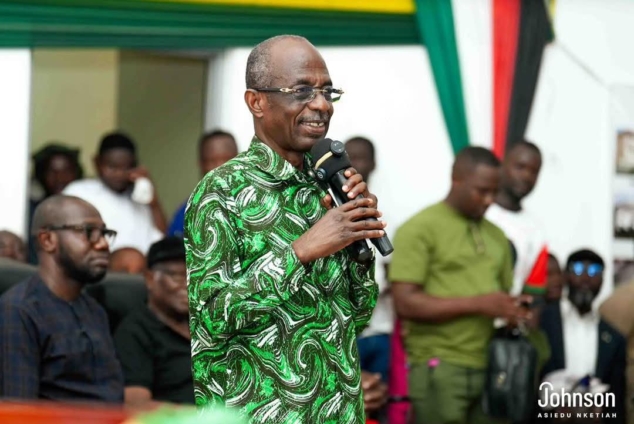
In the ever-colourful theatre of Ghanaian politics, a single statement can travel faster than a trotro in an empty lane. This week, the National Chairman of the National Democratic Congress, Hon. Johnson Asiedu Nketia, stirred public conversation with a remark that was as humorous as it was deeply reflective: “If all 500,000 become police officers, where will they find thieves to arrest?”
Now, to the casual listener, this may sound like a simple joke thrown into a political gathering to lighten the mood. But anyone familiar with Chairman Asiedu Nketia knows that beneath the humour often lies a serious message waiting to be unpacked. The man has a way of wrapping wisdom in satire, the same way our grandmothers wrapped bitter medicine in honey.
The facts themselves are telling. Nearly 500,000 young Ghanaians reportedly applied to join the Ghana Police Service, yet government resources can only absorb about 5,000 recruits this year. If that statistic alone does not provoke reflection about youth employment and national planning, then perhaps the Chairman’s humorous question will.
In essence, the statement highlights an important truth: a nation cannot function if everyone chooses the same path. Imagine a Ghana where half a million citizens suddenly wear police uniforms. Who then becomes the teacher to educate our children? Who grows the maize and cassava that end up on our tables? Who builds our roads, heals our sick, designs our technology, and drives our businesses?
In such a scenario, the police might eventually find themselves directing traffic for goats and chasing chickens across empty markets.
This is precisely the deeper point the Chairman appears to be making. A thriving nation depends on economic diversity. Security institutions are important, but they are only one piece of the national puzzle. The strength of any economy lies in the variety of professions and industries that keep the wheels of productivity turning.
There is also another layer of wisdom hidden in the remark. If society successfully creates opportunities for its citizens eg. jobs, businesses, skills training, and innovation. When that is highly achieved, the number of people tempted to commit crime naturally declines. In that sense, the best way to reduce crime is not simply to recruit more police officers but to build a society where people are productively engaged. It is preventive development rather than reactive policing.
Chairman Asiedu Nketia, known widely for his grassroots approach to politics, has built a reputation as a leader who speaks plainly and without unnecessary decoration. He says things as they are, sometimes with a touch of humour that leaves people laughing first and thinking later. That is the mark of a seasoned political communicator.
Of course, in today’s political climate, some observers, especially those in opposition may be tempted to search for hidden controversy in every sentence spoken by government or figures close to government. But a mature democratic society must rise above the temptation of petty political propaganda.
Opposition politics, at its best, is not about twisting statements for headlines or creating noise where none exists. It is about providing constructive criticism, proposing practical alternatives, and strengthening democratic accountability.
In this particular case, the Chairman’s remark should be seen not as an attack on aspiring police officers but as a humorous reminder that national development requires balance, planning, and realism. Governments must recruit security personnel responsibly, based on budgetary capacity and national needs, while simultaneously expanding opportunities across other sectors of the economy.
After all, a country cannot be policed into prosperity.
Ultimately, the comment reflects a deeper philosophy, the true measure of progress is not how many officers we recruit, but how many citizens we empower to live productive and dignified lives. When the economy works for the people, crime naturally becomes the exception rather than the norm.
And perhaps that is the real joke behind the Chairman’s statement: in a well-developed society with abundant opportunities, the police might indeed struggle to find thieves to arrest. Would that not be the best problem any nation could ever have?
Latest Stories
-
Force-feeding children can cause serious complications —Paediatrician warns
7 minutes -
Mahama warns board chairpersons against taking over executive roles
10 minutes -
Only 61 state entities submitted audited accounts on time in 2025 – Mahama
13 minutes -
BoG warns against return to FATF grey list as financial crime risks rise
19 minutes -
Remembering 9/11: The day terror struck America and changed the world forever
29 minutes -
Mismanagement of public affairs fading trust in government, religious leaders—Ayariga
30 minutes -
Presumption of corruption should apply to unexplained wealth – Kissi Agyebeng
32 minutes -
Survival is not success for state-owned enterprises – Mahama
43 minutes -
Mahama challenges SOEs to turn financial gains into lasting operational efficiency
45 minutes -
Conviction should not be required to recover unexplained wealth – Agyebeng
50 minutes -
Persistent SOE losses will no longer be absorbed by national budget – Mahama
52 minutes -
CAF CC: ‘Nations FC will do much better than we did in Mali’ – Dennis Korsah
1 hour -
Digital fraud incidents rise 98% between 2022 and 2025 – BoG
1 hour -
Only 72 of 148 state entities signed performance contracts in 2025 – SIGA
1 hour -
38 African scientists, 17 global experts storm Kumasi as KNUST opens GPOL optics hub
1 hour