

Audio By Carbonatix
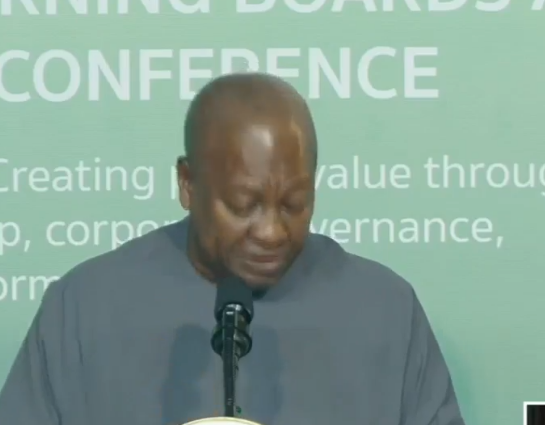
President John Dramani Mahama has warned boards and management of Ghana’s state-owned enterprises (SOEs) that survival can no longer be treated as success, demanding stronger performance, tighter financial discipline and greater accountability across the public enterprise sector.
Speaking at the SIGA Governing Boards and CEOs’ Conference 2026, President Mahama said five state-owned enterprises had recorded losses in every year from 2021 to 2025, while other state entities recorded an aggregate deficit of about $10.48 billion in 2025, up from $2.40 billion the previous year.
He said the financial position of some entities was particularly concerning, with aggregate liabilities of other state entities exceeding their net assets by more than $41 billion.
The President said the figures demonstrated the need to move beyond isolated successes and pursue system-wide improvement.
President Mahama stressed that state enterprises were established either to undertake activities of strategic national importance or to address areas where the private market could not adequately meet the public interest.
Commercial entities, he said, must therefore be efficient, competitive and financially sustainable while generating appropriate returns on public investment.
Entities with public service mandates, meanwhile, must deliver measurable social and economic value through reliable services, effective regulation, protection of public assets and improved outcomes for citizens.
He said the true measure of performance was not whether an institution was busy, visible or able to pay salaries, but whether its work created tangible benefits for ordinary Ghanaians.
“A farmer, trader, worker, entrepreneur, or student” should be able to experience the value created by a public institution, he said.
The standard, he added, applied equally to regulators, commissions, statutory authorities and public funds.
President Mahama said boards and management would be assessed against clear financial, operational, governance and development targets, with poor performance triggering corrective action and, where necessary, changes in leadership.
Performance contracts, he said, should be treated as a covenant with the Ghanaian people rather than administrative paperwork.
Targets must be ambitious, realistic and measurable, while reports and information submitted to the State Interests and Governance Authority (SIGA) must be timely, complete and credible.
He also warned commercially oriented SOEs against relying indefinitely on the national budget to cover poor management.
Every cedi transferred, guaranteed or written off on behalf of a poorly performing enterprise, he noted, reduced the resources available for schools, hospitals, roads, jobs and social protection.
Government would remain a responsible shareholder, he said, but would not provide indefinite financial support to entities that refused to reform.
Boards and management were consequently expected to increase revenues, control costs, manage debt, protect cash flows and address structural inefficiencies before they became fiscal risks.
The President also reminded profitable state enterprises of their obligation to pay dividends.
Returns on public investment, he said, ultimately belonged to the people of Ghana and should contribute to the national budget.
Where enterprises retained profits, such retention should be backed by credible investment plans capable of strengthening the institution and generating greater long-term value.
He cautioned boards and management against using profits that belonged to Ghanaians to finance excessive benefits and comforts.
President Mahama further announced a stronger link between remuneration and institutional performance.
He said the proposed transition from the Fair Wages and Salaries Commission to an Independent Public Employment Commission offered an opportunity to create a more coherent, transparent and sustainable framework for public-sector remuneration, including compensation within SOEs.
Executive pay, he said, should progressively reflect an enterprise’s financial health, productivity, achievement of agreed targets, service quality, fiscal sustainability and broader contribution to the state.
The objective was not simply to control salaries but to create incentives for better performance and strengthen accountability.
High-performing enterprises and their leaders should be rewarded appropriately, he said, but chronically poor performance could not continue to attract higher salaries and allowances.
He directed boards, chief executives and management teams to co-operate fully with SIGA, the Fair Wages and Salaries Commission, the Ministry of Finance and other relevant institutions in compensation reviews and benchmarking.
No SOE, he stressed, should use its corporate status or revenue-generating capacity to operate outside approved national remuneration frameworks.
President Mahama also sought to reinforce the distinction between board oversight and executive management.
He told board chairpersons that board membership was neither ceremonial nor an entitlement. Boards were responsible for strategic direction, policy, risk oversight, financial reporting and institutional performance.
However, chairpersons should not assume day-to-day executive roles within their organisations.
Chief executives, for their part, must regard executive authority as a responsibility to deliver results in accordance with the law, government policy and the strategic direction approved by the board.
“Boards govern and management manages,” he said, warning that board interference in routine operations weakened accountability, while chief executives who resisted legitimate board oversight did the same.
He also demanded independent judgement from board members, saying political connections, personal relationships and proximity to government could not replace competence, integrity, diligence and performance.
The President said the administration would not tolerate conflicts of interest or abuse of public office.
Procurement must be lawful, competitive and transparent; recruitment and promotions must be based on merit; and contracts, investments and asset disposals must demonstrate value for money.
Boards were also expected to protect state-owned land, buildings, equipment and investments under their control.
Unauthorised disposal, encroachment or dissipation of public assets, he warned, constituted a breach of trust.
He said every significant expenditure should satisfy three tests: whether it was necessary, whether it offered value for money, and whether it advanced the entity’s mandate and created public value.
The President also directed SIGA to establish a clear reporting and co-ordination framework for government representatives serving on joint venture boards.
Representatives must regularly report in writing on material decisions, financial performance, emerging risks and issues affecting the state’s interests.
Although they may serve on different boards, he said, government representatives ultimately served one Republic and should therefore operate under a common ownership policy, standard of conduct and overriding loyalty to the Ghanaian people.
The 2025 State Ownership Report covered 162 of 175 entities on the Cabinet-approved state equity portfolio, representing about 89 per cent coverage. The portfolio comprised 53 SOEs, 36 joint ventures and 73 other entities.
Of 162 financial reports analysed, 108, or 66.67 per cent, were based on audited financial statements — the highest proportion recorded in a state ownership report.
The figure represented a significant improvement from the 53 audited statements available for the 2024 report, while reliance on management or draft accounts fell from 99 to 54 entities.
President Mahama welcomed the improvement but said compliance remained inadequate.
Only 61 entities submitted audited accounts by the statutory 30 April deadline. Just 72 of 148 entities expected to sign performance contracts had done so, while only 71 had submitted quarterly reports.
Only 37 of 177 entities expected to hold annual general or stakeholder meetings had complied. Employment data submissions also fell from 142 entities in 2024 to 137 in 2025.
The President said such requirements were not optional bureaucratic exercises but fundamental instruments of ownership, oversight and accountability.
The report showed that SOEs held aggregate assets of $407.85 billion and liabilities of approximately $282 billion at the end of 2025.
Majority joint venture companies had assets of $96.69 billion and liabilities of $82.7 billion.
Other state entities, however, held assets of approximately $341.6 billion against liabilities of $382.75 billion, leaving liabilities more than $41 billion above their assets.
President Mahama said the combination of those liabilities and the $10.48 billion aggregate deficit required urgent action from boards, sector ministries, SIGA and the Ministry of Finance.
There was also substantial progress in the level of recoverable irregularities identified by the Auditor-General.
The figure fell from $15.57 billion in 2024 to $2.24 billion in 2025, representing an approximately 85.6 per cent reduction.
President Mahama welcomed the improvement but said the remaining amount was still significant public money that could otherwise support social services.
He directed boards to recover the funds, correct the underlying weaknesses and prevent similar irregularities from recurring.
The Minerals Commission, Lands Commission and Ghana Telecommunications Company Limited failed to submit their 2025 accounts for inclusion in the report, a situation the President said could not be allowed to undermine public scrutiny.
President Mahama said the ultimate objective was to ensure that every state entity could demonstrate its contribution to Ghana through reliable, independently audited financial information, completed performance contracts, timely reporting, regular stakeholder engagements and full disclosure of material risks.
He challenged chief executives to modernise their operations, improve the quality of their data and ensure that public value was visible in the daily lives of Ghanaians.
Latest Stories
-
Importers petition GRA over alleged unauthorised removal of 28 containers from Tema Port
5 minutes -
Creative Arts Agency Board seeks Lands Ministry’s support for welfare project
12 minutes -
Mahama and Kyrgyzstan Foreign Minister discuss AU-UN cooperation – Ablakwa
32 minutes -
Ghana, Kyrgyzstan explore cooperation in gold mining and trading
33 minutes -
Bono Region teacher unions back strike, demand action on outstanding grievances
35 minutes -
Strike still in force, stay home – GNAT, NAGRAT and PRETAG tell teachers
39 minutes -
Daily Insight for CEOs: Turning Q4 priorities into measurable results
44 minutes -
Heartbreak Diet: Five foods to eat after a breakup or divorce
44 minutes -
Health benefits of sweet potatoes
49 minutes -
Farmers must be central to research – Prof Asare-Bediako
50 minutes -
Nandom youth advocate urges end to political insults, rising drug abuse
51 minutes -
Ho edition: Republic Bank-JoyNews Habitat Fair to offer financing from land acquisition to home completion
55 minutes -
Three Chinese-operated massage spas shut down in Ashanti Region over licensing breaches
1 hour -
VRA Board Chairman calls for proportional power cuts to Ghana’s neighbours during shortages
1 hour -
Polo Beach Club demolished as La Beach clearance exercise continues
1 hour