

Audio By Carbonatix
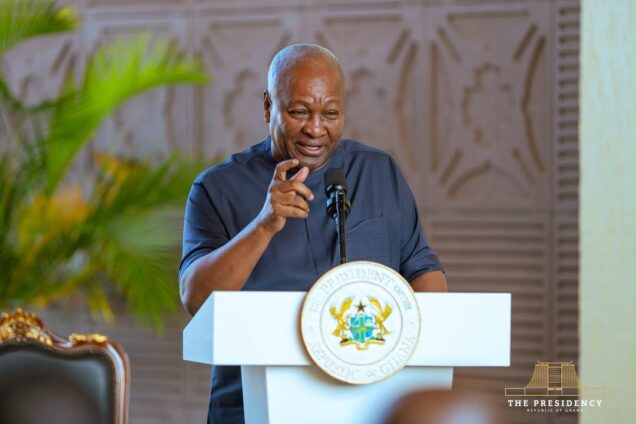
President John Dramani Mahama has challenged boards and chief executives of Ghana’s state-owned enterprises (SOEs) to turn recent financial gains into lasting operational efficiency, stressing that public assets must generate measurable value for citizens.
Speaking at the SIGA Governing Boards and CEOs’ Conference 2026 held at Labadi Beach Hotel, President Mahama said assets including the country’s ports, power infrastructure, factories, water systems, pension funds, land, buildings, equipment and shares held by the Republic belonged ultimately to the Ghanaian people.
He said government, boards and chief executives were merely custodians of those assets and had a responsibility to manage them in the public interest.
“Public ownership must produce public value,” he said.
The President urged every institution represented at the conference to demonstrate with credible evidence the value it had created for Ghanaians.
He recalled his March 2025 meeting with chief executives, when he announced a reset in the relationship between government and its enterprises. He said persistent losses could no longer be quietly transferred to the national budget, while SIGA must become a more effective ownership and performance institution.
He also reiterated that leadership positions should be linked to measurable results, value creation and profitability.
According to President Mahama, Vice-President Professor Jane Nana Opoku-Agyemang reinforced the position during an engagement with specified entities in March this year, emphasising that state-owned enterprises must provide an attractive value proposition to Ghanaians, their ultimate shareholders.
President Mahama said the latest State Ownership Report showed a significant improvement in the aggregate performance of SOEs.
Combined revenue rose from $137.71 billion in 2024 to $176.43 billion in 2025, representing growth of about 28.12 per cent.
The sector also moved from an aggregate net loss of $2.26 billion in 2024 to a net profit of $19.8 billion in 2025.
Return on assets increased from 1.3 per cent to 6.31 per cent, while return on equity improved from negative 1.6 per cent to 15.7 per cent.
However, the President cautioned against interpreting the figures as solely the result of improved management.
He noted that the wider business environment, particularly improved foreign exchange conditions and lower financing costs, had benefited both state-owned and private enterprises.
Approximately $11.72 billion in net foreign exchange gains and a 42.5 per cent reduction in aggregate finance costs contributed significantly to the improved SOE performance.
President Mahama therefore called on managers to use the favourable conditions to strengthen the underlying businesses rather than rely on temporary economic advantages.
The President commended ten SOEs that recorded positive net profits in every year from 2021 to 2025.
The Ghana National Petroleum Corporation (GNPC) recorded the highest average annual profit, at approximately $2.25 billion, followed by the Ghana Ports and Harbours Authority (GPHA) with $1.41 billion.
The Minerals Income Investment Fund (MIIF) averaged $773.9 million, while BOSS Energy averaged $348.1 million.
He also recognised the consistent profitability of the Bui Power Authority, Ghana Exim Bank, Ghana National Gas Corporation, TDC Company Limited, Ghana Supply Company Limited and the Venture Capital Trust Fund.
President Mahama said five consecutive years of profitability deserved recognition, but should also compel those institutions to strengthen governance and aim for even greater value creation.
Several enterprises also recorded notable improvements in 2025.
The Tema Oil Refinery (TOR) moved from a net loss of approximately GH¢745 million to a net profit of $1.09 billion, which the President described as its first net profit in almost a decade.
The Ghana Water Company Limited moved from a loss of $3.06 billion to a profit of approximately $635 million, while the Ghana Cocoa Board (COCOBOD) improved from a loss of $5.73 billion to a profit of $5.11 billion.
BOSS Energy increased its net profit from approximately $3.98 million to $6.84 million.
The Gold Board also recorded a sharp improvement, posting a net profit of approximately $896.5 million, compared with $88.5 million in 2024.
President Mahama said the Gold Board's performance highlighted the strategic importance of establishing transparent, accountable and nationally beneficial structures around Ghana's gold trade.
Despite the encouraging results, President Mahama warned against complacency.
He said the improved financial performance must be supported by stronger core operations and could not depend indefinitely on favourable exchange-rate movements, lower financing costs or other improvements in the business environment.
For him, the State Ownership Report should serve not only as a record of progress but also as a tool for identifying weaknesses and determining the reforms required across the public enterprise portfolio.
The President's central message was that a profitable year, while welcome, does not by itself constitute a successful turnaround.
“A one-year turnaround is encouraging, but sustained performance is the real test.”
He said boards and chief executives must therefore focus on strengthening governance, improving efficiency and ensuring that Ghana's public assets generate lasting value for the citizens who ultimately own them.
Latest Stories
-
Ho edition: Republic Bank-JoyNews Habitat Fair to offer financing from land acquisition to home completion
4 minutes -
Three Chinese-operated massage spas shut down in Ashanti Region over licensing breaches
19 minutes -
VRA Board Chairman calls for proportional power cuts to Ghana’s neighbours during shortages
26 minutes -
Polo Beach Club demolished as La Beach clearance exercise continues
27 minutes -
James Aboagye: Why film schools must embrace the AI revolution
29 minutes -
North Industrial Area fire: AMA demolishes Kofikrom structures to create access routes
35 minutes -
Salaga North MP pushes for establishment of senior high school in district
36 minutes -
Mercy Ships mission to deliver at least 2,400 surgeries, train Ghanaian health workers – Health Minister
40 minutes -
Central Regional Prisons Command launches Medicine and Equipment Bank
41 minutes -
Gender Ministry launches 2026 National Breast Cancer Awareness Month in Ho
45 minutes -
GAPTE must stick to advertised times for the contra-flow system – Local Minister
55 minutes -
Mahama links recent Hohoe flooding to extreme weather linked to climate change
56 minutes -
President Mahama directs MMDCEs to hold biannual Accountability Series
60 minutes -
Ghana Christian International High School, North York Academy deepen Ghana-Canada educational partnership
1 hour -
GNAT, NAGRAT, PTTA-GH tell teachers in Volta and Oti to stay out of classrooms
1 hour