

Audio By Carbonatix
Lawyer and National Democratic Congress (NDC) Communication team member Hamza Suhuyini has defended the Chief Justice Paul Baffoe-Bonnie's engagements with state institutions, arguing that fostering cooperation and building workable relationships with public bodies are inherent responsibilities of the office.
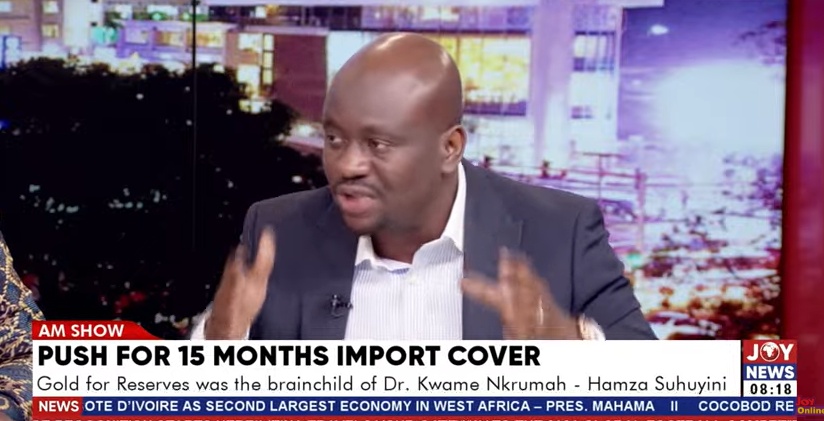
Speaking on JoyNews’ AM Show on Thursday, September 3, Mr Suhuyini said the Chief Justice’s interactions with institutions outside the judiciary should not be interpreted as political involvement, particularly when the purpose was to understand their operations and promote collaboration.
His comments followed the Chief Justice’s visit to the Minerals Income Investment Fund (MIIF) on Wednesday, September 2, during which he praised the performance of MIIF and other state institutions.
The Chief Justice said some of the developments he had witnessed had left him wondering what Ghana had been doing over the previous eight years.
Mr Suhuyini said the Chief Justice was entitled to express his views on matters of national importance and that his leadership should not be confined solely to the courtroom.
“Indeed, beyond the core functions of the Chief Justice, inherent in it is for the Chief Justice to build relationships, to establish cooperation… to establish a workable relationship with other state entities.”
According to him, the Chief Justice’s engagements with state institutions demonstrated an effort to strengthen cooperation and gain a better understanding of their operations.
He cited the Chief Justice’s engagement with the National Petroleum Authority (NPA) and other state institutions, arguing that such interactions were consistent with efforts to promote institutional collaboration.
“He tried to collaborate. He's trying to understand the working psychology of many of these state institutions,” Mr Suhuyini said.
Mr Suhuyini challenged those questioning the Chief Justice’s conduct to identify the specific law or ethical principle they believed he had breached.
“What is wrong with what the Chief Justice is doing? Which law is the Chief Justice breaking? Which ethical underpinning can you point to that the Chief Justice is breaking?” he asked.
He argued that the Chief Justice’s comments at MIIF amounted to an opinion on the state of governance and institutional performance rather than an exercise of political authority.
Mr Suhuyini maintained that expressing views on national affairs did not, by itself, compromise the Chief Justice’s judicial neutrality.
He said there were established mechanisms for scrutinising the Chief Justice’s conduct and decisions if there were concerns that his public statements had influenced his judicial work.
Mr Suhuyini also accused the New Patriotic Party (NPP) of applying inconsistent standards to the Chief Justice.
He recalled that NPP figures had previously praised the Chief Justice for speaking openly about the fight against galamsey, or illegal mining, and had cited his comments in criticising the government.
“It was this same group of people, NPP, who not long ago were in town praising the Chief Justice, the same Chief Justice, on his open statements on the fight against galamsey,” he said.
He specifically referenced NPP Communications Director Richard Ahiagbah, whom he said had described the Chief Justice’s earlier comments as a bold statement.
Mr Suhuyini argued that the NPP had repeatedly relied on the Chief Justice’s position on galamsey when it suited its political arguments, without questioning his ethical obligations or accusing him of partisanship.
“When he said that the situation had worsened, then you did not know that he had ethical requirements as a Chief Justice,” he said.
He therefore questioned why the Chief Justice was now being described as partisan following comments that could be interpreted as favourable to the current administration.
“What kind of hypocrisy is the NPP engaging in?” he asked.
Mr Suhuyini also defended the substance of the Chief Justice’s remarks about developments in state institutions, linking them to Ghana’s broader economic circumstances over the previous eight years.
He questioned whether the country’s economic challenges, including the loss of access to international capital markets, did not provide sufficient context for the Chief Justice’s observations.
“Is it not the fact that eight years ago this country was run down? If this country was not run down, why is it that we were locked out of the capital market?” he asked.
He also pointed to the impact of the Domestic Debt Exchange Programme (DDEP) on Ghanaians, including pensioners, arguing that the sacrifices made under the restructuring exercise illustrated the severity of the economic difficulties the country had experienced.
“If this country was not run down, how come the Ghanaians had to sacrifice their meagre savings under the guise of a domestic debt exchange programme? Even our pensioners,” he said.
He further cited the previous financial difficulties of state-owned enterprises such as the Tema Oil Refinery (TOR), questioning whether the performance of such institutions could not legitimately be assessed against their previous condition.
“Is it not a fact that institutions like TOR were run at a loss? Is that the story today? So what has the Chief Justice said that is not true?” he asked.
Mr Suhuyini maintained that the Chief Justice’s remarks at MIIF should not necessarily be interpreted as a direct comparison between the current and previous administrations.
He said the Chief Justice was highlighting what he considered an encouraging trend in the performance of several state enterprises rather than making a partisan political argument.
Latest Stories
-
Cargill Ghana and International Cocoa Initiative celebrate 111 young graduates building skills for the future
12 minutes -
Video: Madina MP Francis-Xavier Sosu collapses while addressing students at GIMPA
14 minutes -
Hunnyboy reveals how social media landed him Shatta Wale feature
20 minutes -
I am a perfectionist – Actor William Lamptey
24 minutes -
No room for another false start as Ghana begin AFCON qualifying campaign
44 minutes -
“We are grateful for what you have achieved” – AGI President tells Finance Minister
52 minutes -
“No Nation is Inferior”: Mahama champions human dignity and security council reform at the UN
1 hour -
Manhyia South residents, NPP executives fume over botched EOCO arrest of MP
1 hour -
Mahama unveils new deal with global philanthropy
2 hours -
Daily Insight for CEOs: Building customer-centric leadership
2 hours -
Democracy must deliver food, jobs and healthcare, not just elections – Mahama
2 hours -
Capacity constraints must never be a barrier to restitution – Mahama
2 hours -
COMAC pushes for suspension of sections of Customs Act 2026
2 hours -
Mahama calls for Great African Museum to anchor continent’s heritage revival
2 hours -
Mahama cites return of Mpomponsuo sword as model for restitution
2 hours