

Audio By Carbonatix
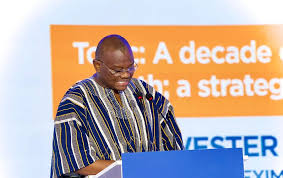
The Chief Executive of the Ghana Export-Import Bank (GEXIM), Hon. Sylvester Adinam Mensah, has underscored the need for a more comprehensive approach to supporting businesses, cautioning that access to finance alone is insufficient to drive sustainable export growth.
Delivering a keynote address at the bank’s 10th anniversary international conference on Wednesday in Accra, Mr Mensah outlined key lessons from GEXIM’s first decade, signalling a strategic shift towards a more integrated and results-driven model.
“The first lesson from our first decade is that finance by itself is not enough,” he stated. He explained that many businesses struggle not due to a lack of ambition, but because of structural constraints such as high or mismatched capital, weak market information, unreliable logistics, and difficulties in meeting standards.
“In other words, businesses need a complete support system, not just a single facility,” he added.
The Chief Executive stressed that export competitiveness is built long before products reach international markets. “It is built in farm productivity, factory efficiency, quality assurance, storage, packaging, logistics, governance, and management discipline,” he noted, warning that weak foundations would continue to undermine export performance regardless of global demand.
He also highlighted the reality of domestic competition, pointing out that international trade pressures begin within local markets where imported goods compete directly with locally produced items.
Mr Mensah emphasised the need for development finance institutions (DFIs) to strike a balance between ambition and discipline. “We must be bold enough to support transformation, but rigorous enough to preserve the quality of our balance sheet, risk controls, and credibility,” he said, adding that sustainable impact depends on strong and resilient institutions.
According to him, these lessons are informing a strategic reset at GEXIM, with a sharper focus on execution and accountability. The bank, he noted, is transitioning from a broad mandate to a more targeted approach that prioritises key sectors, deepens financial instruments, strengthens partnerships, and links interventions to measurable outcomes.
“As we look to the next phase, our approach will be more focused, delivery-oriented, and accountable,” he said.
The remarks form part of broader deliberations at the conference, which is examining how GEXIM can enhance its role in driving Ghana’s trade competitiveness and industrial transformation.
Latest Stories
-
The Ghana Jollof arrest: Mystery surrounds midnight detention of Techiman mother
8 minutes -
Nancy’s journey from financial hardship to best graduating student at Ho Technical University
16 minutes -
TUTAG warns of strike action due to unpaid Book and Research allowance
16 minutes -
GHS records more than 53,000 adolescent pregnancies in seven months
25 minutes -
Mahama urges investors to comply with Ghana’s laws, prioritise local participation
26 minutes -
KNUST, EPA test national air quality data hub ahead of Ghana rollout
38 minutes -
Anidaso Mutual Fund net assets rise 47.7% to GH¢6.31m in 2025
49 minutes -
WFP-Korea programme strengthens local economy and builds resilience in Northern Ghana
53 minutes -
GIIF’s Accra-Kumasi Expressway Ltd. SPV Initiative: A bold blueprint for financing Ghana’s infrastructure development
1 hour -
From surviving dry spells to building resilience: Alhassan’s Story
1 hour -
GRA targets over double revenue by 2028
1 hour -
Black Maidens bring the jama, then bring the goals in WAFU B opener [VIDEO]
1 hour -
GNPC Explorco showcases Voltaian Basin exploration potential at AOW:Energy 2026
1 hour -
Black Maidens cruise past Burkina Faso in WAFU B opener
1 hour -
Dafeamekpor calls for forensic audit after alleged GH¢600m COVID-19 fumigation gap
1 hour