

Audio By Carbonatix
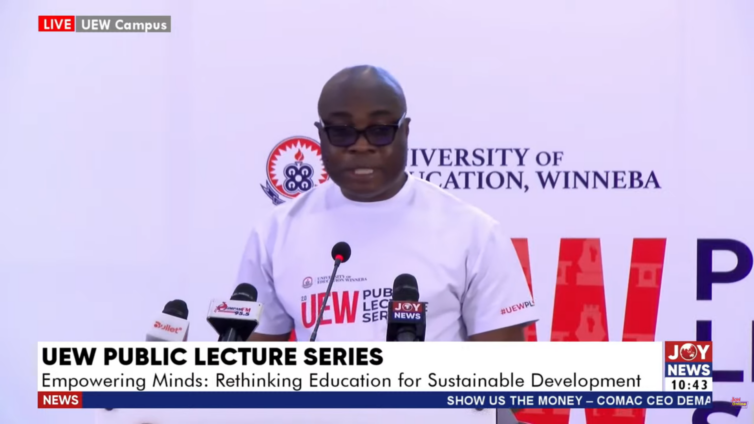
The Vice Chancellor of the University of Education, Winneba (UEW), Prof Stephen Jobson Mitchual, has called on Ghanaian universities to prioritise innovation and the production of impactful graduates rather than continuously expanding academic programmes.
He made the remarks on Friday, April 2026 10, during the UEW Public Lecture Series, stressing the need for a fundamental rethink of higher education in response to national development challenges and rising graduate unemployment.
“The University of Education continues to play a unique role in Ghana’s educational landscape,” Prof. Mitchual said.
“As a nation’s foremost teacher education university, we remain committed to training professional educators, advancing research, influencing policy, and contributing meaningfully to national development.”
He explained that the public lecture series was established to create a platform where academia, policymakers, industry and the general public can engage in critical reflection on national issues.
“This platform enables us to bring together academia, policymakers, industry, and the wider public to reflect on issues that matter to our nation and our future,” he added.
This year’s theme, Empowering Minds, Rethinking Education for Sustainable Development, he described as both timely and necessary, given the rapidly changing global environment shaped by technology, inequality, environmental pressures and shifting labour market demands.
“We live in a world of rapid change. Technology, inequality, environmental concerns, and shifting social and economic demands are defining the role of education in the world,” he said. “In such a time, education must remain relevant, inclusive, and forward-looking.”
Prof. Mitchual delivered a strong critique of the current structure of higher education, warning that universities risk becoming disconnected from national needs if they continue to expand programmes without assessing outcomes.
“I have always said that our educational institutions should not adapt to the programmes that we already have,” he stated.
“If every year we are graduating thousands of students, are we creating problems, or are we solving problems? Because the biggest problem that we have is unemployment.”
He referenced graduate output figures from UEW and other institutions, noting that the issue is not the number of graduates produced but whether they are adequately prepared to contribute meaningfully to society.
“At the end of the day, have we prepared them enough to be able to contribute to the socio-economic needs of our nation? In other words, to be independent?” he asked.
He argued that rather than continually adding new academic programmes, universities must refocus their approach to teaching, learning and innovation.
“We shouldn’t add on to the programmes that already exist. We need to refocus and change the way we are doing things,” he said firmly.
Prof. Mitchual further emphasised that education extends beyond academic attainment, describing it as a tool for shaping critical thinkers and responsible citizens.
“Education is not only about academic sources. It is about shaping minds that can think critically, solve problems, act responsibly, and contribute meaningfully to society,” he noted.
“It is about preparing people not only for work, but also for citizenship, leadership, and service.”
He stressed that Ghana’s development trajectory depends heavily on the quality of education and the calibre of graduates produced by its universities.
“For us in Ghana, this conversation is especially important. The future of our country will be shaped by the quality of education we provide, and by the minds we nurture today,” he said.
Reaffirming UEW’s commitment to national development, he stated that the institution remains focused on training educators and advancing knowledge to support transformation in the education sector and beyond.
“At the University of Education, Winneba, we take this responsibility seriously. We remain committed to preparing educators and advancing knowledge in ways that support educational improvements and national transformation,” he said.
He described the lecture series as more than an academic event, but a national call to action.
“Today’s lecture is therefore more than an event. It is a call to reflection, a call to partnership, and a call to action,” he said.
“It is my hope that this 2026 session of the University of Education Public Lecture Series will inspire meaningful dialogue, stronger collaboration, and renewed commitment to rethinking education for the good of Ghana and beyond.”
Latest Stories
-
Mexico Beckons as Ghana calls 20 to chase World Cup glory
2 minutes -
The Air we cannot see: Why Ghana must start taking its atmosphere seriously
13 minutes -
The Hidden Balance Sheet: Why Ghana’s buy-now-pay-later boom is a household solvency problem, not a consumer convenience story
41 minutes -
Prof. Kwofie urges publishers to use indigenous knowledge systems to decolonise AI
7 hours -
NDC’s two years of economic gains not enough to establish stability – Alan Kyerematen
7 hours -
AFCON 2027Q: Nine new call-up for Cote, The Gambia matches
8 hours -
Ghana’s MSMEs: Burdened by regulation and overtaxed; why the system isn’t working
8 hours -
Patience Akyianu, former Barclays Bank Ghana MD and Hollard Group CEO, reported dead
8 hours -
Mahama pushes ‘health sovereignty’ agenda, says Global South needs control over resources
8 hours -
Mahama: We are reforming systems, fighting corruption and improving use of public funds
8 hours -
Catholic Bishops welcome task force to tackle drug menace, acknowledge inter-agency efforts
8 hours -
Ghana Catholic Bishops demand urgent action against drug trafficking
9 hours -
Tamale: 5 arrested over suspected drug activities; police seize pistols, narcotics
9 hours -
We have lost a great developer – Mankranso residents pay tribute to late DCE
9 hours -
Ghana Law Society sets September 30 for maiden Bar Conference on legal reforms
9 hours