

Audio By Carbonatix
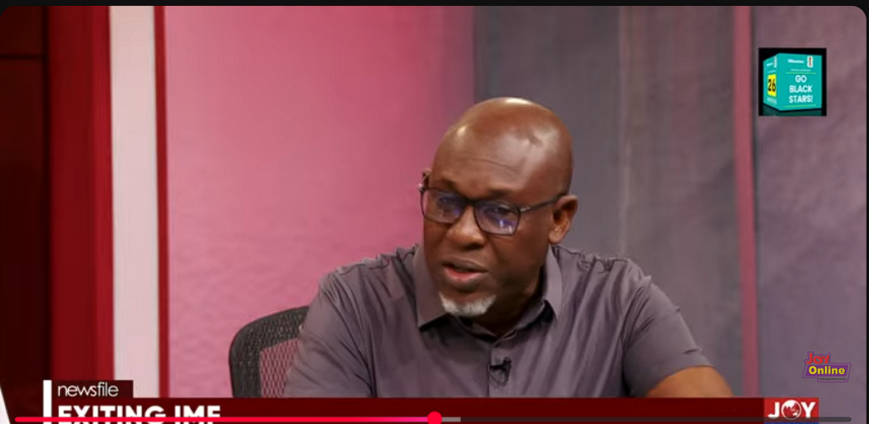
Senior Vice President of IMANI Africa, Kofi Bentil, has cautioned against premature celebration of Ghana’s recent economic improvements under the International Monetary Fund programme.
He argued that the country has achieved stability but not meaningful structural reform.
His comment follows the announcement of the end of Ghana’s three-year US$3 billion loan-supported programme. Ghana says it has effectively completed its IMF programme after reaching a staff-level agreement on the final review of the country’s support arrangement.
Speaking on JoyNews’ Newsfile on Saturday, May 16, Mr Bentil acknowledged that key macroeconomic indicators have improved since Ghana entered the IMF-supported programme in 2023. These include an increase in international reserves, improved import cover, and a relative strengthening of the cedi against the US dollar.
However, he stressed that these gains should not be mistaken for a full economic turnaround, insisting that Ghana’s underlying structural weaknesses remain unresolved.
“Why I say we shouldn’t celebrate this is that when you’ve done something extraordinary, you should also have the sense that something deeper still needs fixing.
We’ve stabilised the economy, but we have not restructured it. It’s like someone who was consuming too much sugar has now cut down, but is still addicted to sugar. Stabilisation alone is not enough if the underlying problem remains.
Restructuring means moving away from the very things that put you in that situation in the first place. That is what we have not done yet—we have only stabilised.
On the surface, things may look fine, but the question is: do we have real resilience? If we are hit by one or two shocks, would we be able to survive?
So we should be careful about celebration. We can acknowledge progress, yes, but those of us who watch these things closely know that this is a familiar cycle—we’ve been here before," he explained.
According to him, the economy is currently experiencing stability rather than transformation, warning that stability alone is not sufficient for long-term resilience.
He argued that Ghana’s recurring economic challenges are rooted in long-standing issues of fiscal discipline, spending inefficiencies, and policy inconsistency, which continue to resurface after every adjustment programme.
Mr Bentil noted that Ghana has repeatedly sought assistance from the IMF over the years, describing the pattern as evidence of a deeper structural problem in economic management rather than isolated fiscal crises.
He further cautioned that while IMF programmes often bring short-term stability through strict policy controls, such gains are not always sustained once external supervision ends.
Latest Stories
-
Livestream: NPP National Delegates Conference underway in Kumasi
25 minutes -
‘We are waiting for the delegates’ – NPP explains delay in voting at Kumasi conference
39 minutes -
Drug fight will yield results as Mahama steps up action – Dzimega
48 minutes -
‘It’s bizarre’ – Freddie Blay questions EOCO’s handling of Baffour Awuah case
50 minutes -
NPP conference to reinforce support for Bawumia ahead of 2028 – Evans Nimako
59 minutes -
France and Ghana’s Gender Ministry explore cooperation on women’s economic empowerment
1 hour -
Ghana’s growing drug trafficking links are deeply troubling – Victoria Bright
1 hour -
‘The MP’s tears are crocodile tears’ – Kofi Bentil on La Pleasure Beach demolition
1 hour -
Freddie Blay alleges Mahama ordered demolition of son’s Polo Beach Club at La Beach
1 hour -
‘We’ve complied with all the rules’ – NPP assures transparency in national elections
2 hours -
‘Who is financing all this?’ – Victoria Bright questions networks behind Ghana-linked drug trade
2 hours -
If we don’t know Baffour Awuah’s charge, there’s a fishing expedition going on – Kofi Bentil
2 hours -
Parliament questions continued detention of Baffour Awuah by EOCO, demands due process
2 hours -
Baffour Awuah did not report to EOCO voluntarily; an arrest warrant forced him – Theophilius Dzimega
3 hours -
Baffour Awuah case risks looking like a display of state power – Sulemana Braimah
3 hours