

Audio By Carbonatix
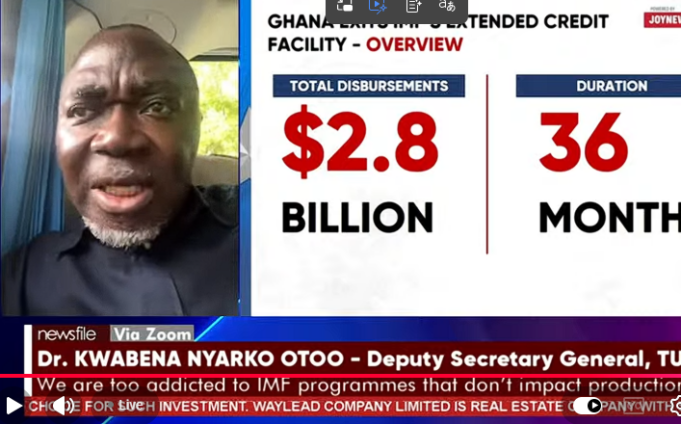
The Deputy Secretary-General of the Trades Union Congress Ghana, Dr Kwabena Nyarko Otoo, has criticised Ghana’s continued dependence on International Monetary Fund (IMF) programmes, warning that the country remains trapped in policies that fail to support production and long-term economic transformation.
Speaking on Newsfile on Saturday, May 16, Dr. Kwabena Nyarko Otoo argued that Ghana’s continued reliance on IMF programmes, coupled with plans for private sector participation in the Electricity Company of Ghana (ECG), reflects a policy direction that has failed to address the country’s longstanding structural economic challenges.
“We are too addicted to IMF programmes that do not ensure production in our part of the world,” he stated.
According to him, Ghana continues to operate an import-driven economy despite periods of macroeconomic stability, leaving many young people unemployed years after completing school.
“We continue to be an import-driven economy and even when there is macroeconomic stability, there is social instability. Our young people complete school and five or six years down the line, they still do not have jobs,” he said.
Dr Otoo maintained that government’s renewed push for private sector participation in ECG is simply an attempt to complete a privatisation agenda.
“Government is simply trying to complete the privatisation process which they could not do with a regular programme. I can assure you the unions are fully prepared and will do everything possible to ensure ECG is not privatised,” he stressed.
He argued that ECG is already showing signs of improvement and does not require privatisation.
“At the end of 2024, ECG was collecting about GH¢900 million. Today, ECG is collecting GH¢2.1 billion. Clearly, ECG is making progress,” he noted.
Describing the privatisation push as ideological, Dr Otoo said there was no justification for handing over the state power distributor to private entities.
“The only reason somebody wants to privatise ECG is ideology. There is nothing wrong with ECG continuing the progress it is making,” he added.
He also downplayed celebrations surrounding Ghana’s economic recovery under the IMF programme, insisting that rising gold prices rather than IMF policies had largely supported the economy.
“Take gold prices out of the equation and let economists tell us where this economy would have been,” he argued.
Dr Otoo called for a complete shift in Ghana’s economic policy framework, with greater emphasis on protection, industrialisation and decent job creation.
“What we need is a whole change in policy framework so that we can begin to talk about protection, creating decent employment and ensuring that macroeconomic stability translates into social stability for the people of Ghana,” he said.
Latest Stories
-
Ghana lose Morocco friendly as Atlas Lions turn to Mali
16 minutes -
2026/2027 GPL: Kelvin Nkrumah strike sends Medeama top of league table
22 minutes -
Emmanuel City crowned champions of maiden Global Game Scouting Tournament
30 minutes -
Thomas Partey loses father Jacob Teye Partey
43 minutes -
Martin Kpebu explains when EOCO can arrest Manhyia South MP after securing court warrant
1 hour -
EOCO’s reasons for seeking Manhyia South MP arrest warrant not justified – Kpebu
1 hour -
MTN Ghana warns SMEs against sharing PINs amid digital fraud risks
1 hour -
Yendi nursing students warn restricted access to skills lab could affect their training
1 hour -
Minority awaits formal notice of arrest warrant for Manhyia South MP – Annoh-Dompreh
1 hour -
LTIF announces 2026 Pan-African edition in Accra from October 6-7
1 hour -
Mfantsipim needs broader funding partnerships to bridge infrastructure gap – Prof Baiden
1 hour -
MP status must not shield anyone from law enforcement – Kwakye Ofosu
1 hour -
EOCO had tactical team ready to arrest Baffour Awuah – Felix Kwakye Ofosu
2 hours -
Afoko can unite NPP’s factions, says Charles Owusu Juanah
2 hours -
Guardiola backing Man City after guilty verdicts
2 hours