

Audio By Carbonatix
An economist at Aston University, Dr. Sajid Chaudhry, says cuts in the Bank of Ghana’s policy rate will have a limited impact on economic growth unless commercial banks also reduce lending rates.
He said lower lending rates were necessary to stimulate economic activity but expressed concern over the slow transmission of policy rate cuts by commercial banks.
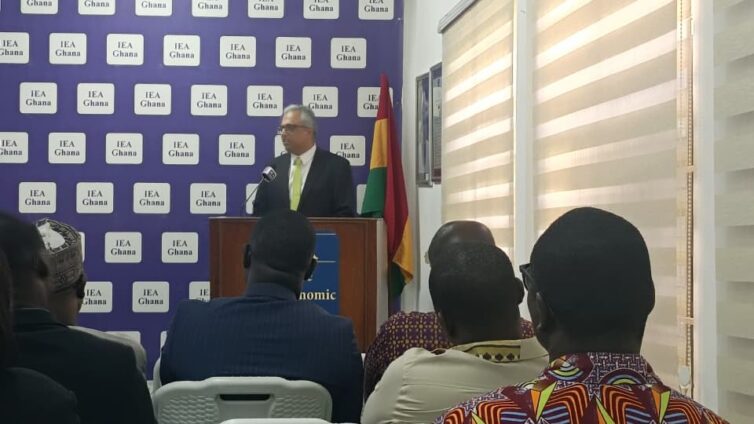
Dr. Chaudhry, who is also an International Fellow of the Institute of Economic Affairs, made the remarks at a forum on interest rates and economic development in Ghana.
According to him, the effectiveness of monetary easing depends largely on its ability to lower borrowing costs and increase private-sector credit.
“Monetary easing can support growth in Ghana, but only if it is transmitted through lower lending costs, stronger private-sector credit, stable exchange rates, and healthier bank balance sheets,” he said.
Dr. Chaudhry explained that an analysis of data from 2002 to 2024 showed that reductions in lending rates were associated with higher Gross Domestic Product (GDP) growth, while high interest rates and inflation weakened economic performance.

He noted that commercial banks had been slow to adjust lending rates downward, maintaining wide net interest margins due to non-performing loans, exchange-rate instability, and broader macroeconomic uncertainty.
“Policy should therefore combine monetary easing with measures that strengthen credit intermediation and bank balance sheets,” he said, while commending the Bank of Ghana for lowering rates in line with declining inflation.
Dr. Chaudhry recommended that the Central Bank adopt regulatory measures to encourage faster transmission of policy rate cuts to borrowers and improve deposit rates when monetary policy tightens.
“The central bank can use some kind of regulatory measures to persuade banks to translate monetary policy rate cuts into lower lending rates,” he stated.
Responding to questions from the Ghana News Agency, Dr. Chaudhry urged commercial banks to strengthen loan screening and monitoring systems, while encouraging businesses to improve productivity and repay loans on time.
“When banks have high levels of bad loans, they are less willing and able to pass lower policy rates through to cheaper lending, which weakens the impact of monetary easing on growth,” he said.
He also urged government to maintain macroeconomic stability through stable exchange rates, controlled inflation, prudent spending, and a sound banking sector to support lower lending rates and economic growth.
Latest Stories
-
‘We won political independence, but global power remained elsewhere’ – Mahama
6 minutes -
Mahama to take Accra Reset agenda into AU framework in 2027
8 minutes -
Drugs cases disgracing Ghana before the world – Catholic Bishops Conference tells Government
18 minutes -
Accra Reset must move from ‘design to execution’ – Mahama
31 minutes -
Dangote praises Mahama’s handling of Ghana’s economic recovery
36 minutes -
Mexico beckons as Ghana calls 20 to chase World Cup glory
46 minutes -
The Air we cannot see: Why Ghana must start taking its atmosphere seriously
56 minutes -
The Hidden Balance Sheet: Why Ghana’s buy-now-pay-later boom is a household solvency problem, not a consumer convenience story
1 hour -
Prof. Kwofie urges publishers to use indigenous knowledge systems to decolonise AI
8 hours -
NDC’s two years of economic gains not enough to establish stability – Alan Kyerematen
8 hours -
AFCON 2027Q: Nine new call-up for Cote, The Gambia matches
8 hours -
Ghana’s MSMEs: Burdened by regulation and overtaxed; why the system isn’t working
9 hours -
Patience Akyianu, former Barclays Bank Ghana MD and Hollard Group CEO, reported dead
9 hours -
Mahama pushes ‘health sovereignty’ agenda, says Global South needs control over resources
9 hours -
Mahama: We are reforming systems, fighting corruption and improving use of public funds
9 hours