

Audio By Carbonatix
For centuries, the belief that menstruation renders a woman “unclean” has persisted, rooted in ancient cultural and religious traditions.
These long-standing taboos continue to fuel period-related shame and discrimination, while also limiting access to sanitation and education for girls and women.
Menstrual justice advocates have stressed that menstruation is a completely natural biological process.
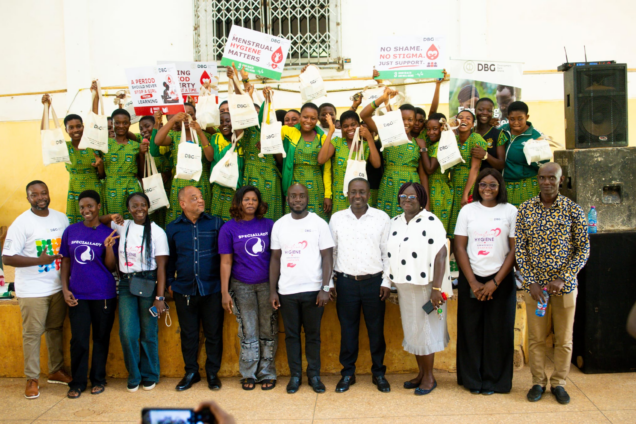
The clarification came during Menstrual Hygiene Day celebrations as the Development Bank Ghana (DBG) rolled out its menstrual hygiene Corporate Social Responsibility (CSR) initiative.
As part of the outreach, DBG donated more than 10,000 sanitary pads and educated students on menstrual health at Tepa Senior High School and Mabang Senior High School in the Ahafo Ano North Municipality, and at CMI Carmel School in the Tano South Municipal District.
The campaign focused not only on disseminating information about menstrual hygiene but also on breaking down taboos surrounding menstruation.
Head of Corporate Social Responsibility at DBG, Barbara Anawonu Wricketts, said menstruation is not a sign of being dirty, unhygienic, or morally impure.
She stresses the importance of education and open conversations to promote menstrual hygiene and empower women and girls to manage their periods with dignity.
"Menstruation is a normal part of women’s lives, and the long-held misconception that it makes a woman ‘unclean’ must stop, because it is the Creator who ordained it as part of women’s lives. That belief often leads to stigma, isolation, and shame", Ms. Anawonu Wricketts said.
She revealed that it's especially evident when people, particularly men, avoid getting close to women during their periods or treat them differently.
This attitude, according to her, not only reinforces harmful stereotypes but also prevents open conversations about menstrual health and limits girls' confidence in school, work, and social settings.
"Challenging the myth and normalizing menstruation is essential if we want to create a society where women and girls can manage their periods with dignity and without fear of judgment," she noted.
Commenting on the initiatives, Barbara Anawonu Wricketts said the Development Bank Ghana (DBG) regularly distributes sanitary pads to students as part of its targeted Corporate Social Responsibility (CSR) activities.
She explained that the outreach, designed to address both access and awareness, aligns with its broader mandate to support human capital development.
“Our goal is to remove the practical and social barriers that keep girls out of the classroom. By combining sanitary pad distribution with targeted education, we are helping to normalize conversations around menstruation and support the confidence of women, especially students, during their periods".
Ms. Wricketts therefore pledged that the bank would remain committed to supporting menstrual health programs and expanding access to sanitary products for girls and women.
School authorities welcomed the initiative, noting that many students struggle to afford sanitary pads each month, a financial barrier that forces some girls to miss classes.
Madam Helena Baffoe Adentwi, Senior House Mistress at Tepa SHS, said the education component targeting both boys and girls is critical to shifting attitudes within the school community.
According to her, open conversations help dispel myths around menstruation and create a more supportive environment where girls feel comfortable seeking help, while boys learn to show understanding rather than stigma.
Female students who took part in the hygiene seminar and donation drive expressed deep appreciation for DBG’s intervention.
“This support means a lot to us,” one student said. “Many of us had no choice but to use rags or scraps of paper during our periods, which put us at risk of infections and other health issues. With access to proper sanitary products, we can manage our menstruation with dignity and attend classes without fear or embarrassment.”
The students noted that the donation is expected to reduce absenteeism and restore confidence, allowing them to focus fully on their studies.
DBG is a Development Finance Institution that acts as an enabler for businesses in Ghana and as a long-term capital provider in the market. It ensures that sustainable, global best practices are applied across all of its operations.
Latest Stories
-
Diaspora Nasara Caucus congratulates Mohammed Ali Suraj, new NPP executives
1 hour -
Dr Antwi-Boasiako’s cybersecurity book showcased at UN crime prevention congress
1 hour -
We will empower the grassroots and protect every vote – NPP’s 1st Vice Chair Kojo Bamba
2 hours -
I do not see myself as better than anyone – NPP’s 1st Vice Chair Kojo Bamba
2 hours -
Police blur the line between invitations and arrests – Reindorf Twumasi Ankrah
3 hours -
Turning invitations into arrests is making citizens reluctant to assist police – Twumasi Ankrah
3 hours -
The Traffitech-GH SMS spot-fine system: The good, the sad, and the funny – Bright Simons writes
3 hours -
Hawa Koomson pledges experienced and mature leadership of NPP women’s wing
4 hours -
Young woman found dead at Kasoa Peace Town
5 hours -
Playback: The Law examined lawful arrest in Ghana
5 hours -
Mahama urges African governments to treat healthcare as an investment, not budget cost
6 hours -
Bawumia congratulates John Boadu and new NPP executives, pledges support ahead of 2028
6 hours -
Aksa Energy delegation pays courtesy call on GRA Commissioner-General
6 hours -
‘No talent should be left out’ – Bawumia pledges inclusive NPP campaign for 2028
6 hours -
Prof. Mike Oquaye recounts how he blocked the Special Prosecutor’s attempt to arrest Bawku Central MP
6 hours