

Audio By Carbonatix
Colombia's presidential election will go to a runoff on 21 June between a leftist and right-wing candidate on opposite ends of the political spectrum, after Sunday's vote produced no overall winner.
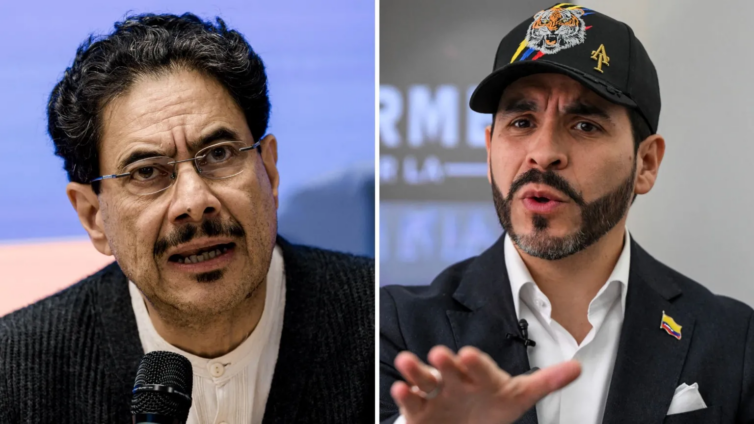
The right-wing Abelardo de la Espriella, an admirer of Donald Trump, came top in the vote, followed closely by the left-wing senator Iván Cepeda, an ally of the current president Gustavo Petro.
The campaign was plagued with violence, including drone strikes, kidnappings, homicides and the assassination of a presidential candidate at a rally last year.
Both men offer differing visions for how to solve Colombia's violent internal armed conflict that has lasted for decades but has resurged in recent years.
On Sunday, neither candidate achieved more than 50% of the vote to win outright.
While polls tipped Cepeda to finish ahead of his right-wing challenger, official results showed that he trailed, with 41% of votes compared to De La Espriella's 43.7%, with almost all ballots counted.
After topping the vote, De La Espriella said in the runoff he would "defeat tyranny, absolutism", calling the result a "triumph for those of us who have never experienced living off the state's teat".
Meanwhile, Cepeda said that he would not comment until the count was verified by judges.
Paloma Valencia, the moderate conservative who finished in third place on less than 7%, has since endorsed De La Espriella.
President Petro, who endorsed Cepeda, said he did not "accept the preliminary count results" and that he would wait for final results reviewed by judges. He alleged irregularities in the vote, including claiming that "hundreds of thousands of votes were added" - without providing any evidence.
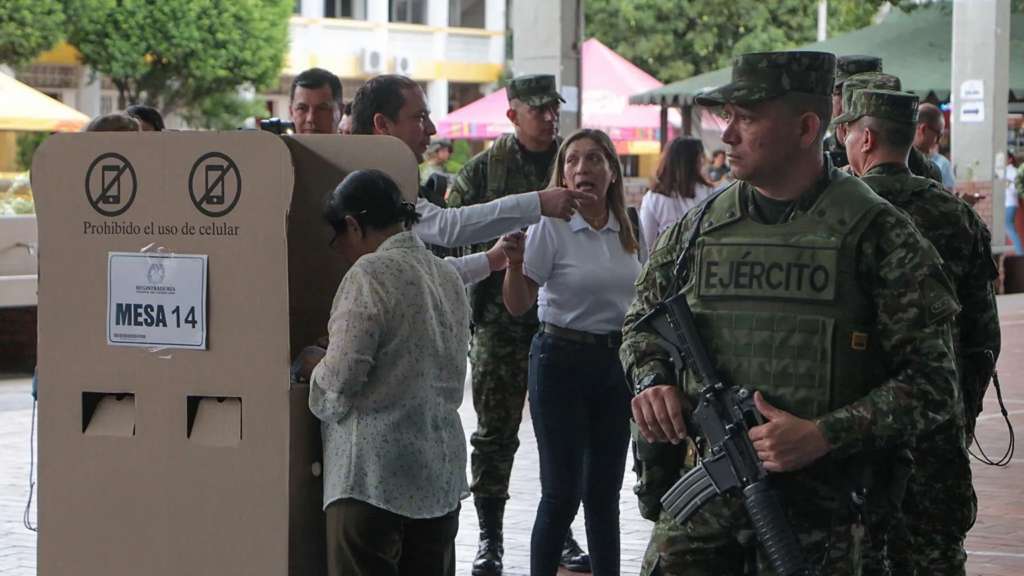
Electoral authorities said the voting day had proceeded "normally and safely".
Cepeda was actively involved in the peace talks that led to a historic deal in 2016 between the Colombian government and the FARC guerrilla group, which led to the disarmament of thousands of rebel fighters.
He is often described as an architect of the "total peace" strategy of President Petro, Colombia first left-wing president, which prioritises dialogue and negotiations with armed groups during ceasefires, over military intervention.
Under President Petro's presidency, cocaine production hit a record high, membership of armed groups grew, and violence on the border surged to its worst level in years, displacing tens of thousands of people. This has led his critics and many security analysts to denounce "total peace" as a failed strategy, though Petro has argued his government has seized the largest amount of drugs in history.
The economy has grown, and Petro increased the minimum wage significantly, though about one in three Colombians still live in poverty.
Cepeda has pledged economic reforms if elected, including expanding welfare benefits and handing land to victims of internal conflict.
De La Espriella is a lawyer and businessman who dubs himself "El Tigre", the tiger. He has heavily criticised Petro's negotiations with armed groups and advocated a tough military crackdown on crime, including closer co-operation with the United States, bombing cartels with US support, more powers for the military and possible mass trials.
He has pledged to build 10 mega-prisons in the jungle in the style of El Salvador's hardline right-wing President Nayib Bukele who, many commentators have observed, De La Espriella has modelled his beard as well as some of his policies on. He has also said he would drastically shrink the state.
De La Espriella has attracted controversy over some of his past clients: he was the lawyer to Alex Saab, a close ally of the US-ousted Venezuelan leader Nicolás Maduro who was recently charged with money-laundering. He also defended the Colombian fraudster David Murcia Guzmán, who led a multibillion-dollar pyramid scheme. He has argued this is just part of his work as a defence lawyer, while critics have accused him of enriching himself by defending powerful criminals.
Relations with neighbours and US
The runoff on 21 June will have implications for Colombia's relationship with the US, and some of Colombia's neighbours.
Trump has adopted a muscular foreign policy approach to Latin America: seizing Venezuela's former leader Nicolás Maduro in a military raid, striking alleged drug-trafficking boats in the Caribbean and Eastern Pacific, imposing an oil blockade on Cuba and creating a "Shield of the Americas" security alliance with right-leaning leaders in the region earlier this year to tackle cartels.
Many countries in the region have shifted to the right in recent elections, including Ecuador, Chile, Argentina, Bolivia, Honduras and El Salvador.
Petro and Trump have clashed and regularly publicly insulted each other over issues including drug-trafficking and US intervention in the region, though relations improved after a meeting at the White House in February. However, anti-narcotics co-operation largely continued during these periods.
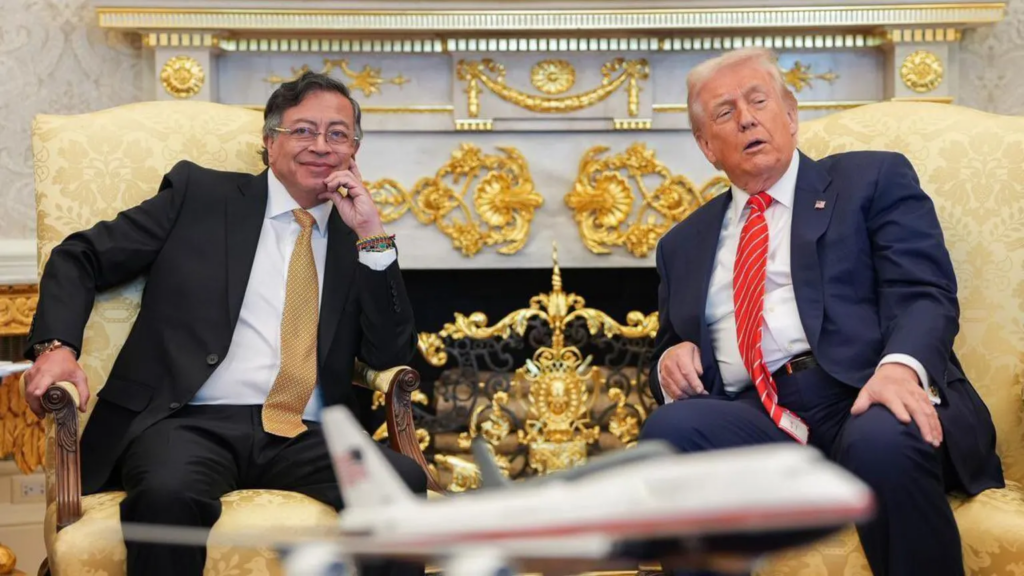
Cepeda, like Petro, has insisted that Colombia should not be a "vassal state" to the US, whereas De La Espriella has expressed a desire to strengthen the security alliance with the US and ideologically aligns himself as closer to Trump.
Trump has not openly endorsed a candidate in this election, unlike some other votes in the region.
The runoff could also impact relations with Colombia's neighbour Ecuador. Colombia is the world's biggest producer of cocaine, but the majority of the world's cocaine now transits through Ecuador, which has led to a surge in violence there too in recent years.
Ecuador's conservative president Daniel Noboa had imposed tariffs on Colombia, accusing the government of not doing enough to secure the nations' shared border. Ecuador has carried out joint military operations on cartels with the US.
Noboa said he had reached an agreement with De La Espriella in a meeting to drop tariffs on 1 June, as the two had agreed on the "handover of Ecuadorean criminals who are in Colombian territory" and a "joint fight against narcoterrorism".
Colombia's foreign ministry accused him in response of "deliberate interference" in its election. Noboa's office did not immediately respond to a request for comment.
Latest Stories
-
Drug cartels may be seeing Ghana as easy route – Lenin Anane Agyei
18 minutes -
Ghana risks gaining notoriety as drug-trafficking hub – Bobby Banson
27 minutes -
Government dismissed my drug trafficking warning, then tried to arrest me – Ntim Fordjour
29 minutes -
Day Two: 3rd Republic Bank-JoyNews Habitat Fair Clinic underway at Junction Mall
29 minutes -
NACOC addressing inherited gaps in fight against drug trafficking – Deputy Director-General
41 minutes -
Taekwondo goes to school as GTF launches five-region youth campaign
45 minutes -
The issues Mourinho is struggling to fix at Real Madrid
51 minutes -
Hundreds throng EducationUSA College Fair in Kumasi in pursuit of abroad studies
54 minutes -
Drug bust: NACOC should be part of port inspection team – Twum-Barimah
57 minutes -
Ward appointed Liverpool’s sporting director
57 minutes -
This isn’t the first cocaine bust; NPP must stop the politicisation – NACOC deputy boss
1 hour -
Drug bust case: Only Customs officers, MPS officials in scanning room – NACOC
2 hours -
I don’t mind being insulted; I have a crocodile skin – President Mahama
2 hours -
Samson’s Take: Verify the badge – and verify the story
3 hours -
President Mahama explains why Ghana must rethink regulation of TikTok, other new media platforms
3 hours