

Audio By Carbonatix
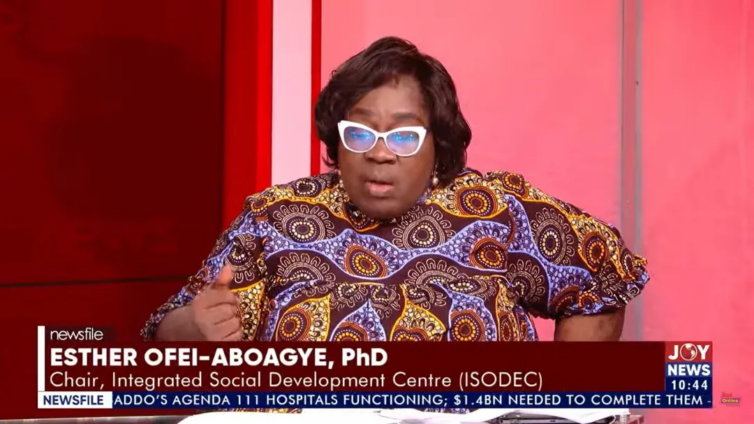
Researcher and member of the Inter-Ministerial Coordinating Committee on Decentralisation (IMCC), Dr Esther Offei-Aboagye, has expressed concern over Ghana's recurring flooding and sanitation challenges, describing them as the result of years of collective failure by both institutions and citizens.
Speaking to journalists on the sidelines of the African Cities Research Consortium (ACRC) Cross-Project Learning Workshop in Accra, Dr Offei-Aboagye said the country's urban flooding situation did not emerge overnight but has been building up over several years due to poor planning, weak enforcement, and a lack of civic responsibility.
"Certainly I'm not happy at all," she said when asked about the recent flooding incidents across parts of the country.
"The problem has been several years in the making. We have had a number of urban development initiatives, but we must ask ourselves why these things have not worked."
According to her, one of the biggest challenges remains the attitudes and behaviour of citizens, particularly regarding environmental management and compliance with planning regulations.
"There has been a missing sense of shared ownership and co-responsibility for where our nation is going," she said.
She said that many Ghanaians have become accustomed to prioritising personal interests over collective wellbeing, making it difficult to sustain progress in areas such as sanitation, waste management and urban development.
"We need to invest in seeing ourselves as each other's keepers and encourage citizens to speak up when things are going wrong," she added.
While acknowledging concerns about the performance of local authorities and Metropolitan, Municipal and District Assemblies (MMDAs), Dr Offei-Aboagye said the responsibility for the country's environmental challenges cannot be placed solely on government institutions.
She said that many illegal developments and environmental abuses occur openly, yet citizens often fail to report or challenge them.
"All these built-up spaces where people fill watercourses and wetlands with plastic and debris so they can build on them, we have seen these things happen for years and moved on," she said.
"In a sense, we are jointly responsible for having brought ourselves to this point."
The decentralisation expert further called for stronger protections and greater independence for local government leaders, arguing that chief executives should be empowered to make difficult decisions without fear of political consequences.
"I dream of a day when a chief executive can stand up and say, 'This is wrong, and I will not support it,' regardless of whose interests are involved," she stated.
She also reiterated her long-held support for the election of Metropolitan, Municipal and District Chief Executives (MMDCEs), saying it could help strengthen accountability and independence at the local level.
Beyond the flooding discussion, Dr Offei-Aboagye highlighted ongoing work by the African Cities Research Consortium and its partners to develop practical solutions to urban challenges.
She pointed to initiatives being implemented in communities such as Old Fadama, where researchers are working with local groups, market women and entrepreneurs to explore ways of converting waste into economic opportunities.
"There is some very innovative work going on," she said.
She cited projects focused on waste-to-wealth initiatives, youth entrepreneurship and improved local governance systems, explaining that the IMCC is particularly interested in how successful interventions can be scaled up across the country.
"The work that has been done in the area of research should not remain on the shelves. We need to identify lessons that can be shared with other assemblies and communities."
According to her, the IMCC sees itself as a coordinating platform that can help connect research findings to policy implementation and local governance reforms.
The ACRC initiative, led by researchers from the University of Manchester and implemented across several African cities including Accra, Lagos and Harare, seeks to generate evidence-based solutions to urban challenges facing rapidly growing cities on the continent.
For Dr Offei-Aboagye, the current period presents an opportunity for Ghana to rethink decentralisation, strengthen citizen participation and adopt practical solutions already working elsewhere.
"This is an exciting time to see where we can harness ideas that work and run with them," she said.
"We need to own our process. We need to look beyond short-term gains and think about the Ghana we want to leave for our children."
Latest Stories
-
Tiptoe Lane’s tech takeover: The story behind Ghana’s booming informal phone market
44 minutes -
Abanga vows to use social media to counter NDC messaging ahead of 2028 elections
46 minutes -
Okai Mintah seeks Sabah Zita Benson’s support for NDC National Youth Organiser bid
60 minutes -
Okai Mintah vows to strengthen NDC campaign machinery ahead of 2028
1 hour -
Mother of four and Jasikan teacher among new Telecel M’ahitti Promo winners
1 hour -
International Youth Shakers Conclave 2026 set to bring global young leaders to London
1 hour -
Gov’t is committed to addressing teachers’ conditions of service, deprived-area allowance – Education Minister
1 hour -
GoldBod’s structure encouraging galamsey – Afenyo-Markin
1 hour -
Tullow starts selling Jubilee, TEN crude to Ghanaian refineries
1 hour -
Local Government Service authorises rationalisation, redistribution of staff
1 hour -
PURC assures consumers of working to ensure quality services in Northern Region
1 hour -
Ghana develops US$4.28bn water financing framework
2 hours -
Christian Council calls for protection of mission schools’ religious identity
2 hours -
Mahama holds discussions with India’s External Affairs Minister
2 hours -
Even when you cough, they come after you — Abanga accuses Mahama govt of criminalising free speech
2 hours