

Audio By Carbonatix
An Engagement Committee Member of the African Cities Research Consortium (ACRC), Dr Esther Ofei-Aboagye, has expressed concern over Ghana's recurring floods, blaming years of weak citizen responsibility, poor planning, and limited accountability in local governance for the country's worsening environmental challenges.
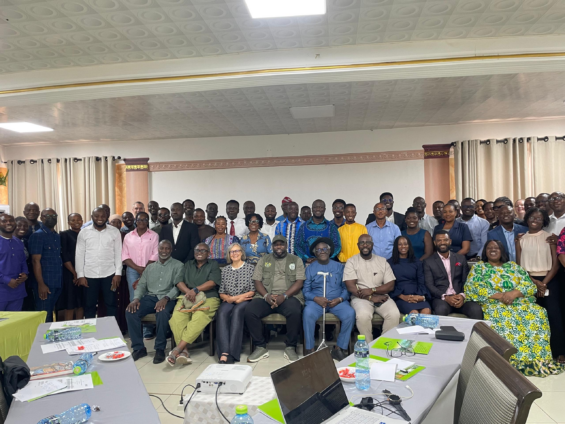
Speaking in an interview on the sidelines of the ACRC Cross-Project Learning Workshop in Accra, Dr Ofei-Aboagye said allowing Metropolitan, Municipal, and District Chief Executives (MMDCEs) to be elected would give them the confidence to make difficult decisions and speak the truth without fear of losing their positions.
"I believe that, number one, the election of chief executives will go quite some way to achieving this level of independence, knowing where your power is coming from," she said.
However, she said that electing chief executives alone would not solve all the challenges facing local governance.
"I don't believe it's a total panacea, because we vote for the MPs and all that. But in addition to that, if we are able to capacitate our people to elect the people who can give them the best, the people with the best visions, the people with the best capacities, the people who can speak up and give them the support, then we can make progress."
Dr Ofei-Aboagye said local leaders should be empowered to act independently and take corrective measures without political pressure.
"I dream of a day when I can have a chief executive who will say, 'What is going on? Am I in agreement? Please, thank you. You can have your job. This is the reason why. I stand for truth. I stand for doing the right thing.'"
According to her, dependence on political patrons often limits the ability of local leaders to make bold decisions.
"When you are beholden to somebody, when your hand is in somebody's mouth, it limits how you can speak," she said.
On the recurring flooding and disaster situation in the country, Dr Ofei-Aboagye said she was far from satisfied with the current state of affairs.
"Certainly I'm not happy at all," she said.
She said that the problem has developed over many years despite numerous urban development initiatives.
"The problem has been several years in the making because there have been a number of urban development initiatives, and we ask ourselves why these things have not worked," she said.
She identified attitudes and public behaviour as major factors contributing to the country's environmental challenges.
"This issue of people's attitudes and mindsets has become very important. That sense of shared ownership and co-responsibility for where our nation is going has been missing sadly," she said.
Dr Ofei-Aboagye urged Ghanaians to see themselves as responsible for the well-being of their communities and to challenge practices that undermine development.
"It is very important that we invest in seeing ourselves as each other's keepers and also encourage ourselves as citizens to be able to say no to things that are happening badly," she said.
She also praised young people for taking positive initiatives and called for greater collaboration instead of competition.
"Young people are doing some very interesting things which should help. How can we encourage that, uplift that, and project that rather than fighting over who is doing what and who is claiming recognition? Let's work together to deal with this."
Responding to a question on whether institutions responsible for local governance were failing the country, Dr Ofei-Aboagye said Ghana was at a critical moment and should take advantage of the opportunity for change.
"We are in a time of change, and we need to take advantage of that period of change," she said.
She called for greater citizen participation and encouraged professionals, community members, and the media to continue speaking out against illegal developments and environmental abuse.
"The media is doing a fabulous job in this respect, but other people also have to come on board," she said.
She expressed concern over the widespread practice of filling waterways with waste materials to create space for construction, describing it as a long-standing problem that society has largely ignored.
"People fill up water spaces with plastic bags so that they can build on them. It's wrong, but for years we've all looked, shaken our heads and moved on," she said.
According to her, the country's current challenges are the result of collective inaction.
"In a sense, we are jointly responsible for having brought ourselves to this point," she said.
Dr Ofei-Aboagye also challenged citizens to take responsibility for waste management and environmental sanitation rather than expecting the government alone to solve the problems.
"We don't want to take responsibility for managing our garbage. We don't want to take responsibility for where we dispose of it or even contribute to clearing gutters and sewage."
"We need to own our process. We need to look beyond the short-term enjoyment and gain to a longer-term perspective of the Ghana we want to leave for our children," she added.
Latest Stories
-
Tamale Metropolitan Assembly distributes 10,000 bags of fertiliser to farmers
4 minutes -
TUSAAG suspends strike, resumes work after renewed talks with government
8 minutes -
PIAC marks 15 years of oil revenue accountability and transparency
15 minutes -
Adongo calls for non-political interference in $1.46bn Heritage Fund review
20 minutes -
FDA records GH¢70m surplus in 2025 amid concerns over ageing lab equipment
22 minutes -
Arise Ghana demands stronger commitment to end galamsey
24 minutes -
96% of Ghanaian pensioners willing to work beyond retirement age – Study
27 minutes -
Ghana gets nuclear power plant simulator
33 minutes -
Temporary Akosombo power control facility to be ready by September – Energy Ministry
34 minutes -
GMTF, Atlantic Lifesciences explore local production of cancer and heart medicines
38 minutes -
GHS medical-legal claims hit GH¢400m in three years
44 minutes -
Mahama cautions Ghanaians not to take religious freedom for granted
1 hour -
We need development pathway, not selection exercise – Sports Minister urges football stakeholders
1 hour -
Government prioritises foundational learning to improve education outcomes
1 hour -
Ghana, Côte d’Ivoire deepen maritime security cooperation through joint boundary inspection
1 hour