

Audio By Carbonatix
Technical universities in Ghana have been urged to undertake extensive reforms in education, research, and industry engagements to remain relevant in an era dominated by Artificial Intelligence (AI) and emerging technologies.
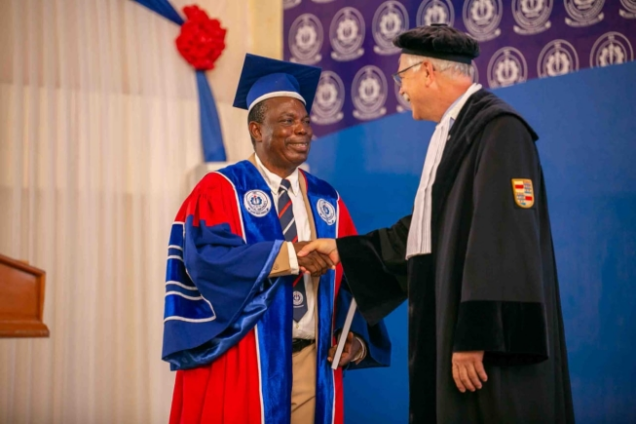
The call was made by the Rector of Wittenborg University of Applied Sciences in Netherlands, Professor Dr. Ron S.J. Tuninga, when he delivered the Seventh Vice-Chancellor’s Distinguished Lecture at Ho Technical University (HTU) on Wednesday (June 17).
The theme was ‘Business Practice Education and Research in the Era of AI: Implications for Technical Universities in Ghana.’
Prof Tuninga said AI-driven transformation was no longer optional but an urgent necessity for higher education institutions seeking to remain globally competitive.
He explained that rapid advances in machine learning, robotics, block chain, quantum computing, cybersecurity and digitalisation were fundamentally reshaping the future of work and the skills required in modern industries.
“The focus should shift from memorisation to judgement, critical thinking, creativity and problem-solving,” Professor Tuninga said, adding that higher-order cognitive skills would become increasingly valuable as AI assumes routine cognitive functions.
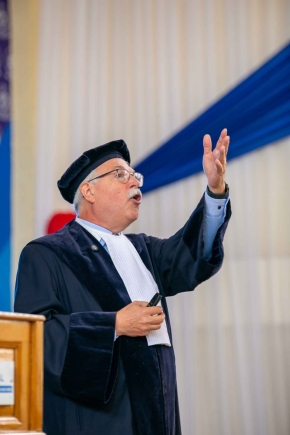
Touching on experiences from the Netherlands, Professor Tuninga highlighted how institutions, including Wittenborg University, were embedding AI into business practice education.
For instance, he mentioned AI-powered loan assessment systems in Dutch financial institutions as examples of how automation was improving efficiency, productivity, and decision-making.
Professor Tuninga identified increased productivity, reduced operational costs, enhanced data-driven decision-making, and new entrepreneurial ecosystems as opportunities AI presented.
He cautioned that Africa still faced challenges such as inadequate digital infrastructure, shortages of skilled professionals, weak research ecosystems, and concerns over data governance.
Further, Professor Tuninga observed that African languages remained underrepresented in many AI systems, saying that underscored the need for locally developed datasets and indigenous AI solutions tailored to African contexts.
He, therefore, called for a comprehensive review of curricula in technical universities, advocating the integration of AI, machine learning and data analytics into both technical and business education programmes, while embedding ethics and responsible AI use into academic training.
Professor Tuninga urged universities to embrace multidisciplinary and interdisciplinary learning models, strengthen partnerships with industry, research institutions and public-sector organisations, and become centres for lifelong learning by offering flexible and modular programmes that supported continuous upskilling and reskilling.
The Vice-Chancellor of HTU, Professor Ben Q. Honyenuga described the lecture as timely and highly relevant, given the growing influence of AI on education, research and business operations globally.
“Understanding AI and its implications has become essential for institutions seeking to remain globally competitive and impactful,” Prof. Honyenuga said.
He reaffirmed HTU’s commitment to integrating emerging technologies into academic programmes, strengthening research capacity and deepening collaboration with industry and international partners.
The Vice Chancellor paid tribute to Professor Tuninga, describing him as a mentor, former supervisor and respected colleague whose expertise would enrich discussions on the future of education and business in the age of artificial intelligence.
The Distinguished Lecture formed part of HTU’s ongoing efforts to stimulate intellectual discourse, generate innovative ideas and promote research that responds directly to the needs of industry and society.
The event attracted academics, researchers, students, industry practitioners and policymakers, who deliberated on the implications of AI for business practice, education and research within Ghana and beyond.
Latest Stories
-
Ghana’s mining deaths fall sharply, but Chamber insists ‘three deaths are too many’
2 minutes -
Tatale Sanguli officials destroy expired food products, warn traders
8 minutes -
Police arrest two watchmen over alleged defilement of 14-year-old student
14 minutes -
The woman behind General Mosquito: Could Ghana be meeting its next First Lady?
15 minutes -
Court remands man over alleged Labone bank robbery attempt
19 minutes -
Supreme Court to rule today on challenge to legal vacation warrants
25 minutes -
Tamale Metropolitan Assembly distributes 10,000 bags of fertiliser to farmers
30 minutes -
TUSAAG suspends strike, resumes work after renewed talks with government
34 minutes -
PIAC marks 15 years of oil revenue accountability and transparency
41 minutes -
Adongo calls for non-political interference in $1.46bn Heritage Fund review
46 minutes -
FDA records GH¢70m surplus in 2025 amid concerns over ageing lab equipment
47 minutes -
Arise Ghana demands stronger commitment to end galamsey
49 minutes -
96% of Ghanaian pensioners willing to work beyond retirement age – Study
53 minutes -
Ghana gets nuclear power plant simulator
59 minutes -
Temporary Akosombo power control facility to be ready by September – Energy Ministry
60 minutes